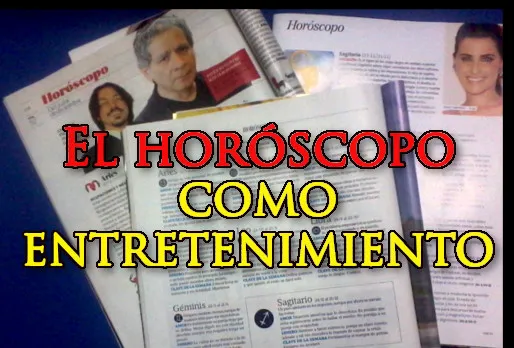
Can horoscopes be considered entertainment? Do people read them because they are entertaining?
Those of us who are against magical thinking face a double challenge: To convince those who blindly believe that people's destiny is tied to the stars or some superior force that this is false; and to convince the supposedly already convinced that the issue is important.
I explain the latter: many people would agree with me that horoscopes and astrology (not to mention tarot and other forms of divination) have no truth value to offer. However, a large number of those same people maintain, at the same time, that it is not a topic that deserves much concern, since people read horoscopes as entertainment and do not give them much importance.
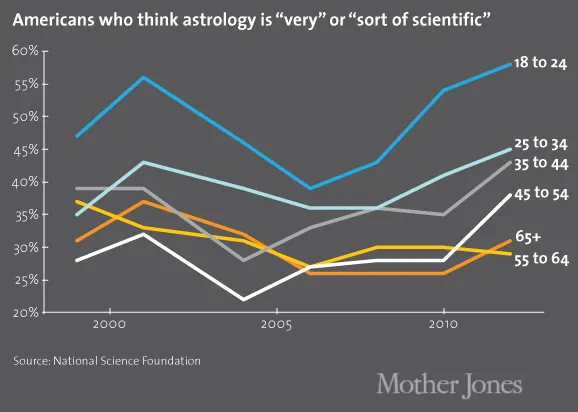
Some surveys have been conducted that seem to prove them right. I can cite the surveys conducted in Great Britain and the United States by the site YouGov [1]. It must be said that, at the same time, there are other studies (also surveys) that seem to indicate if not the opposite, at least, something different [2].
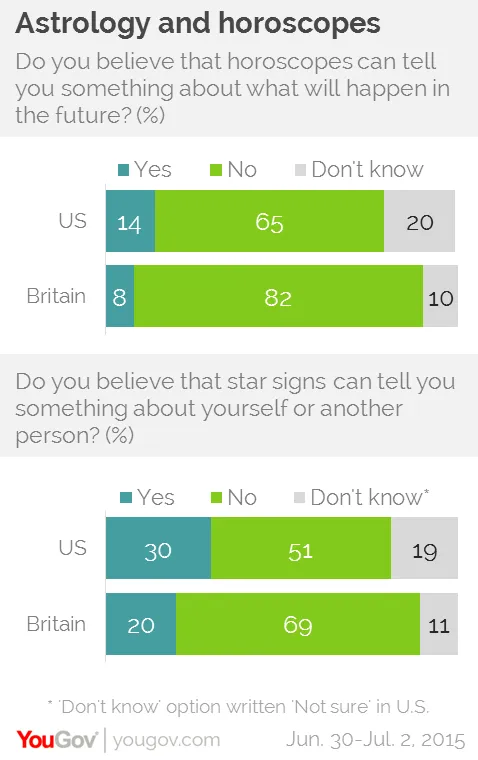
As a conclusion, this group considers that although astrology and horoscopes are false, they are also harmless. Therefore, they are discourses that do no "harm" and thus do not deserve attention.
This perception is not minor, because if we adhere to this idea, then there is no point in having an anti-astrological discourse.
PUBLIC PERCEPTION AND KNOWLEDGE: A QUESTION OF METHOD
However, anyone who has had some training in social sciences will know that surveys are very powerful and very limited tools. They allow, with relative ease, to "know" the opinion of many people and, if the sample is chosen carefully, the result can be extrapolated to a larger population group (sample-universe).
But they have a major limitation. They ask closed questions, that is, with options predetermined by the pollster and therefore, what is known about the public is limited. If we only consider these results we would very easily fall into reductionisms.
Another tool that can be used in a complementary way is in-depth interviews. This involves having a dialogue with a person, based on a free questionnaire, but with a pre-elaborated structure or guide. It allows for follow-up questions, delving into what the person "really" means, but they take much more time to conduct and much more to process. Unlike surveys with closed questions, interviews are difficult to analyze. It requires finding significant differences and similarities between people's answers, answers and questions that are not identical.
Since the number of responses (total interviewees) is very small and the questions are not the same, the result cannot be extrapolated.
But they allow us to know with greater precision what people think, even if we do not know at the same time what percentage of a population thinks in that same or a similar way.
An intermediate possibility is to conduct surveys with a larger number of questions, including some open-ended questions.
A SMALL STUDY
Without academic pretensions, I conducted a series of in-depth interviews with 12 people. The sample has these characteristics:
6 men, 6 women. 4 people between 20 and 29 years old; 4 between 30-39; 4 between 40-49 years old.
6 people with complete or incomplete university studies; 6 people with complete secondary education.
6 students, 6 active professionals.
All 12 people could be classified as middle-middle class.
10 are inhabitants of Capital Federal-Argentina, 2 inhabitants of Greater Buenos Aires, all Argentine by birth. All interviews were conducted between March and April 2016.
Incomplete interviews were conducted with more people, but they were interrupted for not meeting some requirement. One requirement was that they read the horoscope, whether by buying the newspaper, reading a newspaper not bought by them, or via the web, applications, or other means. They were also asked about the frequency of reading, and the interview was not continued if the frequency was less than 1 reading per month.
Therefore, all 12 people say they read the horoscope, although in different ways. Especially in the case of women, through magazines, for example, the Sunday supplements published by newspapers (Clarín, La Nación, Perfil).
Others say they read the horoscope published in newspapers.
7 said they read the newspaper Clarín almost every day; 4 said they read several newspapers every day via the web; 1 said they read Perfil on weekends and read some news portal via the web almost every day.
5 said they believe in God and are Catholic, but not practicing or orthodox.
5 said they believe in God, but not in any religion, although all 5 were educated in Catholicism. Of these, 4, however, also had direct or indirect contact with evangelicalism (for example, through a family member).
2 said they are agnostic. Of these, 1 said they want to believe there is a "cosmic force that gives meaning to everything" (which for me is enough to consider them a "believer," it was a man, but I separate him considering that his first answer was "agnostic," it was an open-ended question).
All the people interviewed said they do not take reading the horoscope seriously, that they do not consider what is said there will happen, that it is a kind of entertainment, pastime, entertaining curiosity, habit.
When asked if the media they usually read stopped publishing the horoscope, would they look for that discourse in other media or change their reading medium, 8 said no; 2 said it is possible they would look for the horoscope on the web; 2 said they would change their reading medium. The coincidence of these last two is notable since both interviewees (man-woman) indicated they would do so considering they would also do the same if they removed the "claringrilla," which also indicates which medium they read.
However, for the majority of these few interviewees, they read the horoscope because it is offered, not because they seek it out.
Nevertheless, I insist, these are not extrapolable results.
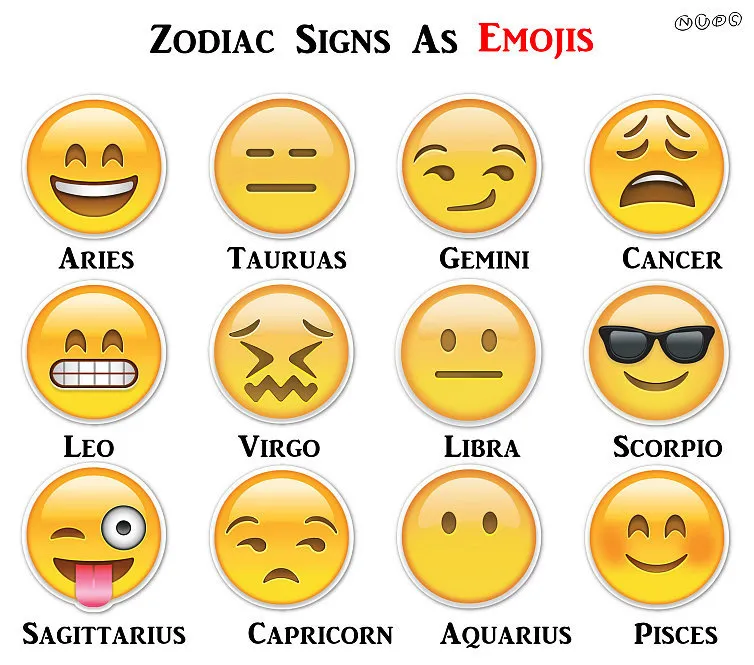
The 12 people were asked day-month-year of birth and "zodiac sign". The 12 people answered "correctly" what their sign was.
None of the 12 people said they had studied astrology formally or informally or had any relative who practices it.
None could explain why they are of those signs: the answers varied between: "Because that's what they say", "that's how I learned it", "because I was born in October".
In all cases I asked follow-up questions.
For those who gave a variant of "because that's what they say or what I learned", I inquired where it is said or how they learned it. 6 people said they learned it from their parents. I inquired if their parents had taught them astrology. They indicated no, that they had simply told them they were of such and such a sign because they were born on such and such a date.
All the people also knew the supposed signs of their closest relatives.
Another 6 indicated that is what the horoscope in newspapers, magazines, websites, radio, TV, astrology books indicates. Regarding astrology books they cited "the type of books by Horangel", books that are published once a year.
Only 1 person said they had ever bought (twice) that type of book. But 8 in total (i.e., another 7) said they had ever read or skimmed that type of book, bought by a family member (the mother or wife, in all 7 cases).
I insisted on asking why, having been born on such a date, they were of such a sign, why was it like that?, what was the reason?
4 responded that they believed it was due to the position of the Sun in the sky, the rest said they didn't know.
The 4 who gave a positive answer were asked about that position of the Sun in the sky, what position, could they explain something more?
In all 4 cases they indicated that the Sun on that date coincided with a constellation. The word constellation was used in 3 of the 4 cases; in the remaining one the word "stars" was used and they were asked, what stars?, to which they completed "the ones that form a group", they were asked, constellation?, and they affirmed.
Everyone was asked if zodiac sign was the same as constellation. 8 said yes, 2 that they didn't know, 2 that no. Among the latter, they indicated that they knew there were other constellations besides those of the zodiac. When asked for examples, they indicated (as constellations): Aldebaran (sic), Andromeda, Orion. In one case they wanted to give a word and couldn't get it out, indicating that there were two, a big one and a small one. As they couldn't name it, I suggested the word "Magellan", and they indicated yes, "the Magellan stars" (sic).
They were asked if there were differences between a person born under one sign and another.
The answers were very varied and broad like "all people are different".
Then I inquired: if you had to choose a person to form a group and perform a common task and the only thing you know is that person's zodiac sign, would you be fine with any sign or would you prefer one over the others.
6 said they would prefer someone of the same sign as them; 4 that they didn't care about the sign, but that to decide they needed other data (not astrological); 2 said they didn't know, but that they might consult it on some website (very similar answers).
They were asked if they considered astrology to be a science.
8 said they didn't know; 2 that yes, 2 that no.
Among those who said no, they were asked why and gave similar answers, including that the horoscope is usually written by a novice journalist or one who made a mistake, as a punishment.
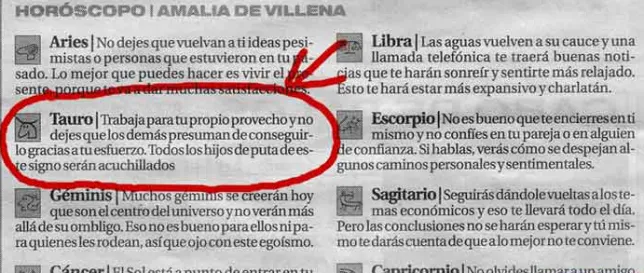
I asked again emphasizing that the question was about astrology, not exclusively the horoscope. In both cases, they said they didn't know, but that there were people who dedicated themselves to that. I asked and they gave me proper names (of astrologers). I asked again if they considered those people as "scientific". The answers varied between "scholars", "know-it-alls", "they know something".
Among those who said they didn't know, I asked if they could indicate something that was "science". They gave answers like chemistry, physics, biology, mathematics, geography...
I asked if there was a difference between those sciences and astrology.
Besides the obvious answer that they study "different things", they couldn't clearly distinguish one thing from the other.
I asked then if astrologers research something, to the same group of 8 who said they didn't know if astrology was a science. 4 said they "believed" they studied the planets. 4 said they didn't know.
Among the first 4 I inquired if only planets. In all cases the Sun was added. I asked if among the planets Pluto was included. 3 said it is no longer a planet. The remaining one said "yes because it's like a planet". The previous three were asked if before Pluto was considered a dwarf planet astrologers considered it in their "studies". The three said they didn't know, but they believed so.
I asked the 3 again if after Pluto was considered a dwarf planet astrologers continued to consider Pluto. The three said, with different intensity, that "they believed not".
The 12 people were asked if the position of the planets in the sky says something about a person's personality. 10 said with variants that it could mean something, 2 that they don't know.
In 8 cases something similar to the following was indicated in different parts of the interview: there are many things we don't know and that maybe later will be known.
In 7 cases the millenary character of astrology was alluded to in relation to words like "wisdom", "millenary knowledge" and also in relation to ancient civilizations like the pre-Columbian ones (Mayans, Aztecs) and their knowledge of the sky.
Everyone was asked if people of the same sign as each of them were similar to them, that is, if they found that people of the same sign were similar.
In 10 cases they answered yes, with different intensity, indicating that they can be very similar or somewhat similar.
In 2 cases it was indicated that there is a tendency (the verb was used conjugated that way, "there is" and not "there would be") but not a definitive one.
In all cases I asked if they could know a person's sign if they knew their personality characteristics.
6 said maybe yes, 6 said no.
I asked everyone: If a person is very rational and structured, is it more likely they are a Virgo or a Pisces?
6 said they didn't know; 6 said Virgo, but 4 answered it with conviction, almost without hesitation, 2 indicated "maybe they would be a Virgo" or a similar formula.
I asked the same thing again but about "good people", Aquarius-Scorpio.
7 said Aquarius almost without hesitation; 4 said Scorpio (one said he was of that sign; two others said a relative was of that sign); 1 said they had no idea.
I asked the same in relation to stubborn or hard-headed, obstinate, persistent people and Taurus-Libra.
8 answered Taurus, two answered Libra (one person indicated it was because she was of that sign, another that their partner was), two that they didn't know.
Finally I asked if they knew of people whom they respected in some sense and who believed in astrology.
8 said yes. Some gave names of known personalities, like actors or journalists, others indicated their partner (their girlfriend/wife) or mother.
Conclusion
Some conclusions can be drawn even though the answers are not representative of a population.
There are people who read the horoscope because it is offered, not because they seek it out. If it were not offered, many would not look for it elsewhere. Note that I am not indicating majorities, minorities, or percentages.
Those who say they read the horoscope often point out that it is entertainment, that they don't give it much importance, but at least in this sample, everyone said they knew their sign and the majority doubted whether astrology is science or not.
These same people, however, do not know why they are of those signs, although some indicate it would be because of the position of the Sun "in the constellations", which reveals that, coinciding with not having received any astrological instruction, they are unaware of what astrologers say.
They say they know their sign from the horoscope (here lies its "harmlessness"), or from their parents, but they also indicate that their parents are not astrologers (so it is possible to infer that their parents also learned about the signs from the horoscope or other discourses of "popular astrology").
Although with different intensity, they believe they can determine if a person is of one sign or another in relation to a personality characteristic, aside from the socialization process. Here, again, lies its "harmlessness".
It is worth noting that although this small work has not been done with academic intentions, properly documented, with a sufficient sociological theoretical basis to design a good sample, it was still very difficult. It is necessary to interview people who are not very close to you, but at the same time who are willing to answer honestly and therefore, with a certain level of trust. This implies a relaxed prior dialogue, explaining that the information is confidential, that there will be no discussion about their answers, but that the intention is to honestly know what they think and do.
If we add to that the intention of having a somewhat representative sample, women-men, students-professionals, the search is truly complex.
Some interviews became longer, other times, they were conducted with less time available from the interviewee, which limits the dialogue.
After starting the interviews I considered that I should add some questions, but I refrained because I had already started.
As may have been noticed, this type of tool allows one to have a notion of people's thinking and action that does not emerge in surveys, contradictions that show that thought is much more complex than "horoscope as entertainment" or not.
It remains for another time to reflect on whether this type of discourse can be understood as producing some kind of "harm". But it is not harmless.
Horoscope and pastimes
A reflection is in order, let's say of a semiotic type. It is usual for newspapers to publish the horoscope as part of a "pastimes" page that may include crosswords, sudoku, etc. Those pastimes or "games" have certain rules and require the active participation of the reader. Crosswords, for example, indicate definitions and the reader must determine which word refers to that definition. It is a form of question that the reader answers, actively.
With the horoscope the opposite happens. The reader does nothing more than accept or read what is indicated there. In this sense it is questionable to consider the horoscope as within the "pastime" genre, although it is true that those games function like the general discourse of riddles. But in the horoscope the supposed riddle is made by the writer and the reader accepts it or not.
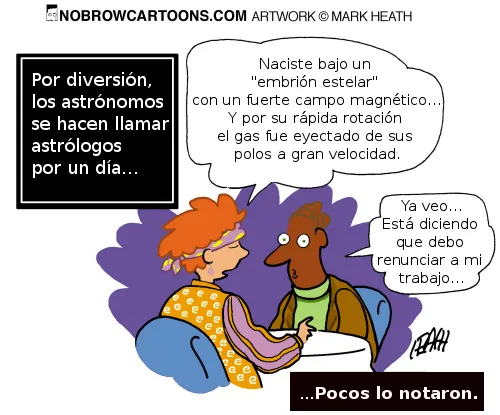
It is possible to think, however, that humor cartoons, which are sometimes also included alongside pastimes, are a form of entertainment that does not actively demand the reader, but that do aim to generate a reaction, sometimes reflective, through humor. Does that happen with the horoscope? I think not. At least, if we compare it with the type of humorous discourse that follows.
The horoscope as humorous discourse
If it is possible to relate "entertainment" with humor, although they are not the same, then, if what some people seek is to entertain themselves, there is a way: Leo Maslíah wrote Horóscopos y otras sentencias, published by Ediciones De la flor, Buenos Aires, 2003. The series of stories begins with "Horóscopos" which, of course, were invented by the Uruguayan author. I extract a sample, hilarious, from that text:
January 1st to February 24th
Aries
A sudden and irreversible change in your life will immediately trigger others not so sudden, which will soon give way to more gradual ones, which will come on little by little and will form a cyclical routine in which you can settle with all comfort for a more than lasting time.
Leo
Saturn's rotation on its own axis will impart a dangerous tendency toward narcissism. Avoid wearing rings.
Virgo
For the fulfillment of your purposes, people demand conditions that you will not tolerate. Do not give in, but act with elasticity and show yourself favorably disposed to make concessions. Behave courageously, but avoid showing your face.
Libra
You believe you are a native of this sign but you are not. Your relatives registered you in the civil registry several months late. They always lied to you about your age. Your birth certificate is fake. Try to establish exactly who is responsible for this and pressure them until you obtain reliable data on the day and time of your birth. Once this is done, restructure your personality until it matches the characteristics of the new sign.
Sagittarius
The stars are arranged in an extremely favorable way for you, but you constitute a threat to them. With your presence you deflect their orbits and several globular clusters are rapidly leaving the galaxy. If you care at all about the common good, move away to some remote point in space-time, where the distortion you impart does not harm the structure of the universe.
Capricorn
If you rule your life by the stars, you should not only look at the pictures they seem to form in the sky. You must also look at the temperature of each star, the chemical elements produced in its interior, the frequencies of its radiations, etc. If you do not conscientiously analyze all these factors, it is inevitable that things will go badly for you. Your lack of achievements, in recent times, is precisely due to this negligence. When consulting the horoscope without knowing anything about antimatter, supersymmetry or black holes, your behavior is equivalent to that of a small child who only looks at the pictures in a comic book magazine, without understanding what the speech bubbles say because he still cannot read.
Related sources and links
- [1] 8% of Britons believe horoscopes can predict the future
https://yougov.co.uk/news/2015/07/03/8-of-Britons-believe-horoscopes-predict-the-future/ - [2] More and More Americans Think Astrology Is Science
http://www.motherjones.com/blue-marble/2014/02/public-opinion-astrology-dumb
About the images
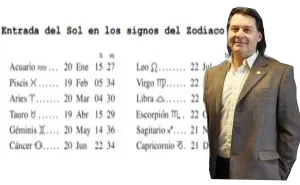
The initial image was made with my own photo. The graphics belong to the sources cited above.
The emoji image was taken from Nups https://nupsb8.wordpress.com/2014/09/15/zodiac-signs-as-emojisemoticons/