A group of astronomers led by a Brazilian studied a young star similar to our Sun in its youth and concluded that Earth's magnetic field was key in the appearance of life on our planet.
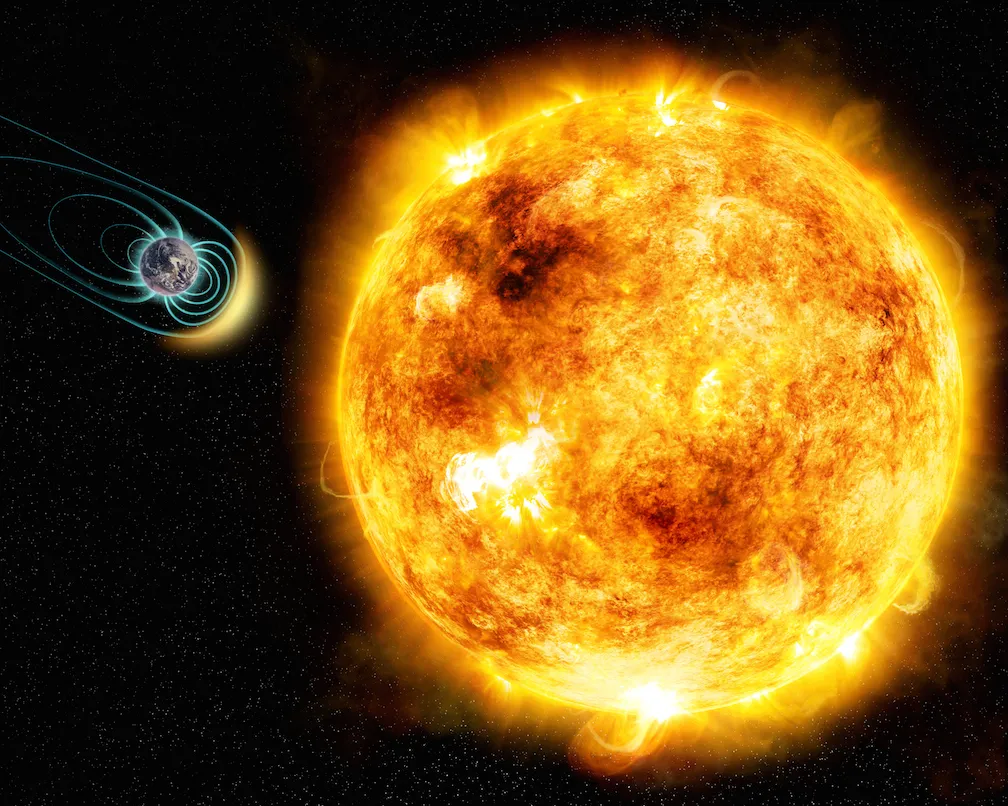
Four billion years ago life arose on Earth. Life emerged because our planet had a rocky surface, liquid water, and an atmosphere. But life prospered thanks to another necessary ingredient: the presence of a protective magnetic field. A new study of a young star shows that a magnetic field plays a key role for a planet to be suitable for life.
"To be habitable, a planet needs warmth, water, and to be protected from a young and violent Sun," said José-Dias Do Nascimento, lead researcher of the study, who belongs to the Harvard-Smithsonian Center for Astrophysics (CfA) and the Federal University of Rio Grande do Norte (UFRN) in Brazil.
Kappa Ceti, a star located 30 light-years away in the constellation Cetus (the whale or sea monster), is very similar to our Sun, but younger. The team of astronomers calculated an age of 400-600 million years, which agrees with the estimated age from its rotation period (a technique developed by Søren Meiborn, see below). That age corresponds to the time when life appeared on Earth. As a result, studying Kappa Ceti provides insights into the early history of our solar system.
Like other stars, Kappa Ceti is very magnetically active. Its surface is covered with giant spots like those on the Sun, but larger and more numerous. It also emits a stream of plasma or ionized gases into space. The research team found that this solar wind is 50 times stronger than that of our star.
Such a fierce stellar wind could spoil the atmosphere of any planet in the habitable zone, unless the planet were protected by a magnetic field. Without that magnetic "shield," a planet could lose most of its atmosphere. In our solar system, Mars suffered that fate and went from a planet warm enough to have oceans to a cold and dry desert.
The team modeled the strong stellar wind of Kappa Ceti and its effects on the young Earth. The early magnetic field would be as strong as today's or only a little weaker. Depending on the assumed strength, the researchers found that the resulting protected region or magnetosphere of Earth would be one third to half as big as it is today.
"Early Earth didn't have as much protection as it has today, but it had enough," commented Do Nascimento.
Kappa Ceti also showed evidence of enormous eruptions that release 10 to 100 million times more energy than the largest flares ever observed on the Sun. These highly energetic eruptions can destroy a planet's atmosphere. By studying Kappa Ceti, researchers hope to learn how frequently it produces super-eruptions and thus know how frequently our Sun produced the same phenomenon in its youth.
The research was accepted for publication in The Astrophysical Journal Letters. The observations were part of the Bcool program (Bernard Lyot Telescope) which is also part of the MagIcS initiative.
Sources and related links
- CfA: Young Sun-like Star Shows a Magnetic Field Was Critical for Life on the Early Earth
https://www.cfa.harvard.edu/news/2016-06 - Magnetic field and wind of Kappa Ceti: towards the planetary habitability of the young Sun when life arose on Earth
J.-D. do Nascimento Jr. et al
arXiv:1603.03937 [astro-ph.SR]
http://arxiv.org/abs/1603.03937 - About the Søren Meiborn technique
The true age of stars
http://www.noticiasdelcosmos.com/2011/05/la-verdadera-edad-de-las-estrellas.html - Stars' Spins Reveal Their Ages
https://www.cfa.harvard.edu/news/2015-01
About the images
In this artistic illustration, the young star Kappa Ceti is covered with starspots, a sign of its high level of magnetic activity. New research shows that its stellar wind is 50 times greater than that of our Sun. As a result, any planet like Earth would need a magnetic field to protect its atmosphere and be habitable. The physical sizes of the star and the planet and the distance between them are not to scale.
Credit: M. Weiss/CfA