An introductory guide on a pending topic.
I will say there is a group of people in favor of scientific thinking and against magical thinking. In such a group there will be science professionals and people whose work is not scientific whom we could call "amateurs".
All those people do not think alike. Supposedly we have a common "cause", although the positions regarding astrology in particular might not be the same.
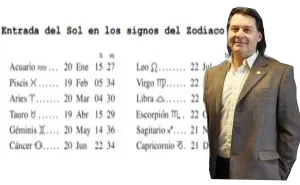
On another occasion I pointed out that it is easy to find, especially in recent years, a discourse supposedly against astrology based on what I called "Ophiuchus Arguments" which circulated widely and, in my judgment, are a set of weak arguments.
[See on this blog: The problem is not Ophiuchus]
It is worth making the following clarification: arguments could be considered weak or strong in relation to their objectives. If a series of reasonings achieves its objectives, it could be strong. But it is also possible to consider that there are strong and weak objectives.
If the Ophiuchus arguments attempt to generate doubts among astrology enthusiasts, perhaps such arguments fulfill that objective. However, it is to be assumed that those doubts would hold for a short time. In this sense they would be weak arguments. But also, if that were the objective ("only to generate doubts") it could be said that it is a not very ambitious and somewhat simplistic objective.
Another type of objective could be to show/demonstrate that astrology is not a science, that its postulates are false. If the objective were that, the Ophiuchus arguments would not fulfill it, since with them neither of the two things is shown or demonstrated. The only thing the aforementioned arguments point out is that astrology possesses conventions different from astronomy. The calendar, time zones, the different astronomical coordinates, are conventions. Astrology uses other conventions: it divides the sky into 12 parts of 30º and assigns each one a name similar to that of 12 constellations of the ecliptic, but somewhat "shifted". It is a convention different from dividing the sky into constellations with boundaries and not just with imaginary lines.
That simply evaporates the created doubts.
By virtue of this, I have pointed out that there is a task to be done: to build more solid arguments against astrology.
For that, it would be worth making a guide for the work to be done.
A ROADMAP: Preliminary notes
1-We people have not given the same meaning to astronomy in the past as we do today. Nor to astrology. Even in the present, astronomy enthusiasts do not give it the same meaning. The same with modern astrology. This is important because those meanings of astrology imply different interpretations, with distinct postulates. If we do not know and analyze them, we do not understand them.
2-To carry out point 1, it is necessary to investigate, inquire, explore discourses: oral, written texts, documents in which we find different meanings of astrology based on an analysis of such discourses.
3-When analyzing them, the "academic" custom is to reference them, to indicate references.
4-Analysis work can go through different stages of elaboration: in the first stages, as an approximation, such references could be omitted and included in later stages. This would allow getting to the heart of the issues more agilely.
5-In the case of astrology, different meanings could be distinguished, namely:
5a-Astrology is a science with objects of study and methodologies, which elaborates theses and models for the purpose of contrasting them with reality in an observational and empirical way.
5b-Astrology studies some objects of the solar system and their influence on human life.
5c-Astrology scientifically studies objects of the solar system and their influence on human life.
5d-Astrology is a path of spiritual truth seeking.
5e-Astrology is not a science.
5f-Astrology is not predictive.
5g-Astrology does not explain social behavior based on the position of solar system objects in the sky.
5h-Astrology is a metaphorical discourse.
5i-Astrology is a symbolic discourse.
5j-Astrology speaks of gods (as "object of study") and of planets (as symbols).
5k-Astrology claims to speak of planets, but speaks of gods.
5l-Astrology is a faith, it cannot be proven, only believed or not believed.
5m-Astrology is personal, individual, not a discourse (thought) about the collective.
6-What is listed in the previous point has some characteristics:
Each statement can be complementary or incompatible with others.
It is not a definitive list, we could find other meanings.
7-Discourses are classified into genres. It is important because: does it make sense to object to Superman if we know those movies and comics are fiction?
If it is fiction, it is imaginary. It makes no sense to say that the imaginary is not real, it's a truism.
But if a fiction discourse is interpreted by some as non-fiction, then the problem is one of discursive genre. In that case, it does deserve to be shown that as such a discourse it is not possible (it is unreal), therefore it is fiction.
8-There are several types of discourses that intertwine the astrological with the scientific:
8.1-The Sun and the Moon influence human life, therefore it WOULD BE POSSIBLE that the planets do too.
8.2-Research has been conducted to prove astrological discourse (different types of studies).
8.3-If an astrological prediction is confirmed in reality, then, astrology is true.
By virtue of this, it is necessary to address each of these points, considering that the second contains sub-items that should be evaluated distinguishing their differences. This point is a priority.
9-In my view, except for certain astrological discourses that could be considered metaphorical (and which would have to be investigated more deeply), there is ONE underlying astrological model to the others:
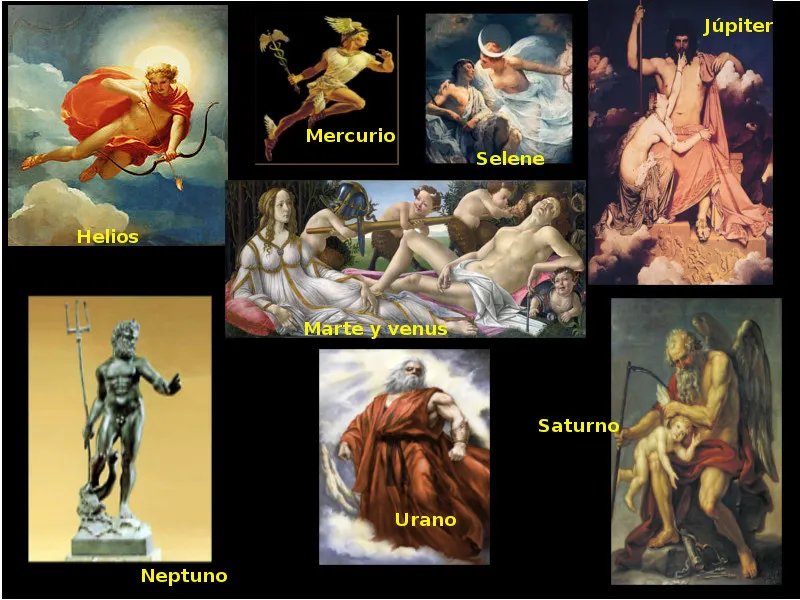
Astrology starts from assuming that gods exist. The gods of the Greco-Roman tradition. Such gods are the ones that would influence people, not the planets that received their names from such gods in antiquity.
In this model, the planets would be symbols, forms in which the gods materialize that function as a signal, index, clue, sign. Therefore, when an astrological chart is drawn, the planets, the sun and the moon are placed in the sky at a specific moment (when a person is born or when a consultation is made). And the astrologer interprets that "photo of the sky" not by virtue of some influence from the planets, but by reason (or unreason) of the gods associated with those planets.
Thus, a person born on date xx, will have planet YY in the sky and since such a planet is associated with a god (which it points to with its presence in the sky), then there will be an influence from that god on the consulted person.
These assumptions are not scientific hypotheses: one cannot prove that immaterial beings exist. Since the chemical, atmospheric, physical composition of the planets is not evaluated, it has nothing to do with astronomy. Gravity, distance, apparent brightness, albedo, or any other "physical" data are not taken into account. Only the "tendencies" generated NOT by the planet, but by the gods and myths associated by the Greco-Roman tradition are considered.
This model is also general and not personal (a characteristic of the sciences) since the god Saturn would generate similar influences on all people, although the combination of influences from different gods would be personal, but not unique: two people born in the same minute in the same hospital would have the same "photo of the sky".
But since the gods and myths also refer with their names to objects, and since astrologers do not clarify this, it is a deliberately ambiguous discourse.
If this model is the one that really underlies the most widely circulated astrology, then I invite readers to evaluate the statements in 5.
9.b-INCOMPATIBILITY OF SCIENTIFIC DISCOURSE
If that is the underlying model in the most widely circulated astrological discourse, then there is a problem with the scientific community, since being against that model is being against faith.
And, despite being in the 21st century, many scientists believe in some god.
They do not believe in the god Jupiter, but they do in Christ. And such a contradiction is only overcome by appealing to blind faith, contrary to scientific thought. Perhaps that is why professional astronomers and many amateurs have not developed solid arguments against astrology. It is that, to some extent, they are not against magical thinking. Surely many of them sit in the same chair every time their favorite team plays, or cross their fingers while waiting to be granted a postgraduate scholarship or are against abortion because the newborn has a "soul", etc.
Others, on the other hand, although they are against that form of thinking, will be strongly conditioned to say it, to express it orally or in writing, since in a conservative society, it is frowned upon. Furthermore, it would be getting into "difficult" issues, for which they are not paid, for which they have not received academic instruction and it does not increase their metrics, that is, it is a problem...
Furthermore, we are supposed to want to attract the public to astronomy and science and not push them away. Doing so in a coherent and solid way would turn people against us, since according to various global surveys, a large majority of people have some blind faith in some immaterial form (be it god, biocosmic energy, karma, etc.).
Perhaps, on this point, there may not be much collaboration from professionals (with honorable exceptions), but there is on other points, such as point 8.
10.NEO-ASTROLOGICAL-PSEUDO-SCIENTIFIC MODEL
Based on the previous model, another perspective emerged:
Given that we have APPARENTLY found some regularities in social-individual behavior and an APPARENT coincidence with astrological discourse, even without postulating the existence of gods, attempts have been made to evaluate whether astrological postulates can be "true".
From there arise the "investigations" of point 8 that have no model, but only seek to contrast statements with reality through correlations.
It is important to account for the lack of a model. For that, I am going to propose a model, not as a suggestion, but only to show what a model is and what its utility would be.
Suppose the planets, the sun and the moon emit particles not yet detected and unique. Mercury would emit "mercurian" particles and Venus others that are different.
Let's say that all these particles reach Earth when there is a certain apparent "alignment" in the sky with such objects and that such particles, therefore, reach the entire population without distinctions.
But in people older than 30 days, the immune system destroys the particles and they produce no influence.
On the other hand, in newborns, due to insufficient development, such particles do produce influences.
A 1-day-old child would be more influenced than a 30-day-old child, since we would postulate that with the days, the children's immune system strengthens. The critical point would be between 30-31 days, after which children would be immune.
This model does not perfectly fit the astrological postulates since here we would only be considering planets and not "signs": The Moon in Cancer would emit the same particles as the Moon in Gemini. Therefore we could add: according to the "sign" the particles could have 12 "flavors" (analogous to particle physics schemes). Those "flavors" would be slight differences in the influence of each object.
As strange as it may seem, if a model like this were used, some "scientific" research would be possible: it would be transforming a myth into a hypothesis, which implies putting it in doubt. Instead of blindly saying it is so, we would ask ourselves if it is so or not and the answer should come from an investigation that proves or refutes the model.
If the model is true, then an experiment could be carried out to discover such particles. Dark matter is a set of hypotheses. Some of them propose, as a possibility, the existence of non-baryonic particles. Experiments have been carried out in recent decades, so far without results. Currently, some hypotheses propose that such particles could be part of a family, that is, have different "flavors". But if they are not found, another explanation will have to be sought.
11.SCIENTIFIC THOUGHT AND DISCRIMINATION
It should be added that so-called scientific thought includes something very important: Can such a phenomenon be explained in another way?
It is important because if a father hits his child, one supposed possibility is that it is due to the influence of a "planet," perhaps by unknown particles. But can that behavior be explained in another way?
A vital importance in this regard is linked to prejudice and discrimination. Modern biology includes theories that assume that black people are different because they possess a genetic variation compared to white people.
And the same could be thought of other issues: that a person steals might be due to a genetic variation.
A consequence of this is Nazism and the concept that black people, Jews, homosexuals, etc., are "oddities" that must be corrected genetically.
But the basis of that way of thinking is the prejudice that black people are different from white people, gays from heterosexuals, men from women. There is no doubt that differences exist in skin color, sexual choice, clothing. But can those differences be explained in a way other than a genetic variation? A social reason and not a "natural" one?
Is there any evidence that black people behave in the same way, different from white people?
Is there any proof that such supposed difference in behavior is due to genetic variations?
If it is possible to explain behaviors without appealing to genetic variations and there is no evidence that behavior is different only due to skin color and there is no proof of such variations as the cause of different behaviors, then, maintaining that black and white people are different (only because of skin color) is a prejudice. Using such prejudice leads to discrimination. Discrimination is the child of magical thinking, not scientific (even though it is sometimes a discourse used by scientists).
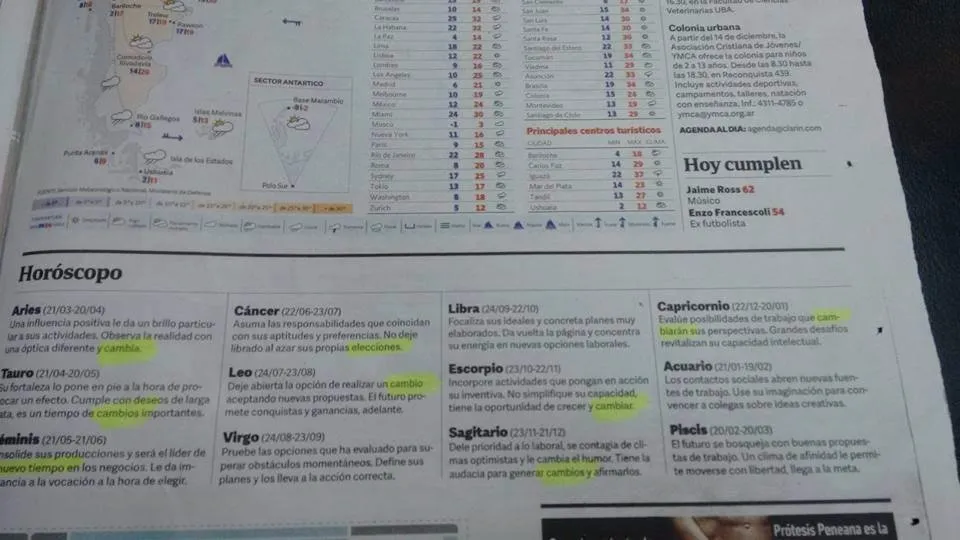
Astrology assumes there are 12 classes of people: Leos are different from Geminis. The difference would lie in the supposed influence of unverifiable gods or planets (never investigated and implausible). And such a difference is not even assumed as a hypothesis, but as absolute truth. That is why it is a myth that generates prejudice and is a highly discriminatory discourse.
[See in this blog: Can a myth be true?]
There are even records of the use of "astrological profiles" among human resources managers when evaluating a person for a job or as a way of "knowing" possible compatibility for forming couples. In fact, there are people who look at a person's "sign" as an "indication" of whether they would be compatible.
That is why it is difficult to understand the flagrant contradiction between those who are against forms of discrimination, those who suffered such discrimination (gays, women, black people, etc.), but subscribe to astrology.
Astrology is, therefore, an archaic, reactionary discourse. It is a highly deterministic way of thinking: what happens in societies is not the result of social contradictions, class struggles, struggles for status improvement, whose basis is obtaining the material conditions for a dignified existence, along with other social phenomena like the need for group belonging, social recognition, etc. No, for astrology all behavior is "explained" by gods who have very human characteristics. The gods were created by human beings, not the other way around.
But it is easier to blame someone else: the blame for society's ills is not ours individually and collectively, but that of the gods or the planets.
Yes, there are differences between people. But if we assume, without evidence and without considering other plausible explanations, that those differences are due to the influence of Greek or Roman gods, it means we have not left the Middle Ages.
THE ROUTE CONTINUES
The neomodel, based on myths and blind faith, has been attempted to be made "scientific" by conducting certain types of research, although without a model. Such research is of different types. It is necessary to evaluate such research to understand what they tried to find out and what kind of conclusions can be drawn from them.
Furthermore, I have stated that there are metaphorical astrological discourses (I refer to forms of Jungian analysis, artistic references) that should also be evaluated to understand.
The first is a priority since it includes the notion stated in 8.1 that generates much confusion.
CONCLUSION-OBJECTIVE
The objective of this post is to start a path in the development of better, more solid arguments against astrology. Other pseudosciences like numerology also deserve solid arguments against them, but the basis is similar.
To achieve that objective in stages I propose:
1-Reclassify several notes in this blog with the tag "ContraLaAstrología" so that it is easier to access similar notes in this sense.
2-Translate some texts by professional astronomers who have addressed the issue more solidly, although incompletely, taking into account what was expressed in point 8.
3-Develop during this year a first version of a text as complete as possible, in Spanish, and partially documented.
4-Develop specific arguments about points 8 and 9: the supposed research on astrology (point 8) and why there would be an underlying model, explain why it is possible to think of it that way (point 9). Also, in relation to that model, address the possible incompatibility of the scientific discourse between science and faith.
The importance of developing these arguments can be shown from the "more elaborate" discourses of astrologers, precisely based on the "Ophiuchus arguments," as we can see in the related links [1 and 2].
Sources and related links
[1] A review of the most widespread anti-astrology prejudices, by Olga Weyne, former career researcher at CONICET in Entremujeres.clarin.com (5-3-2016)
[2] Sergio Barreiro: "That astrology is not a science does not mean it is anti-scientific and false," in Entremujeres.clarin.com (24-02-2016)
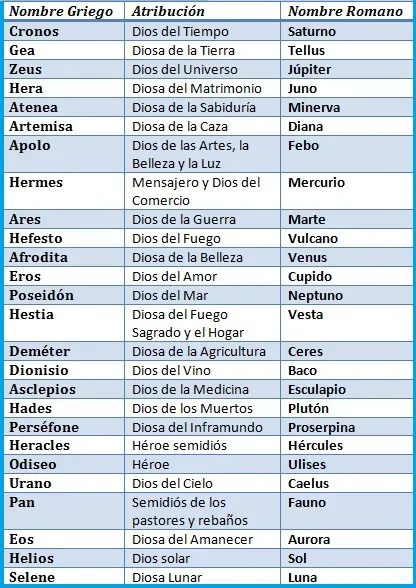
GREEK GODS, THEIR CORRESPONDENCE IN ROME, CHARACTERISTICS AND ATTRIBUTES https://diverletras.wordpress.com/2014/01/27/dioses-griegos-su-correspondencia-en-roma-caracteristicas-y-atributos/
About the images
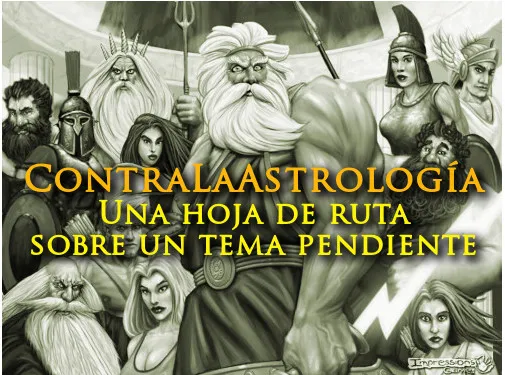
Initial image: Representation in "Justice League" style of the gods of antiquity.
http://pequelia.republica.com/maternidad-paternidad/nombres-de-dioses-griegos-y-romanos.html
Image 2: Table of correspondence Greek and Roman mythology http://losolmoshistoria4.blogspot.com.ar/2012/10/mitologia-clasica-los-nombres-de-los.html
Image 3 composed of: Helios at Noon, by Anton Raphael Mengs [Public domain], via Wikimedia Commons; Mercury, image taken from Blogodisea; Venus and Mars. Sandro Botticelli (c. 1483) from Wikimedia; Selene and Endymion (Wikimedia); Jupiter and Thetis, by Jean Ingres, 1811 (Blogodisea); Saturn, by Ivan Akimov (Wikimedia); Uranus from Wikia; Neptune (Blogodisea).
https://es.wikipedia.org/wiki/Helios http://www.blogodisea.com/mercurio-hermes.html https://es.wikipedia.org/wiki/Marte_(mitolog%C3%ADa)
https://es.wikipedia.org/wiki/Selene http://www.blogodisea.com/jupiter-zeus.html https://es.wikipedia.org/wiki/Saturno_(mitolog%C3%ADa)
https://commons.wikimedia.org/wiki/Category:Saturnus_(deus)#/media/File:Ivan_Akimov_Saturn.jpg http://es.mitologia.wikia.com/wiki/Urano http://www.blogodisea.com/neptuno-poseidon.html