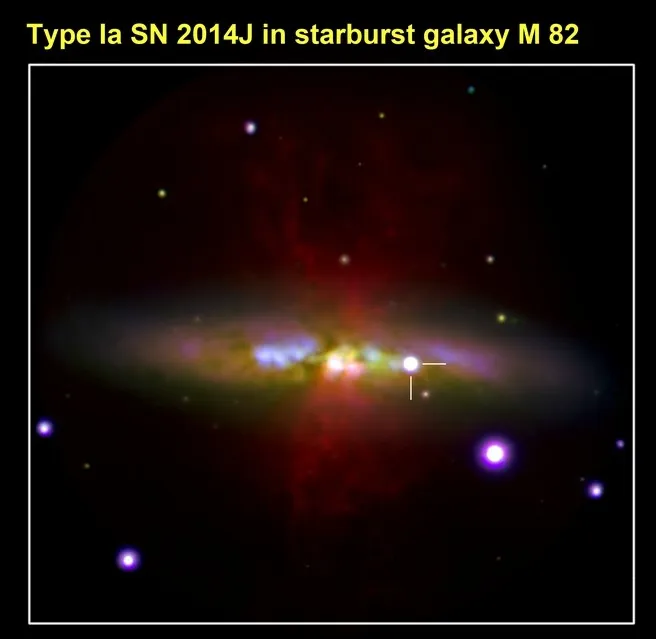
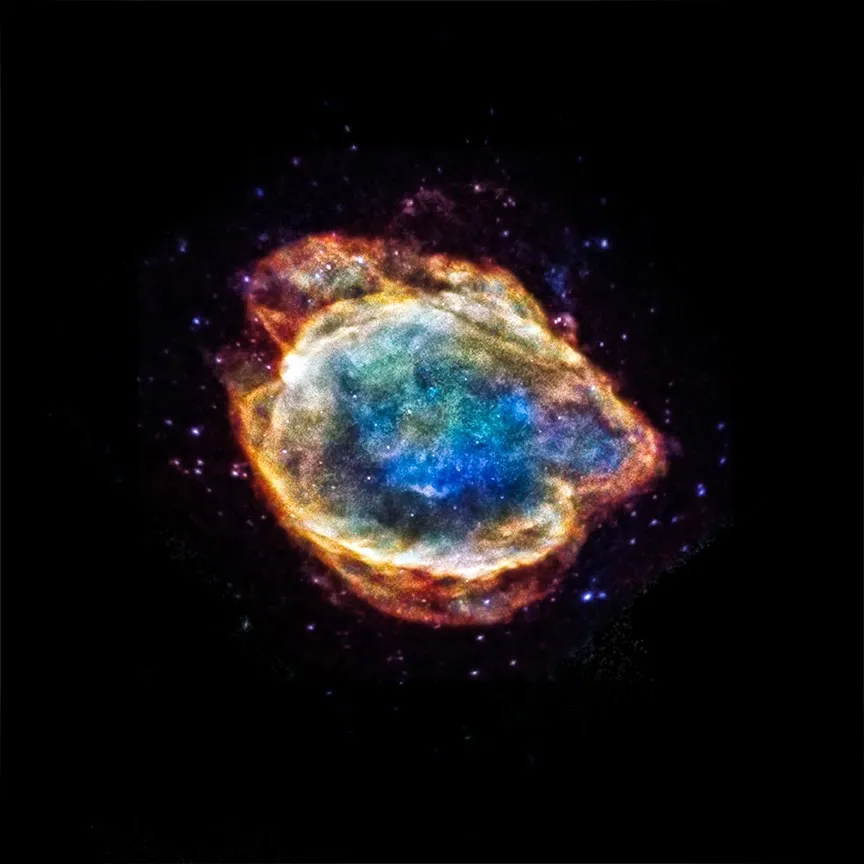
Are these events harmful to life on Earth? New studies follow the clues of radioactive isotopes to find out where and when events close to Earth occurred. The effects for events at a greater distance than 30 light-years are unknown.
It is often said that if a supernova is recorded at more than 10 parsecs (33 light-years), we should not worry. Furthermore, it is estimated that an explosive event of this class occurs, in that volume, every 240 million years.
If we increase the volume, the frequency also increases: in a volume of 100 light-years (27.8 times the volume of 33 light-years) the frequency would be 1 supernova every 8.6 million years. In 200 light-years, 1 every 1 million years [1].
It has been calculated that in galaxies like ours there is a supernova every 30 years [2].
If Hubble recorded 150 billion galaxies and in each of them there was a supernova every 30 years, in total there would be 5 billion per year, that is 13 million per day [3].
But since almost all of them would be much farther than 30 light-years, there would be no problem, or would there?
Three new papers were presented yesterday in Nature on the frequency and danger of supernovae in the neighborhood. One work corresponds to Anton Wallner and colleagues [4]. It indicates that it is calculated that within a volume of 100 parsecs there would be a supernova every 2-4 million years, based on the Milky Way rate (2 per century). They analyzed iron-60 deposits from the oceans and concluded that they would come from supernovae that occurred 1.5-3.2 million years ago and 6.5 to 8.7 million years ago.
A second paper, by Dieter Breitschwerdt and others [5] traced the iron-60 isotope from the oceans and consider that it would have originated from two supernovae at distances between 90 and 100 parsecs (326 light-years). The closest one occurred 2.3 million years ago and the second 1.5 million years ago.
For his part, Adrian Melott (University of Kansas) published a work on supernovae in our neighborhood [6].
During these outbursts, radioactive elements, such as iron-60, are released into space. What effects can they have on life on Earth?
"This research shows that certain events occurred in the not-so-distant past. They make clear approximately when they occurred and how far away they were. Knowing that, we can consider what effects they might have had. Then we could look for events in Earth's history that might be connected", explained Melott [7].
According to the scientist, it is not known what effects they could have had. "These events were not close enough to cause a mass extinction, but they were not so far away as to be ignored", he commented.
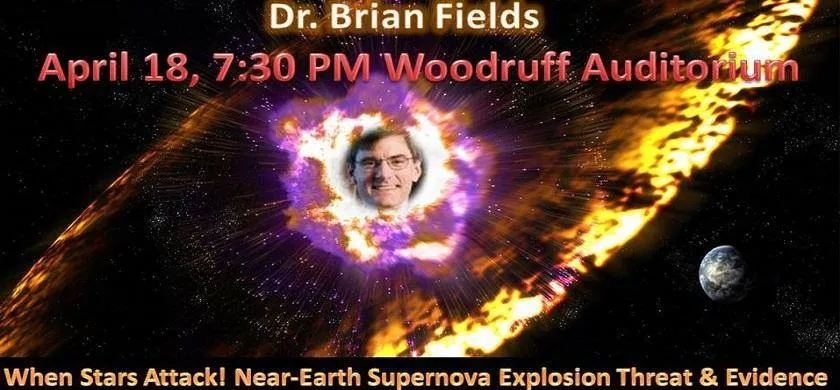
A colloquium to be held in the Woodruff auditorium on April 18 by astrophysicist Brian Fields is titled "When Stars Attack! Near-Earth Supernova Explosion. Threats and Evidence" [8].
Fields originally conceived of using the iron-60 isotope to trace episodes of nearby supernovae.
DESTRUCTION AND CREATION IN THE COSMOS
Stars fuse elements, from the simplest to the most complex. They begin as simple groupings of hydrogen that, through nuclear fusion, transform the simplest element into Helium. Towards the end of their lives, depending on their mass, stars expel their outer layers from the atmosphere into interstellar space. From that enriched material new stars and planets will form that will contain those elements. Thus, generation after generation, stars produce the enriched, heavier elements that allow a world like ours to exist. The most massive stars end their lives violently, in supernova events. Nova means "new". For the ancients it was the sudden brightness of a "new" star. For us, it is about events in which pre-existing stars increase their brightness considerably. But not because a star is "being born", but because it is "ending". Through the dialectic of nature, that end is also a beginning of "new life". Beautiful. But, if it is close to home, it will also be terrible. Two sides of the same coin that shine under the same sun. As Nano Serrat sang, ♫"...the truth is never sad/what has no remedy..."♫
The best defense against this "attack" of nearby supernovae is knowledge. And, as may have been noticed in what was said above, they do not seek such knowledge only by looking at the sky, but by scrutinizing the oceans. However, a sea of questions remains...
Sources and related links
- [1] Near-Earth_supernova
https://en.wikipedia.org/wiki/Near-Earth_supernova - [2] LBL study of supernovas has surprising results
http://www2.lbl.gov/Science-Articles/Archive/supernova-search.html - [3] Frequency of supernovae in the universe
https://www.physicsforums.com/threads/frequency-of-supernovae-in-the-universe.180205/ - [4] Recent near-Earth supernovae probed by global deposition of interstellar radioactive 60Fe
A. Wallner et al.
Nature 532, 69–72 (07 April 2016) DOI:10.1038/nature17196 - [5] The locations of recent supernovae near the Sun from modelling 60Fe transport
D. Breitschwerdt
Nature 532, 73–76 (07 April 2016) DOI:10.1038/nature17424 - [6] Stellar astrophysics: Supernovae in the neighbourhood
Adrian L. Melott
Nature 532, 40–41 (07 April 2016) DOI:10.1038/532040a - [7] Proof that ancient supernovae zapped Earth sparks hunt for aftereffects
https://today.ku.edu/2016/04/01/proof-ancient-supernovae-zapped-earth-sparks-hunt-aftereffects - [8] "When Stars Attack! Near-Earth Supernova Explosion Threat and Evidence
https://www.facebook.com/events/877508855695024/ - Hipertextual: The explosion of giant supernovae bathed the Earth in "radioactive waste"
http://hipertextual.com/2016/04/supernovas-explosion-basura-radiactiva-tierra
About the images
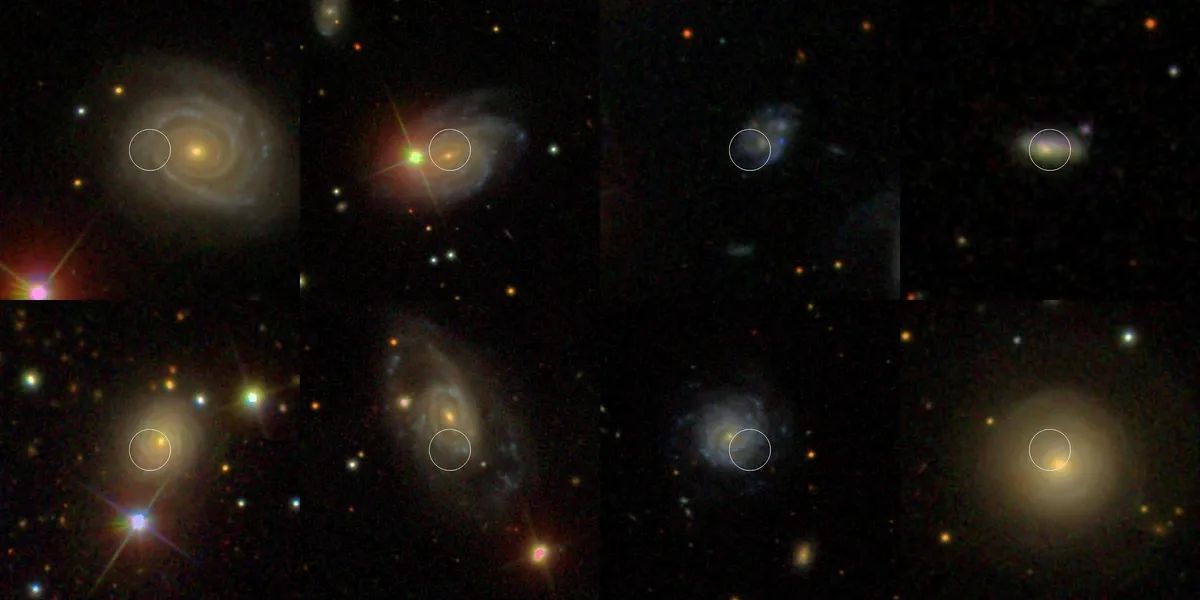
Initial image: GALEX composite showing from left to right and top to bottom the following galaxies (and supernovae): NGC 6038 (SN 1999cc), UGC 5234 (SN 2003W), A112539+2249 (SN 2004as), A225942-0000 (SN 2005ku), M+05-54-41 (SN 2006en), UGC 14 (SN 2006sr), UGC 8162 (SN 2007F) and IC 807 (SN 2007cp). Credit SDSS.
https://www.nasa.gov/jpl/galex/pia18929/after-the-explosion-investigating-supernova-sites