A variety of activities begin this week in Buenos Aires: Telescope course with the Amigos de la Torre; Café Científico of the Planetarium; IAFE Astronomy Workshops.
New presentation of the 2016 Planetarium Café Científico Cycle
Thursday, May 12, 19:00 h / Hotel Castelar: Av. de Mayo 1152, C.A.B.A
The Planetarium's science outreach proposal includes a wide variety of shows and complementary activities. One of them is the Café Científico, where experts tell the public, in a plain, colloquial manner, and with coffee in between, the news and curiosities of their research areas. This proposal is enhanced by the attraction of visiting the Notable Bars of the City of Buenos Aires. On each occasion, the activity will take place in one of the typical porteño cafés.
In 2015, the Planetarium resumed this memorable cycle (which reached its peak between 2001 and 2004) with renewed topics and new invited specialists. This year we continue on the same path: and the second meeting will be led by science journalist and writer Martín Cagliani*.
The presentation and moderation will be led by Lic. Mariano Ribas (UBA), coordinator of the Science Outreach Area of the Buenos Aires Planetarium.
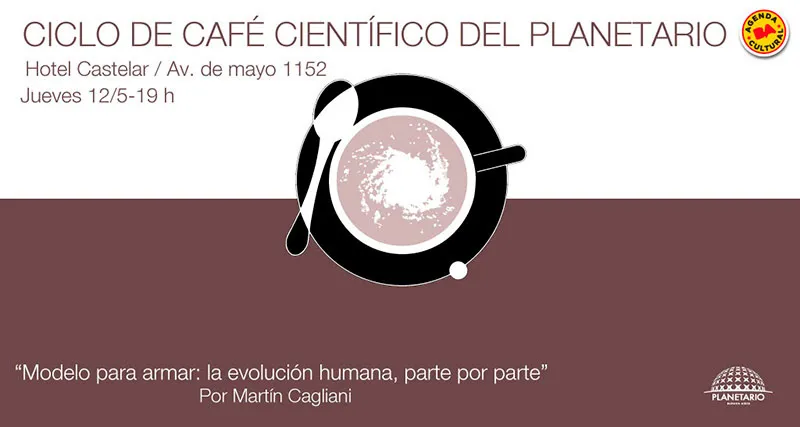
Model to assemble: human evolution, part by part
There is no more fascinating journey than the history of our species. We carry within us millions of years of evolution and our body is a collage of adaptations and changes that we inherited from some ancestor lost along the way. In this "Model to assemble" we will see where our legs, our mouths, our bones came from and how what we are exposes our small place in the Universe.
After all, it is always useful to be aware that our hands come from the fins of a certain primordial fish, or to know why, nowadays, we are not covered in hair.
Knowing our history is the best starting point to know where we are going, because our body and its parts are and will continue to evolve.
Martín Cagliani is a science journalist and writer. He studied Anthropology and History at the University of Buenos Aires. He was a contributor to the science supplement of Página/12 for several years and is currently a regular contributor to Quo in Spain; Scientific American in the United States and Muy Interesante in Argentina. Author of the book Modelo para armar from the Ciencia que Ladra Collection.
Cagliani also has a science blog on the internet, called Mundo Neanderthal http://neanderthalis.blogspot.com
The Planetarium's Café Científico cycle aims for scientific knowledge and discoveries to circulate socially, being transmitted in the most plain and enjoyable way possible. So that science is an everyday thing... like a rich and so porteño steaming coffee.
We look forward to seeing you then on Thursday, May 12 at 19 h. at the Hotel Castelar (Notable Bar of the City of Buenos Aires). Av. de Mayo 1152, C.A.B.A
Telescope course at the San José Observatory
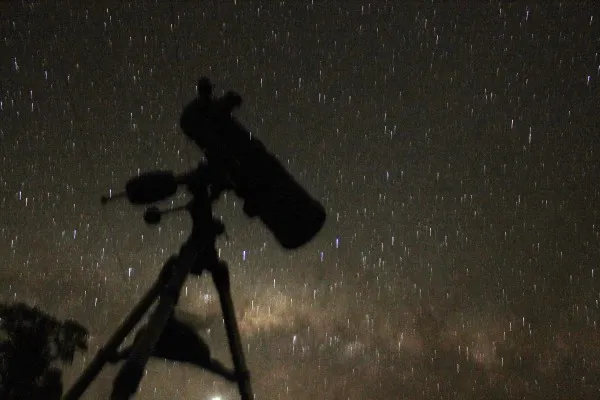
On Friday, 13/05, the Telescope course will begin at the San José Observatory. The syllabus includes notions of optics, operation of the various types of telescopes, selection of eyepieces and accessories, mounts and their use, as well as use of instruments and nighttime practices with them. The course is designed for all those who want to learn how to operate a telescope, whether they are about to buy one or for those who already own one and wish to get the most out of it.
Start: Friday, 13/05/14
Schedule: 19:30 to 22:00
Location: Colegio San José, Bartolomé Mitre 2455, CABA (announce yourself at the porter's lodge)
Duration: 4 classes
Suggested minimum age: 12 years
Fee: $500 (students of Colegio San José free) - All proceeds go entirely to the maintenance of the San José Observatory
Registration: takes place on the same start day when paying for the course
Notice: access to the Observatory is by stairs and is equivalent to 8 floors
Inquiries and information:
www.observatoriosanjose.com.ar
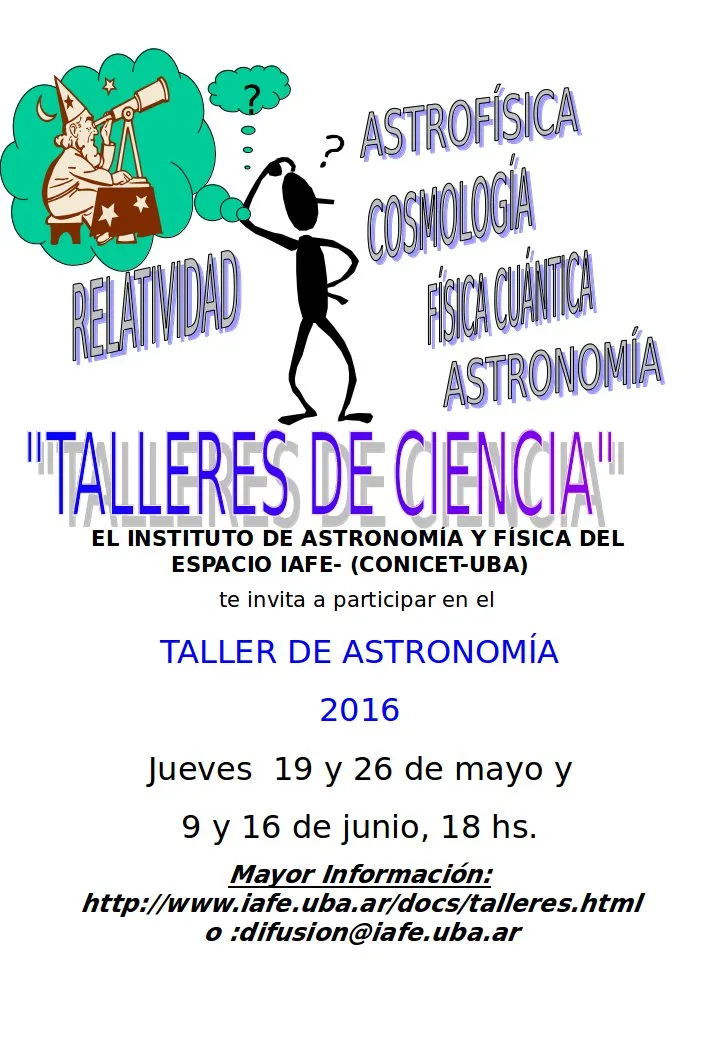
SCIENCE WORKSHOPS: ASTRONOMY 2016
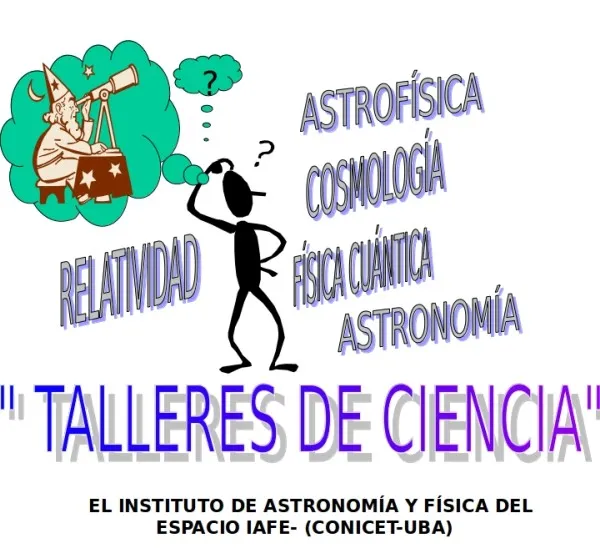
The Institute of Astronomy and Space Physics -IAFE- (CONICET-UBA) invites all those interested in topics related to the study of the Universe to participate in its Workshops.
-First meeting: Thursday, May 19, 18 h.
"Our restless Sun: the different faces of a star"
Dr. Marcelo López Fuentes
It is often said that if it weren't for the magnetic field, the Sun would be a star as boring as most astronomers think it is. Among the different types of stars available in the cosmos, our Sun is indeed a fairly common star. However, there are two things that make it special for us: it is close enough that we can see phenomena that are undetectable in other stars, and its behavior has, for obvious reasons, a much more direct impact on our lives. In this talk, we propose to review our current knowledge about the Sun and look at it as a laboratory of physics under extreme conditions through impressive observations obtained with state-of-the-art instruments.
-Second meeting: Thursday, May 26, 18 h.
"The fascinating life of Galaxies"
Dra. María Emilia De Rossi
The study of galaxies is one of the most fascinating branches of Astronomy and can contribute to unveiling secrets about the origin and evolution of our Universe. However, researching galaxies is not an easy task since within them coexist the most varied astrophysical systems, ranging from planets like ours, millions of stars like our Sun, and even gigantic black holes. On the other hand, galaxies do not spend their lives in complete isolation but, on the contrary, interact with other galaxies and with the medium that surrounds them. Moreover, many galaxies collide with each other in violent collisions that dramatically alter their properties. These processes are so complex that to analyze them astronomers must resort to sophisticated telescopes and state-of-the-art computers. In this talk, we will analyze what they are, how they formed, and what the life of galaxies is like based on telescope observations and simulations generated by the most powerful supercomputers of today.
-Third Meeting: Thursday, June 9, 18 h.
"Galaxy Formation and Dark Matter"
Dra. Susana Pedrosa
What is the possible nature of dark matter? Its role in galaxy formation. The most recent models. How is the formation and evolution of galaxies studied through numerical simulations?
-Fourth meeting: Thursday, June 16, 18 h.
"From chemistry to biochemistry in the Galaxy"
Dr. Sergio Parón
In this Workshop we aim to study the interstellar medium of our Galaxy. We will highlight that stars are the fundamental building blocks that make up and give rise to practically everything we see. We will study the chemistry related to stars and the interstellar medium, and follow the steps of a possible biochemistry that could occur in exotic places in space.
IMPORTANT: The meetings are free and participation does not require prior registration. Entry to the Institute will be from 17:30 h until the capacity of the 70-seat classroom in the Conference Room is filled and STRICTLY CLOSES AT 18 H. IAFE Building-Ciudad Universitaria- Núñez-Buenos Aires.
NOTICE: We inform you that due to the reforms carried out within Ciudad Universitaria, those arriving by car can only enter via the bus entrance and park in the parking lot of Building I, informing the security personnel that they are attending an IAFE activity.
For more information:
Website: http://www.iafe.uba.ar/docs/talleres.html or by email to difusió[email protected]
Sources and related links
- IAFE
http://www.iafe.uba.ar/docs/talleres.html - OBSERVATORIO SAN JOSÉ
http://www.observatoriosanjose.com.ar/ - Planetario Galileo Galilei
http://www.planetario.gob.ar/