Next September 29, as part of Accessible Tourism Week, the Galileo Galilei Planetarium of the City of Buenos Aires will offer shows for people with visual and hearing disabilities. Also, a course on The Galileo case at Observatorio San José and a lecture on binaries at Amigos de la Astronomía.
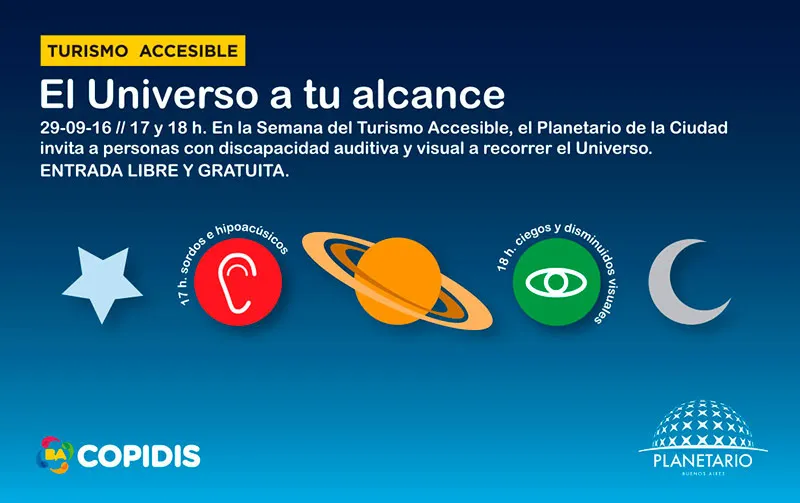
The City Planetarium will offer free shows for deaf and hard-of-hearing people and for blind and visually impaired people, bringing the Universe closer to the public with special needs and eliminating the barriers that limit their access.
At 17 h, the Planetarium invites deaf and hard-of-hearing people to discover the Universe on a dazzling and immersive journey through time and space with a special showing of “From Earth to the Galaxies”, which was specially adapted by Planetarium staff, COPIDIS and Lengua de Señas Argentina. It will be narrated in Spanish, subtitled and interpreted in sign language.
Non-exclusive prior registration (individuals and groups): [email protected]
At 18 h, the Planetarium will offer a show for blind and visually impaired people, accompanied by their families and friends, and invites them to “touch the sky with their hands”. It is an inclusive experience to tour the Buenos Aires sky, learn about the Universe and discover the life of stars through touch and hearing, using a tactile celestial map with raised indications and a recorded, musicalized narration.
Non-exclusive prior registration (individuals and groups): [email protected]
To learn more about the program for non-regular audiences “Planetario Accesible”, go to http://www.planetario.gob.ar/n_personas_ciegas.html and http://www.planetario.gob.ar/n_personas_sordas.html
The Galileo case
On Friday, September 23, 2016, the lecture series 'Lecture series at Observatorio San José - The Galileo case, past and present' begins at Observatorio San José.
The confrontation between Galileo and the Catholic Church became an archetype of the conflicts between science and religion. Like every historical episode, the famous trial that in 1633 condemned the scholar for defending Copernicus's doctrine that the Earth was not the center of the universe was and is an object of varied and controversial historical interpretations. In this lecture, the facts will be reviewed and the perspectives of analysis will be discussed, as well as the reactions of specialists to the results of John Paul II's initiative in 1992 to revisit the matter.
Start: Friday, September 23, 2016
Duration: 1 night
Schedule: Fridays from 19 to 22 h
Lecture by Dr. Miguel de Asúa
Master in History and Philosophy of Science (University of Notre Dame, 1990),
Ph.D. in History of Science (University of Notre Dame, 1992),
CONICET Researcher
Fee: Free
Address: Bartolomé Mitre 2455, Capital Federal (Colegio San José)
Access is by stairs and is equivalent to about 7 floors approximately.
Information and registration:
www.observatoriosanjose.com.ar [email protected] [email protected]
WHEN STARS FORM SYMBIOSIS at Amigos de la Astronomía
Amigos de la Astronomía invites us to the next conference, to be held on Saturday, October 08, 2016, at 19:00 hours.
Its title is: "WHEN STARS FORM SYMBIOSIS" by Dr. Claudio M. Quiroga (UNLP).
At the clubhouse at Av. Patricias Argentinas 550-CABA-
Admission is free.
http://amigosdelaastronomia.org/
Symbiotic stars are stellar systems formed by two stars separated by a distance similar to the Sun–Earth distance and orbit one around the other. One of the stars is an evolved red giant, and the other is a hot component, generally a white dwarf. The red giant loses, transfers mass to space, part of which is captured by the hot component. This capture of material can give rise to thermonuclear explosions, known as "slow novae", which prolong the life of the white dwarf that, otherwise, would stop shining in a few tens of thousands of years. These violent thermonuclear explosions in the Universe lead to the formation of spectacular nebulae like the known "Southern Crab Nebula". The gas transfer also affects the evolution of the red giant. For this reason, stellar symbiosis is spoken of: each of the stars depends on and influences the evolution of the other. Understanding the evolution of symbiotic stars means better understanding the life of stars in general, since most stars in the Universe are double stellar systems.
Dr. CLAUDIO M. QUIROGA