Run Universe, run!
For astronomers, according to their latest measurements, the universe would be expanding faster than expected. An Argentine collaborated in the work.
A team of astronomers led by Nobel laureate Adam Riess discovered that the universe expands between five and nine percent faster than previously calculated. This disagrees with the rate predicted using measurements of the infant universe.
"This surprising finding may be an important clue to understanding those mysterious parts of the Universe that make up 95% of everything and do not emit light, such as dark matter and dark energy", said Adam Riess.
A possible explanation for this unexpected rapid expansion is a new type of subatomic particle that could have changed the balance in the early universe: dark radiation.
The team measured the so-called Hubble Constant with an uncertainty of only 2.4%. These measurements were made with the Hubble Space Telescope and differ from those made with the WMAP probes and the Planck satellite which measured the same constant in the early Universe.
"You start from two ends and expect to meet in the middle if all your drawings and calculations were done correctly. But now the ends do not meet in the middle and you want to know why", Riess explained metaphorically.
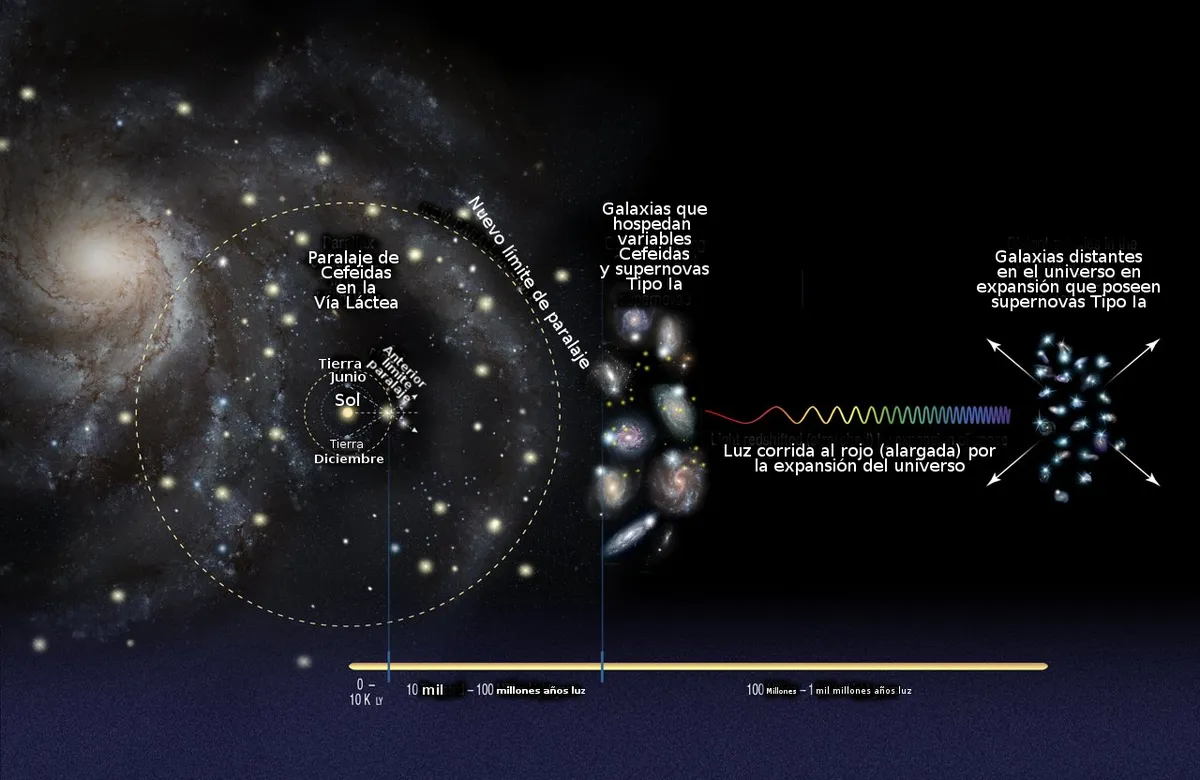
The team used Hubble to observe Cepheid variables and Type Ia supernovae, which are used as "standard candles" and to calculate the distances to those variables they used parallax. This is called the "Cosmic distance ladder" (see below).
However, parallax is used for relatively short distances. In this case, that limit was extended by using the WFC3, one of Hubble's cameras, across the galaxy.
The team measured about 2400 Cepheids in 19 nearby galaxies and with this data as a basis calculated the distances to 300 Type Ia supernovae in distant galaxies.
The Hubble observations were made by the "Supernova H0 for the Equation of State" (SH0ES) team.
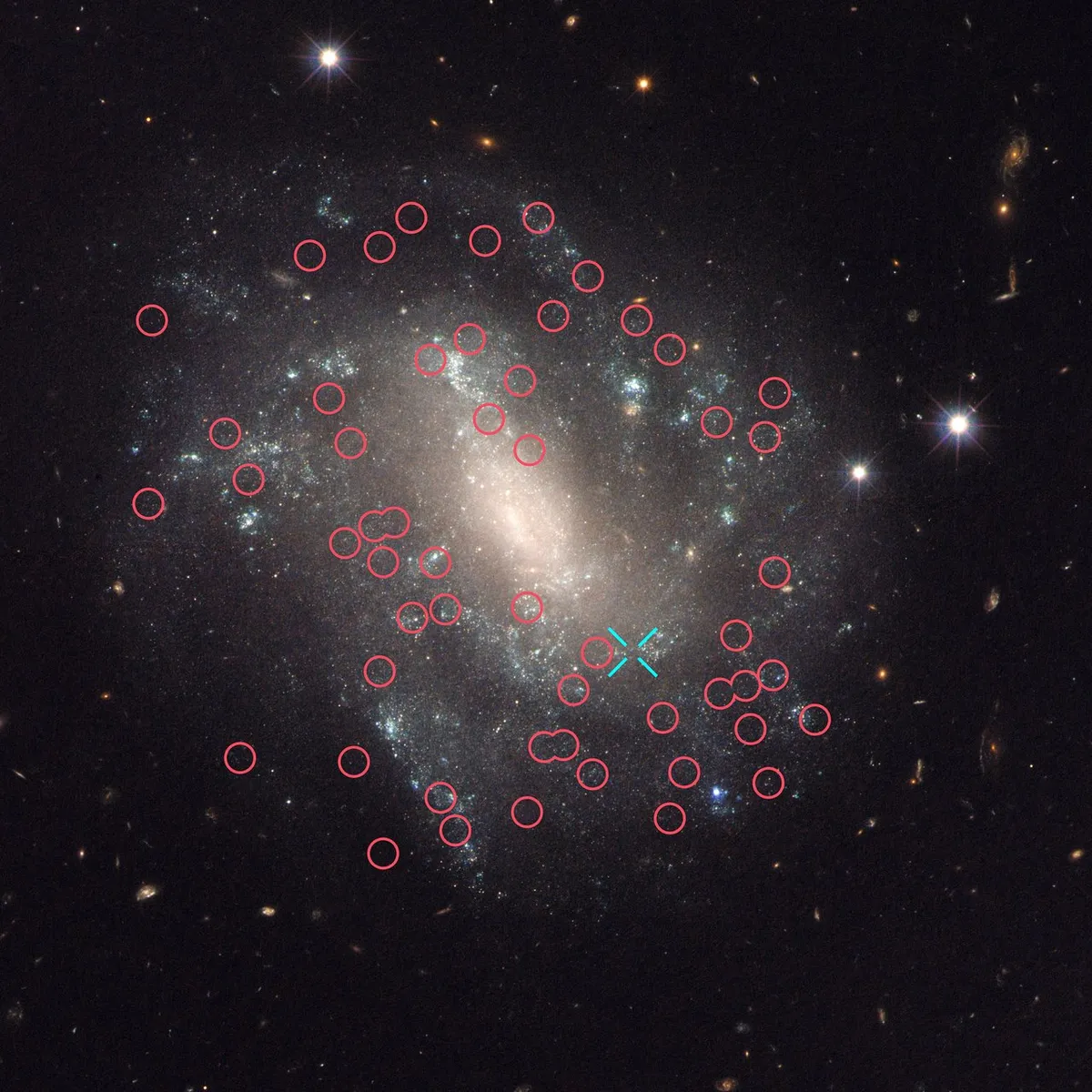
Image 2: This image corresponds to the galaxy UGC 9391 which contains two types of objects that astronomers use to calculate distances to galaxies: Cepheid variables (red circles) and Type Ia supernovae (the blue cross indicates supernova 2003du). UGC 9391 lies 130 million light-years away.
The previous measurement of the Hubble constant was between 70 and 75 km/sec/Mpc. The new measurement indicates H0 = 73.02 ± 1.79 km s−1 Mpc−1, which is 3.0σ (standard deviation) higher than the value of 67.27 from the Planck Collaboration. With some corrections they arrived at the result of 73.24 (±1.74) km/sec/Mpc, as the authors indicate in a paper submitted to ApJ.
The team signing the paper has as second author Lucas M. Macri (Texas A&M University, USA) who commented: "We know very little about the dark parts of the universe, so it is very important to measure how they push on space throughout cosmic history".
Lucas Macri is an astronomer born in Buenos Aires, Argentina, on August 19, 1972. He is a U.S. citizen.
Sources and related links
A 2.4% Determination of the Local Value of the Hubble Constant
Adam G. Riess, Lucas M. Macri, Samantha L. Hoffmann, Dan Scolnic, Stefano Casertano, Alexei V. Filippenko, Brad E. Tucker, Mark J. Reid, David O. Jones, Jeffrey M. Silverman, Ryan Chornock, Peter Challis, Wenlong Yuan, Ryan J. Foley arXiv:1604.01424 [astro-ph.CO]
http://arxiv.org/abs/1604.01424v1
Berkeley: Universe expanding faster than expected http://news.berkeley.edu/2016/06/02/universe-expanding-faster-than-expected/
SpaceTelescope: Hubble finds Universe may be expanding faster than expected http://www.spacetelescope.org/news/heic1611/?lang
A ladder to measure the cosmos http://www.noticiasdelcosmos.com/2010/06/una-escalera-para-medir-el-cosmos.html
About the images
Image 1:Credit: NASA,ESA, A. Feild (STScI), and A. Riess (STScI/JHU)
Image 2:Credit: NASA, ESA, and A. Riess (STScI/JHU)