Reflections on a series of booklets on "Mysteries" published uncritically by the children's magazine.

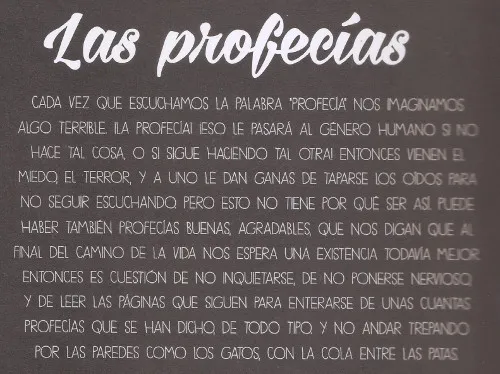
The children's magazine from Editorial Atlántida in Argentina, Billiken, has been publishing a series of booklets in its weekly edition on the general theme of "Mysteries". In its latest issue, this week, number 17 dedicated to "Prophecies" is already circulating.
The themes of previous issues included: UFOs, elves, vampires, ghosts, witches, etc.
Publishing texts on these topics, in itself, would not be objectionable. They are fictional discourses created by human beings that we have no reason to hide. But the publication does so uncritically.
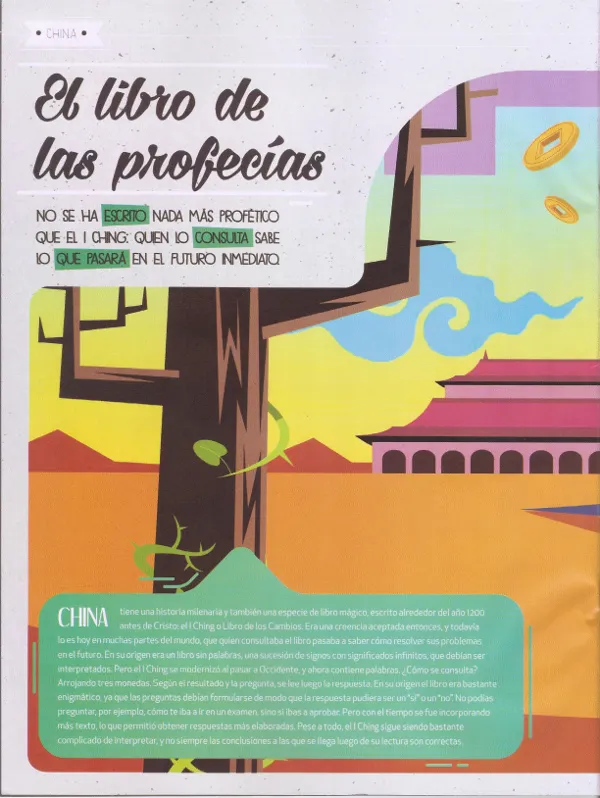
In this case, the booklet reviews authors of prophecies like Nostradamus, the Mayans, Rasputin, etc., but at the end it states about the I-Ching: "Whoever consults it knows what will happen in the immediate future".
This ultra-conservative, archaic, and reactionary stance should not be surprising for publications from that publishing house. Consider the history of Billiken itself or the magazine Gente during the last dictatorship. (See the final Postscript).
PROPHECIES, PREDICTIONS AND FORECASTS
I bring up the topic for two reasons. The first is that, in line with what has been published here previously, it is necessary to account for the pseudoscientific discourses existing in the social semiosis in order to make a diagnosis of their quantity and quality.
Secondly, it is appropriate to take this particular discourse to delve into an important matter: what are the objections to pseudoscientific predictions?
AMBIGUITY
One of the objections to pseudoscientific discourses like divination is that their predictions are sufficiently ambiguous to mean nothing, or rather, to not be wrong. For example, if about someone's personality traits it were said: "You are introverted, but you have an ease for communicating with others," we could say that given the contradiction, it is impossible to be wrong. This is related to the "Forer Effect" commonly used to object to astrology (see https://es.wikipedia.org/wiki/Efecto_Forer).
However, it is NOT the ambiguity (which is a consequence, a symptom), but the method (the cause) that should be objected to. To make this clear, it is worth keeping in mind that scientific discourse includes forecasts or predictions and that it is often somewhat ambiguous or often wrong. Therefore, serious objections are needed. Here we go.
THE RESULT AS A PROXY
A proxy is a variable taken as an indication of something, for example the GDP of a country can be considered a proxy for its economic growth. Other variables can also be taken, such as the level of consumption, the amount of cement shipments, etc.
The result of a prediction or forecast is a proxy for its reliability, in relative or percentage terms.
However, other issues besides the result should be considered, as it could be coincidental or contingent.
For example, if before a soccer match (where three results are possible) I predicted that the home team would win and that happened, does that mean I have powers to predict the future or was it just a coincidence?
But if a person got all 10 matches right, would we say it's a coincidence? If we say no, does that mean that person can know the future?
In soccer World Cups, there has been in recent years the pseudoscientific custom of trying to know a result through the supposed "choice" of some animal.
Suppose the animal gets it right 5 times in a row, does the animal know the future?
One could then ask: if such a person got it right several times, how do they know in advance? That is, to inquire about the method.
If the person tells us they know the forecast from dreams, would we continue to trust them even though the results up to that point support them?
If the person says they know because they hear a voice in their head or because an "apparition" appears to them, would we continue to trust the person?
If the answer is yes, there are two possibilities: Either we trust THAT person as the sole possessor of powers that the rest of us do not have; or what we trust is the method.
Similarly, the other way around: if the answer is no, either we do not trust the powers of THAT person (but perhaps we do trust the power of other people) or we do not trust the method.
Trusting the method assumes that reality can be known by dreaming or waiting for an apparition to appear.
Trusting the person assumes the notion that there are people different from the rest, superior, with supernatural powers.
The latter is clearly archaic and objectively outdated. Let's go to the former: the method.
THE WEATHER FORECAST
A predictive scientific discourse is the meteorological one. In its simple form, aimed at the common public not expert in such knowledge, it is a very ambiguous discourse. Saying that tomorrow for such a place during the first hours of the day it will be "partly cloudy" What does that mean? Is a single cloud enough to consider the statement true? If so, it is very difficult to be wrong because it is an obviousness and therefore has no value.
Certainly the weather service is not infallible and we would like it to be right more than it usually is. I do not know, however, statistics on the level of accuracy of any weather service in the world. It would be good to know those statistics, if they exist, but if so, one should think about how accuracy or error is determined with ambiguous statements.
Let's also consider that there is usually more than one forecast per day for each region, for example one for the morning, another for the afternoon and another for the night. And that there are also updates.
It is worth noting, however, that zero ambiguity does not exist. Every discourse is ambiguous to some extent. Ambiguity can be reduced with narrower definitions, but there will always be diverse interpretations.
Therefore, the important thing about the weather forecast is not its ambiguity, but its method. It is not done by appealing to the forecaster's dreams, nor to their particular mood. The old lady next door is not asked if her bones hurt nor is the I-Ching consulted.
On the contrary, data is obtained on some variables of interest such as humidity, wind direction and speed, cloudiness, satellite maps of cold or warm fronts, etc.
These data are evaluated with a theoretical model thanks to which we know how, for example, rain is produced. This theoretical construct is not a myth: it is objective knowledge through which we know that clouds are water vapor and that it is matter that changes state under certain circumstances.
Therefore, what is important is not only the result, but the explanation. Let's give a school example:
If the teacher asks what the cube root of 27 is and a student answers that it is 3 but when asked again why that is the result cannot explain it, then do they know or not?
The correct answer is NOT just the result, but its interweaving with an explanation.
What are the explanations for pseudoscientific predictions? They are usually like those pointed out before: either the person making them is a superior being or in contact with some divinity; or a method is used such as dream interpretation that should be valid for any person. In the latter case, we would get very different results among different people. But also, what relationship could there be between an individual's dreams and weather variables?
In reality, the appeal to dreams and their interpretation is NOT an explanation. But one could formulate one like the following: when a person (anyone in any culture or place in the world) dreams of a rabbit, then it means that tomorrow it will rain.
This would suppose that the rabbit dream would have a universally valid and unique meaning, which is unsustainable.
SUBJECTIVISM
Predictions or prophecies are invalid, not erroneous.
Error is making a mistake in a calculation. Invalid is considering that adding three numbers is the same as multiplying them.
Pseudoscientific prophecies or predictions are invalid because they are based on the PERSONAL, sensory, affective perception of a subject.
This is not the same as subjectivity. All people are subjective. A person may not like the full moon, but regardless of that, the moon is "round," not square. The shape of the moon does not depend on our mood and the interpretation of our dreams.
We can dream of triangular moons or moons shaped like cheese and the moon will not change shape due to each person's whims.
Therefore, to UNDERSTAND reality, our personal desires do not matter. Because we want to know, in an approximate way, what it is like, how natural and social reality works regardless of our personal desires, which are different.
In any case, with objective knowledge it is indeed possible to build our subjectivity and want to change reality.
It is clear then that there are two kinds of people: Those who want to change the world "backwards" so that we go back to depending on wizards and sorcerers who claimed to be interpreters of the divinities; and those of us who want to change the world "forward" based on the development of the material conditions of existence and scientific knowledge.
The former yields answers with no level of doubt, absolute, but also absolutely invalid.
The latter is more difficult to do and is full of uncertainty because the answers will not be absolute, but probable.
Probably someday we will manage to surpass ourselves as a species. Cutting science budgets, reducing salaries and increasing layoffs, and publishing nonsense for children does not seem to be the best path.

Postscript
According to the newspaper La Nación, the name of the magazine Billiken comes from a doll that was nicknamed with that name because of the American president William Howard Taft also known as "Billy". He was a Republican.
According to Eduardo Galeano in "Las venas abiertas de América Latina" Taft would have said: "The day is not far distant when three Stars and Stripes at three equidistant points will mark our territory: one at the North Pole, another at the Panama Canal, and the third at the South Pole. The whole hemisphere will be ours in fact as, by virtue of our superiority of race, it already is ours morally".
Fascist foolishness unfortunately has current validity...
See:
A doll with a controversial name http://www.lanacion.com.ar/875305-un-muneco-de-nombre-polemico
William Howard Taft https://es.wikipedia.org/wiki/William_Howard_Taft
Reader's letter in NYT with reference to the phrase quoted by Galeano, in English http://www.nytimes.com/1997/11/01/opinion/l-us-morals-devastated-latin-america-904287.html
Página/12: Billiken under the dictatorship https://www.pagina12.com.ar/diario/suplementos/radar/9-3012-2006-05-21.html
About the images
Images from issue 17, scanned by me.
Image of the collection's brochure from https://www.facebook.com/BILLIKENONLINE/