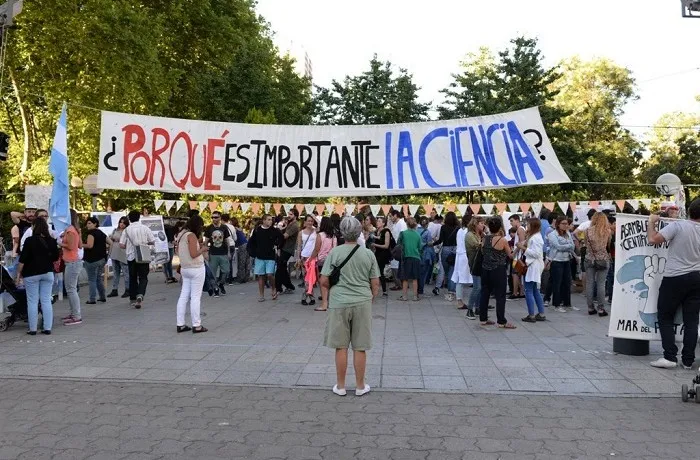
Reflections on statements by the Minister of Science in Argentina.

As several media outlets point out, Lino Barañao, Minister of Science and Technology, when asked about the cut in the number of new researchers entering CONICET, said: “there is no country with 30 percent poverty that is increasing the number of researchers as Argentina is doing” [1].
Beyond other aspects of the Minister's statements obtained by the press, I would like to stop and think about the phrase quoted above.
1-SCIENCE AND DEVELOPMENT
I want to tell a brief anecdote and a thought I had on the matter a couple of years ago when interviewing a renowned Argentine astronomer. I asked him why science was necessary. He replied (more or less) that the greater the investment in R&D, the greater the development of countries, as could be verified in the statistics of the so-called "first world" countries.
Although there is statistical corroboration, one might ask to what extent research in astronomy (black holes, galaxy mergers, the interstellar medium, binaries, variables, supernovae, etc.) could generate greater "development" in a country. One might ask what is called "development".
2-EXPENDITURE AND INVESTMENT
In previous statements, Minister Barañao indicated that for him science is an investment and not an expense [2].
Some time ago, for a March just before classes started, I heard in a television report a bookstore owner telling students' parents that even though the cost of school supplies was a bit more expensive than the previous year, education was an investment and not an expense.
From a semiotic point of view, all words admit several meanings. In no way will I say here that such a word means this and not that for capricious reasons.
However, in everyday speech, when we go shopping at the market, we say we "spend" money. On the other hand, a businessman who buys a stock on the stock market will say he is making an investment. It is difficult to find that in uses like these the verbs are used differently.
That is: supermarket->expenditure; stocks->investment.
No one will deny that if what we buy at the market is, for example, food, then we buy something that is NECESSARY, and that most people obtain the money by working.
On the other hand, when you buy a stock at $100 and sell it three months later when it is worth $150, you obtain a PROFIT of $50 WITHOUT WORKING.
No one will deny that the first is expenditure (the necessary, fruit of labor), just as no one will deny that the second is investment (the unnecessary, fruit of speculation).
Reality is more complex because we have all bought things that we later realized we did not need (waste); and there will be "investors" who buy stocks that do not go up, but down (bad investment).
Therefore, using the word "expenditure" only with a negative bias and the word "investment" only with a positive bias is questionable.
I will be told that the difference lies in the time that passes until the benefit is obtained: short for expenditure, long for investment.
Since in education and science the benefits are obtained in the long term, the preferential use of the term investment over expenditure could be justified. But it happens that this preference seems to be accompanied by a benevolent nuance, as if spending on what is necessary did not also justify it, and in the unreal abstraction that all investment is good (when it may not be).
However, how logical and necessary would it be to invest large sums of money to build spacecraft in a country with pockets of poverty?
Investing (spending in the long term) in something that is not necessary today and that perhaps (perhaps not) will be necessary in the future while not investing in what is necessary now, would that be a good or a bad investment? For the question not to be only abstract, we must recognize that there are other expenditures or investments that should also be considered.
Incidentally, as Barañao points out, science does not pay immediate dividends in any case because it requires work and takes time. Precisely because it is the fruit of labor and not stock market speculation, I would prefer to use the verb to spend rather than to invest.

3-SCIENCE OF POVERTY
But this puts us face to face, again, with the Minister's statements. In a country with 30% poor people, is it logical to do astronomy (to give an example)?
Does it make sense to increase the number of researchers?
As we see, the statement is abstract. Applied to concrete reality, we could say that it is justified to increase budgets and incomes of researchers to solve the causes of poverty.
Of course, for that, we would have to KNOW the causes of poverty and to know the causes, science is needed.
Since the new government took charge of the Executive and the National Institute of Statistics and Censuses (INDEC) and the poverty data were released, the political class and the pundits of the moment have been tearing their clothes over such a high number of poor people in Argentina (one third of the population).
But how to solve a problem whose causes are unknown?
Or perhaps we don't want to deal with the causes, but with the symptoms?
Palliative treatments are necessary. No one wants to suffer. But if all we do is give morphine to the sufferer and do not investigate and treat the causes, the pain will disappear for a while and will reappear as long as the causes persist.
4-DEVELOPMENT AND POVERTY
Abstract statements must become concrete, as glimpsed with those I cited in the second point. Greater investment in R&D, in what sense does it generate greater development?
Official incentives for several years to biotechnology applied, for example, to agrochemicals are aimed at greater food production that economically favors the few agricultural producers in obtaining greater dividends with less expense (and, apparently, with negative consequences for soils and the population as a result of excessive use of chemicals).
It is greater "development" for some. Precisely for this type of reasons there is poverty.
Having greater scientific knowledge to increase the quantity of cereals and oilseeds that will later be unaffordable for local consumers due to miserable wages, which includes over-exploited rural laborers, will be a greater macroeconomic "development," but it is precisely that economic connotation of science that separates the rich from the poor.
As if this weren't enough, not only are cuts to scientific research justified in the name of a poverty whose causes are not explained, but the payment of astronomical fortunes in external debt is endorsed (at least through inaction) with the sole purpose of returning to the financial markets to continue getting into debt.
This is not new. The previous government started a similar path (payment to the IMF, agreement with ICSID and the Paris Club) with the same objective, cut short by the famous Griesa ruling.
That is truly unacceptable in a country with so much poverty. As unacceptable as the devaluation of the currency and purchasing power, which is also not a procedure patented by the current government, but is systematic, which includes the previous government and the previous management of the same portfolio, in the hands of the same person.
5-SCIENCE AND WORK
How to create greater sources of employment should be the main scientific concern to solve the greatest scourge of the population (Argentine and global).
How to create decent sources of employment, for which one must be against all forms of precariousness like that carried out by the State itself in all its ministries, including that of science.
Above all, scientists are workers. But the issue does not begin and end with the amount of income, but includes the (not very transparent) entry mechanism; the lack of job stability-continuity; the precariousness of the fellowship system; and the lack of a comprehensive scientific policy that addresses not only the problems "of the country," but those of the workers.
On this point, I want to endorse the proposal made by a group about creating our own union, instead of being included in the unions of state employees [3].
With our own union, scientific researchers would have a better tool to actively oppose the different cuts and forms of precariousness that did not start now, but are the fruit of a continuity.
In another political scenario, something similar could have happened, with some slight quantitative difference. Perhaps the cut would have been somewhat smaller (in money and in the number of new entrants), but one cannot always be choosing the "lesser evil" because there will always be a greater evil to scare us.
It's about scientists taking the bull by the horns and making a qualitative leap that begins by understanding science in a different way. It is not enough to produce knowledge apart from its concrete applicability.
We have the necessary knowledge to avoid floods and anemias, but there are flooded and malnourished people. Faced with these evils that permanently plague the most humble, science workers must denounce the lack of concrete application in social reality of knowledge already produced. Hiding the numbers of the poor or artificially increasing economic "growth" is only an anti-scientific attitude.
Promoting (by action or inaction) a slight reduction in the income tax applied to salaries while maintaining that tax and when for a decade the opposite was done does not seem an attitude consistent with scientific thinking. Even less so when what is not discussed is the value-added tax, particularly on food and basic necessities.
There was a slight improvement in scientific salaries in these years, but it is hiding the Sun with one's hand to ignore the real and concrete fact that the enormous mass of wage earners in the country has incomes far below a basic family basket, added to galloping unemployment and a deepening of undignified work.
Therefore, we do not need a "science for the country," but a science for the workers, those in science and all others. A science against poverty is more jobs, not fewer.
Sources and related links
- [1] Barañao says they seek "a situation of equilibrium" in entry to Conicet
http://www.telam.com.ar/notas/201612/172741-baranao-conicet-ingreso-carrera-investigador.html - [2] Barañao: "The budget in technology is an investment, not an expense"
http://canal.la/23747-Baranao-El-presupuesto-en-tecnologia-es-una-inversion-no-un-gasto.html - [3] RyR: CONICET: An adjustment more than announced
http://razonyrevolucion.org/conicet-un-ajuste-mas-que-anunciado/
About the images
Initial image Instagram ConicetDialoga
Image 2 from http://www.bioeconomia.mincyt.gob.ar/del-laboratorio-al-mercado-2016/