The Planetarium invites you to a Master Class by Dr. Juan Carlos Forte, which will explain the complexity of globular clusters and dwarf galaxies, ancient systems that are key to Astronomy.
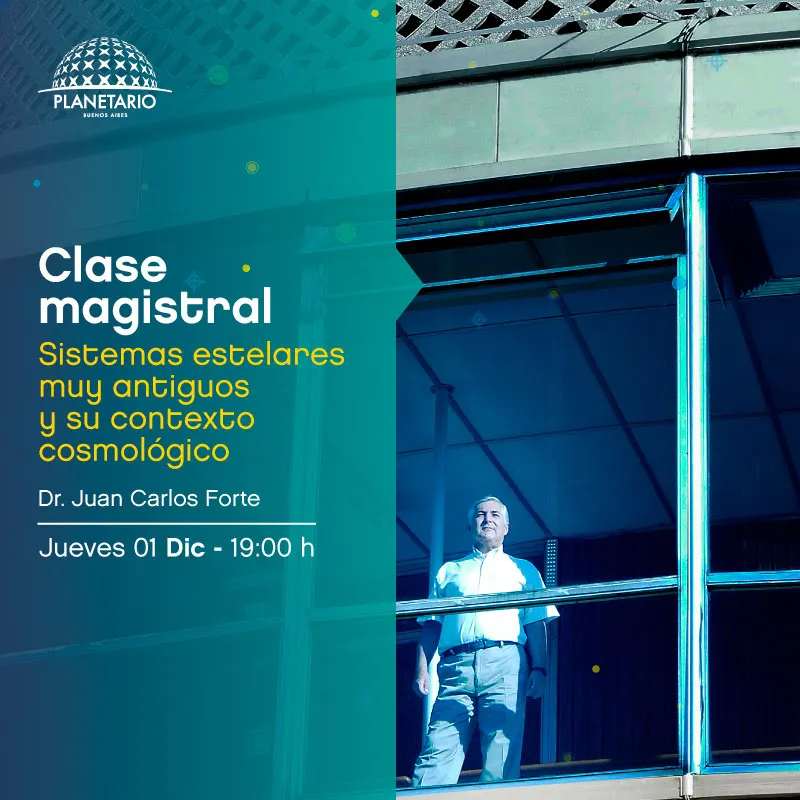
Next December 1 at 19h, the Planetario de la Ciudad de Buenos Aires Galileo Galilei presents one of its traditional Master Classes, which will be given by Dr. Juan Carlos Forte, former Dean of the Facultad de Ciencias Astronómicas y Geofísicas of the Universidad Nacional de la Plata, who will address complex, unexpected and poorly understood phenomena among the oldest objects in the Universe: globular clusters and dwarf galaxies.
This activity is part of the Master Class cycle where important figures in science –prestigious university professors and from national and foreign scientific institutions– present a topic of their specialty after a mini show of full dome images projected on the Planetarium's dome.
“The formation of the first stars and stellar systems in the earliest stages of the Universe and their effects on subsequent evolution are key points for Astronomy. Some of those systems have survived for about 12,000 million years and tell us part of what happened at that moment in history. Among them, globular clusters and some types of dwarf galaxies can be mentioned. They are often characterized as "fossils" and, for decades, have been identified as simple systems. Nothing could be further from the truth. The new observational capabilities rather indicate complex, unexpected and poorly understood phenomena. The presentation includes a review of those processes from both the galactic and extragalactic perspective.”
Dr. Juan Carlos Forte*
*Dr. Juan Carlos Forte holds a Doctorate in Astronomy from the Universidad Nacional de La Plata. He conducted postgraduate studies at the Kitt Peak National Observatory (Tucson, Arizona, USA) and specialized in the study of ancient stellar groups, formed in the first stages of the Universe. He served on numerous national and international scientific committees. He held various teaching positions at the UNLP, of which he became Dean of the Facultad de Ciencias Astronómicas y Geofísicas. He represented Argentina on the director team of the Gemini Project, through which two 8-meter diameter telescopes were installed. He received the Consagración award from the Academia Nacional de Ciencias de Buenos Aires, the Carlos Varsavsky award from the ANCEFN and the Gold Medal from the Asociación Argentina "Amigos de la Astronomía". The International Astronomical Union assigned his name to one of the asteroids discovered at the Estación de Altura U. Cesco (San Juan). He is a member of the Academia Nacional de Ciencias and the Academia Nacional de Ciencias de Buenos Aires. He is currently a Senior Researcher at CONICET with his workplace at the Planetario Galilei.
Planetarium Show Room / Free admission, no prior reservation required / Entry in order of arrival
Sources and related links
Planetario Galileo Galilei de la Ciudad de Buenos Aires http://www.planetario.gob.ar/