What the near 2017 will be like in astronomy and space sciences: eclipses, planetary events, mission launches.
Recently I saw the movie whose original title is Tomorrowland (The World of Tomorrow, Brad Bird, 2015), starring George Clooney. The actor's character, Frank Walter, says something similar to the title of this post.
Certainly, when I was a teenager, popular science magazines narrated through supposed gurus that in a few years there would be flying cars and that newspapers would be made of flexible digital tactile material. Oh, and that robots for performing household tasks would abound. Other types of predictions were that a permanent base would be established on the Moon and that space travel would be a common form of tourism.
Today, new gurus tell us what the future will be like, which professions will disappear and which will be created, they tell us that private cars and public transport will be autonomous and some of the failed predictions from 30 years ago are maintained.
There are, however, no fantastic mechanisms to predict the future, let alone with the supposed precision narrated in the Disney movie.
But we can know some things that will happen in 2017, some with great precision.
ECLIPSES
During 2017 there will be 4 eclipses, two of the moon and two of the Sun. On February 11 there will be a penumbral lunar eclipse visible almost all over the world, except Oceania. It will be between 22 and 02 (UTC time).
On August 7 there will be a total lunar eclipse that will not be visible in South America, although it will be partially visible in some countries like Colombia and Venezuela and Central and North America.
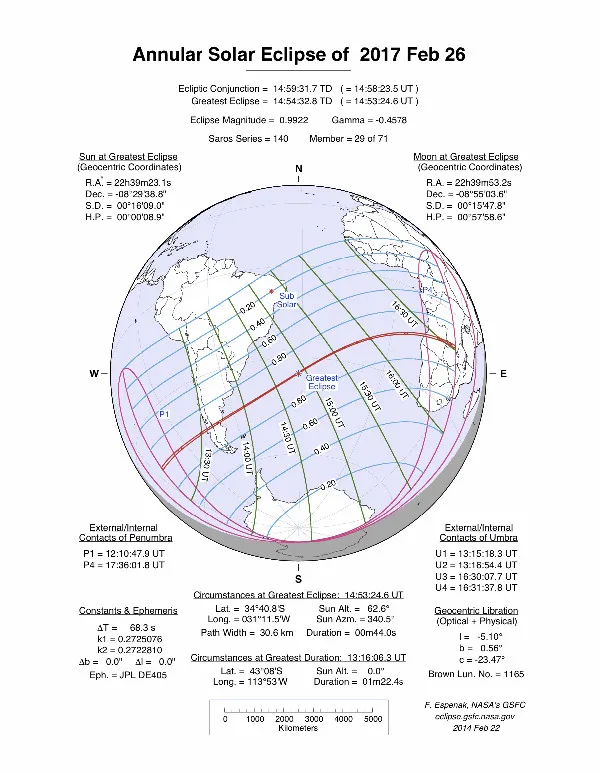
On February 26 there will be an annular solar eclipse between 13 and 16 (UTC) partially visible from southern Argentina and Chile. For that date, the Second Workshop on Dissemination and Teaching of Astronomy will be held in Esquel, Chubut, from February 22 to 26, 2017. See http://sion.frm.utn.edu.ar/WDEAII/
On August 21 there will be a total solar eclipse visible almost exclusively in the USA.
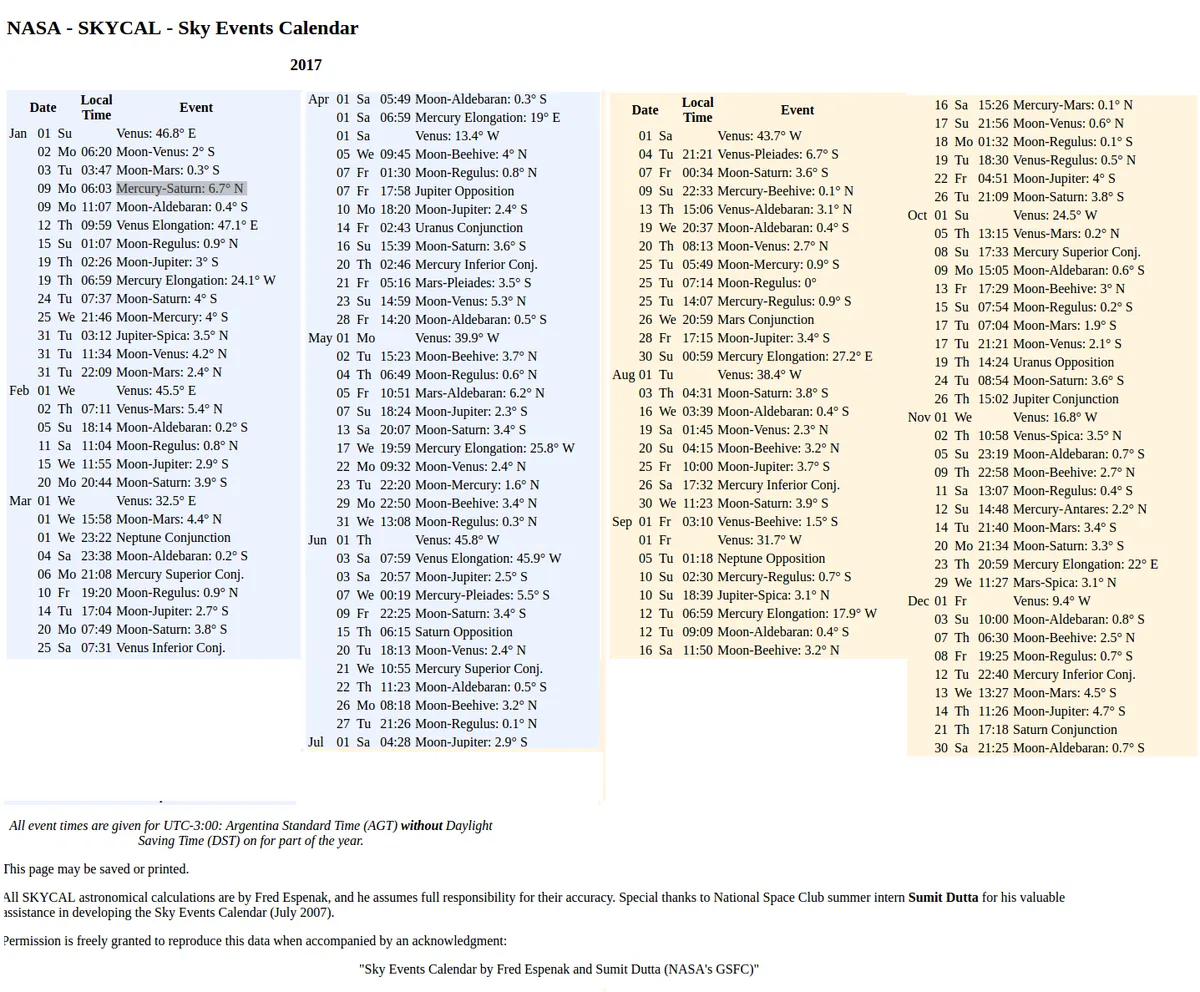
There will be no transits of Mercury or Venus. For the former we can expect one in 2019, for the latter we will have to wait a century. Some of the apparent encounters between the moon and the planets can be seen in this image with hourly data in UTC -3.
FLY-BY AND BYE BYE OF CASSINI
NASA's great Cassini spacecraft will have its final orbits which can be seen in this animation:
The orbits in green seen from the beginning of the animation represent the F-ring orbits that Cassini is completing in the period November 2016 - April 2017. During these 20 orbits, the spacecraft will approach the outskirts of Saturn's main rings.
The orbits in blue represent the "Grand Finale" that will take place between April and September 2017, leading the spacecraft to its mission end, plunging into the gas giant's atmosphere on September 15.
The bottom part of the animated image shows a graph with Cassini's distance to its point of closest approach to the planet, which changes several times during the course of the Grand Finale as NASA engineers call the culmination of the mission. The orange circle represents Titan's orbit.
SPACE TELESCOPES
TESS (Transiting Exoplanet Survey Satellite) is a telescope to search for exoplanets scheduled for launch in December 2017. Like any launch, it can be postponed.
ESA, the European agency, plans to launch CHEOPS (CHaracterising ExOPlanet Satellite) to analyze stars around which planets are already known to exist. The mission is also planned to be launched from Kourou in late 2017.
HERE COME THE CHINESE
We'll have to see how communicators manage to pronounce Chang'e 5, China's unmanned mission to the Moon to bring back samples, scheduled for launch in the second part of the year. It will have been 40 years since such a mission was carried out, like the USSR's Luna 24 in 1976.
HERE COME THE INDIANS
Chandrayaan-2 will be India's second lunar mission. Unlike the previous one, it will bring back samples of material and will roll a rover on the surface of the satellite. It had been considered for launch in 2017, but according to recent statements by the director of ISRO (Indian Space Research Organisation) it would be in 2018.
WILL THERE BE MORE STILL?
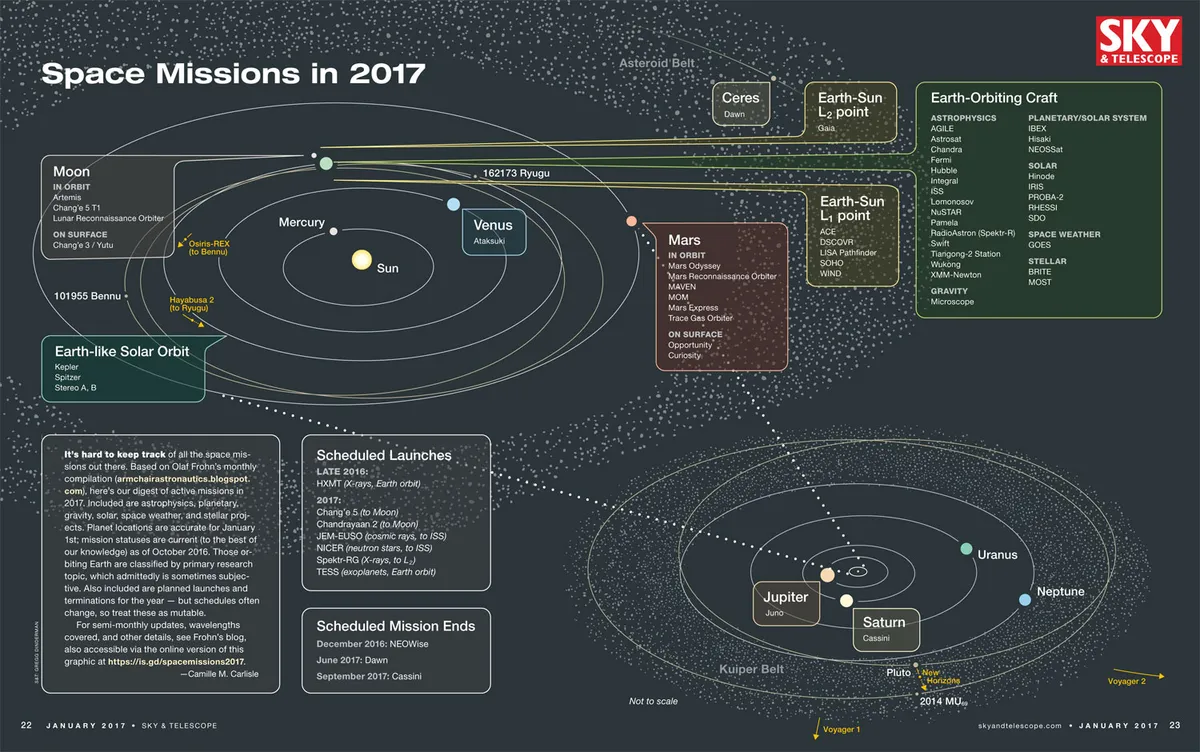
Yes, there will be other launches and scientific missions and tests. Sometimes it's hard to keep track of every mission. There are two sources of information worth considering. The blog armchairastronautics.blogspot.com provides valuable content. Based on that source, Sky and Telescope magazine made an infographic with active and new missions in 2017.
The image can be seen on the magazine's website:
http://www.skyandtelescope.com/sky-and-telescope-magazine/active-space-missions-2017
NUMERICAL CURIOSITIES
2017 is 11111100001 in binary, 7e1 in hexadecimal. It is a prime number therefore it is not a perfect number (it is not the sum of its proper divisors), that is, it is not friendly with itself.
Numbers do not have special or universal meanings, in any case, numbers are signs and can have as many meanings as other signs have.
If I could share a wish, I wouldn't be as optimistic as the girl in Tomorrowland, but I would be in another way. I would say that I hope 2017 finds us as friends of ourselves and that we are not permanently orbiting around others.
Health and good life for all!
Let's avoid the use of fireworks at parties.
COMMENT ON THE POST TITLE
Yesterday someone wrote to me saying that according to the first paragraphs of the text, the title should be reversed, since I say (and that person agrees) that predictions of the future now are very similar to those made decades ago.
It's a very good observation.
The title, however, was chosen with caution and must be maintained for reasons that are not "inside" the text: it is a relation to what is narrated in the movie cited at the beginning. I will explain:
The narrative core of the film is that adults have a dystopian view of the future, whether through novels or through data from concrete reality. The protagonist girl, Casey, persistently asks herself: Can it be fixed?
And although the brightest minds gave up considering that the end of the world is inevitable (they know the day and hour of the global cataclysm), the girl -pushed by her optimism and persistence- manages to change that future that seemed unchangeable. That is to say, that the future depends on us, in spite of everything. And, therefore, the (final) future is not what it was (predicted), since it could be changed. Of course, to do so, one must think and act differently.
Tomorrowland is a movie for young people (because it's Disney and has two young protagonists), but I think the message is valid for everyone. Casey, on the other hand, is the daughter of a NASA engineer who is about to lose his job due to the dismantling of Cape Canaveral. And the girl, who knows how to recognize the brightest stars in the sky, wonders at the beginning, what those stars would be like if she could go there. Someone tells her that perhaps there is nothing there. And she wonders: what if everything exists?
Sometimes science fiction movies allow us to reflect deeply on the current world.
Sources and related links
- NASA ECLIPSE
https://eclipse.gsfc.nasa.gov/solar.html - Cassini's Final Orbits
https://saturn.jpl.nasa.gov/resources/7365/ - NASA TESS
https://tess.gsfc.nasa.gov/launch.html - ESA CHEOPS
http://sci.esa.int/cheops/54321-cheops-exoplanet-mission-meets-key-milestones-en-route-to-2017-launch/ - ISRO CHANDRAYAAN 2
http://www.isro.gov.in/chandrayaan-2 - SKY AND TELESCOPE
http://www.skyandtelescope.com/sky-and-telescope-magazine/active-space-missions-2017/
About the images
Fred Espenak, NASA/GSFC Emeritus
NASA/JPL-Caltech
© 2016 Sky & Telescope