The agency shares its best images through Pinterest and GIPHY.
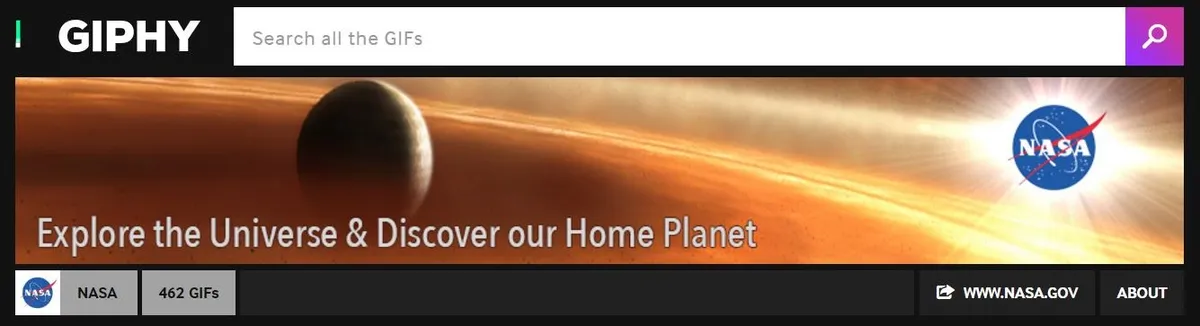
Last week NASA announced a partnership with GIPHY, the site for sharing animated GIFs.
The announcement reminded that the agency shares its images and videos as "pins" on Pinterest.
The Eternal Return of GIFs
GIF files have been used for a long time. In the dawn of the internet it was very common to see files of this format, whose name means "Graphics Interchange Format". The format was created by Compuserve in 1987. GIFs were frequently used both for "animated" images and for images with a transparent background. For the latter, the use of the PNG format, which is more efficient, is now more common.
Those with a few gray hairs will remember that a couple of decades ago, the "under construction" pages of websites often contained an animated GIF to indicate the temporary status of the content.
GIFs also began to be used as banners for advertising, now replaced by flash.
Compressed images in apparent motion that could have a finite or infinite loop could replace a video sequence.
Nowadays GIFs have come back into use, especially in memes, that is, for humorous purposes (satirical or ironic).
And there is a tendency to consider that in an increasingly audiovisual society, GIFs and emojis will replace text.
COMMUNICATION IN MOTION
GIFs are neither inherently good nor bad. It depends on how they are used. They can be an excellent complement to a written text that attempts to describe an emotion. From a linguistic point of view, it is an audiovisual ellipsis.
But they can also be very didactic for conveying motion, particularly in astronomy.
NASA has been using GIFs for multiple purposes, including the didactic one. An example is the use of a GIF to explain what the launch window for a spacecraft traveling to Mars would be like. As we will see, the image says many things that would be difficult to say with words alone, but the image is a complement to a text.
The Giphy has a link to the JPL page where the matter is explained primarily using words (in English).
http://www.jpl.nasa.gov/edu/teach/activity/lets-go-to-mars-calculating-launch-windows/
THE EVOLUTION OF THE GIF
Perhaps in the near future, NASA and other agencies will also join a new trend that could be thought of as an evolution of the animated GIF: the Cinemagraph.
A Cinemagraph is like a GIF in which only one part is animated. In other cases, they are small time-lapses. For now, it is considered an "artistic GIF".
Perhaps this is the future of the animated GIF and NASA will also get on that train. And maybe it will also endorse the formal proposal presented in Nature to create a package of science emojis (see below) that, I hope, does not have scissors (or has crossed-out scissors)!
Sources and related links
- NYT: One Small Step for NASA, One Giant Leap for GIFs, by JONAH ENGEL BROMWICH
http://www.nytimes.com/2016/12/14/science/nasa-giphy.html - NASA Shares the Universe on Pinterest and GIPHY
https://www.nasa.gov/press-release/nasa-shares-the-universe-on-pinterest-and-giphy - NASA Giphy: http://giphy.com/nasa
NASA Pinterest: https://www.pinterest.com/nasa - Nature: I can haz more science emoji? Host of nerd icons proposed
Katherine Bourzac
Nature 539, 341 (17 November 2016) doi:10.1038/nature.2016.20960
http://www.nature.com/news/i-can-haz-more-science-emoji-host-of-nerd-icons-proposed-1.20960
About the images
Stars and Aurora Borealis from the ISS armanddijcks https://flixel.com/cinemagraph/ypy8bw9fgw1zv2b4htp2/