Since September, El Mostrador has been publishing a Spanish-language astronomy outreach comic.

On September 7, the Chilean site El Mostrador announced that starting the following Saturday, an astronomy outreach comic strip created by Italian astronomer Angelo Adamo would be published. That note indicated that the management of this publication has been possible thanks to the Millennium Institute of Astrophysics (MAS), directed by also astronomer Manuela Zoccali, and funding from the Millennium Science Initiative.
From that note, I extract some paragraphs:
In his comics, Adamo explains the physics of celestial bodies to readers in a simple way, through simple examples, like a cigarette butt or the practice of skating, but he also includes formulas to challenge the reader's intelligence.
"In this case then I decided to try a proposal that requires active rather than passive participation: for example, I hope that some of my readers decide to get involved and try, together with Tomás, some simple calculations with pencil, paper and calculator," he explains.
"I wanted to show that I trust the reader's intelligence, and I want to invite them to make a small effort, to thus discover that it is possible to push oneself a little more, and discover that they can understand more than they themselves suspected," he states.
For Zoccali, the goal is "that ordinary people, and particularly teenagers, understand that the physical laws that explain the properties of celestial objects are not the result of black magic, accessible only to a few experts, but can be understood, or at least intuited, by anyone, because something similar happens in real life."
I invite readers to read the full introductory note to learn more about the author and the initiative.
AN ANALYSIS
Since then, 6 strips have been published with the following themes:
1-Escape velocity
2-Black holes: Can light escape?
3-Dogs in orbit: why planets are spherical
4-The smoking sun: difference between inner and outer planets
5-The pressure of gravity
6-Hydrostatic equilibrium
First, the subjective: I am not a youngster, the audience that seems to be the main (though not only) target of the strip, and therefore I don't know by what criteria the strips are evaluated. Personally, I don't find the drawings very attractive, but beyond the style of the stroke, I think what's missing is color. In a comic, color is important. Readers will notice that there is color in the initial title of the strip and with color something is "said": the letters MAS are colored, not the rest. Evidently, it's because of the participation of MAS, the Millennium Institute of Astrophysics.
The strip has two main characters: Tomás, the student, and the teacher, whose name is unknown so far. The teacher is somewhat eccentric or, to put it another way, uses somewhat heterodox analogies, like lighting a cigarette, even though his attire is the complete opposite, rather orthodox, with his bow tie and suit.

Already in the first strip, Adamo uses some formulas for escape velocity. I have no problem with the use of formulas in the sense indicated in the introductory note. However, the use of such formulas implies assumptions about the level of knowledge of the audience one wants to reach.
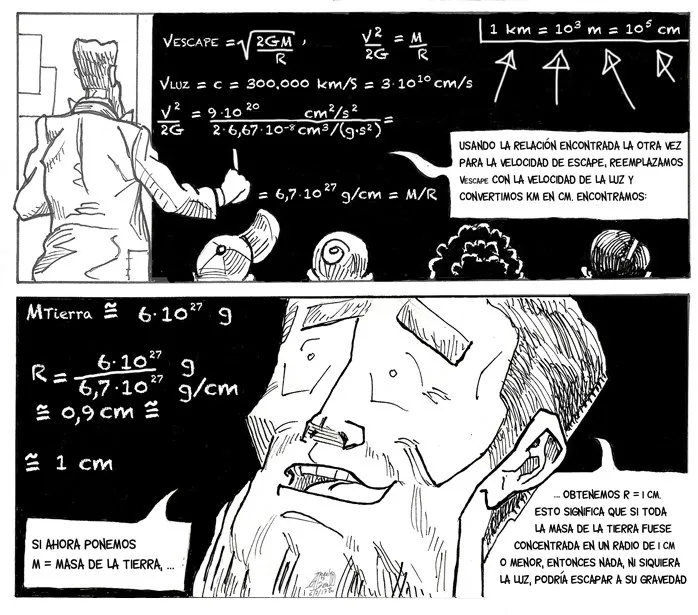
I think it's very good to encourage readers to do calculations, but unfortunately reality shows not only apathy, but basic ignorance, so I wouldn't start from so many assumptions. It is precisely for that reason that outreach is needed, that is, to tell things in a different way, more attractive and less repulsive for the "student readers."
In the fifth strip "Pain, discomfort, heat, stench, pressure" ρ, the Greek letter rho, is used, which is very similar to a P.
Scientists are used to this, and with some clarification the ambiguity could be overcome, but without clarifications it could be confusing.
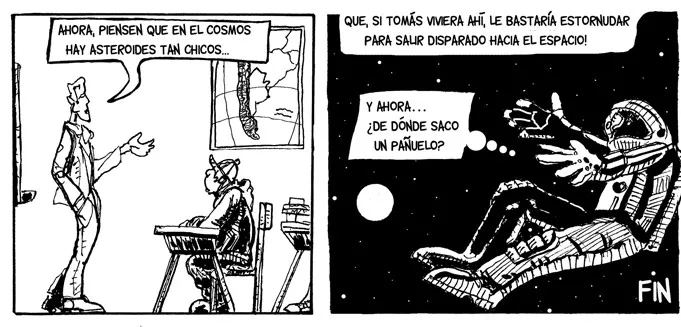
On the other hand, a comic in magazine form requires telling a story, while in the form of strips published in newspapers or magazines at a certain frequency, they are usually associated with a joke or reflection, although in several cases they also tell a story that continues from issue to issue, as happens with Altuna in Clarín. In the first two strips of Tomás, there is a bit of a "gag" at the end, but then that disappeared.
Conclusion
It is hasty to draw conclusions. Every project is built in a process and it is to be expected that these six strips are only the beginning. The project is justified by the need to transmit knowledge in different ways, more attractive to other audiences. It would then be appropriate to choose methods different from the traditional ones. In the strip, there are some different elements, in fact the comic itself is already a different mode, but not so much in that there is a teacher, students, in an educational context where the students listen and the teacher imparts.
He uses the blackboard and writes formulas assuming they know how to solve for variables and understand them from the knowledge in mathematics obtained in another subject with another teacher. That is, the strip repeats what happens in the school environment. If such a context were sufficiently good, outreach would not be necessary.
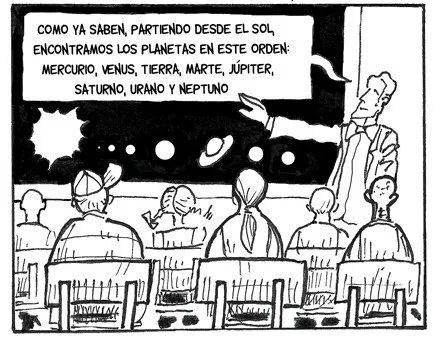
It is very good not to underestimate the readers, but it would be appropriate to better define then who the target audience is. If the goal is to reach an audience that has some basic knowledge in mathematics, but with many problems, even in simple matters like solving an equation, converting units of measurement, etc., then help should be provided so that this can be understood.
Perhaps one should seek to first understand the concept and then, perhaps in the next strip, translate the theoretical concept into numbers and equations, helping in that process.
Some suggestions occur to me, keeping the essentials: that teachers and students leave the classroom; that students ask questions; that some topic be addressed starting from recent news like a discovery.
For example: if someone asks why the Hubble Space Telescope isn't pointed at the Moon to look for the US flag or the buggy they took on the Apollo missions, one could answer that it makes no sense because the instrument's resolution wouldn't allow it to 'resolve' objects of that size at the given distance. This can first be explained with examples from everyday life, without using formulas. And then yes, move on to the numbers to make clear the scale we're talking about, in particular to compare why Hubble can resolve galaxies (at a much greater distance, but also much, much larger). The concept of angular size in astronomy is very commonly used.
If the scenes take place in a high school and the protagonist is a student between 13 and 18 years old, one would expect him to have a girlfriend, to like a girl, or at least a classmate who knows as much or more than Tomás. In the second strip, a girl appears and in a small panel of the vignette they are seen holding hands. Greater participation from the girl could be interesting.
What I think is usually sought in a comic is fantasy, and I don't think fantasizing about school is very interesting. Perhaps the students and teacher should embark on a journey.
I think adding color could help make the strip more attractive. Perhaps black and white is part of the style Adamo feels comfortable with. Some illustrators delegate to colorists to paint their works.
In any case, the initiative is valuable and I hope it has continuity. As with anything else, it would be worth evaluating whether these initiatives meet their objectives in the long term.
Beyond the strip's potential for the general public, I think it could be a source of inspiration for high school teachers and supporting material in subjects like physics.
Finally, it's not insignificant to mention the small number of resources of this kind in Spanish, despite the fact that in recent years scientific outreach in general and astronomy in particular has increased. Plays, YouTubers, TV programs, blogs, books collaborate with the goal of reaching different audiences with different predispositions and knowledge. The comic is a genre that yesterday and today attracts audiences eager for stories.
Welcome then to Tomás and Adamo to the world of astronomy outreach in Spanish.
Note: the strips can be read by accessing the El Mostrador website, culture section. On Saturdays, when it is published, there is a link on the homepage. An easy way to access it at any time is through the author's tag: http://www.elmostrador.cl/autor/angeloadamo/
Sources and related links
- The cigarette and the girl on roller skates to explain the laws of physics: the science comic for adults and kids arrives
http://www.elmostrador.cl/cultura/2017/09/07/el-cigarrillo-y-la-chica-en-patines-para-explicar-las-leyes-de-la-fisica-llega-el-comic-sobre-ciencia-para-grandes-y-chicos/ - Instituto Milenio de Astrofísica
http://www.astrofisicamas.cl/
About the images
The images are extracts from the online strip and the credits belong to Adamo/El Mostrador.