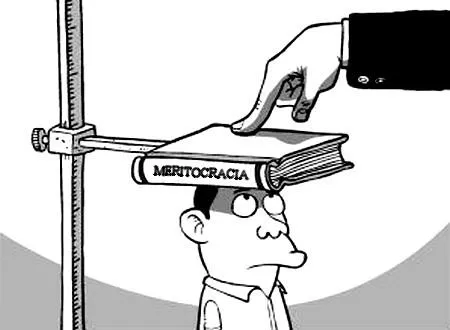
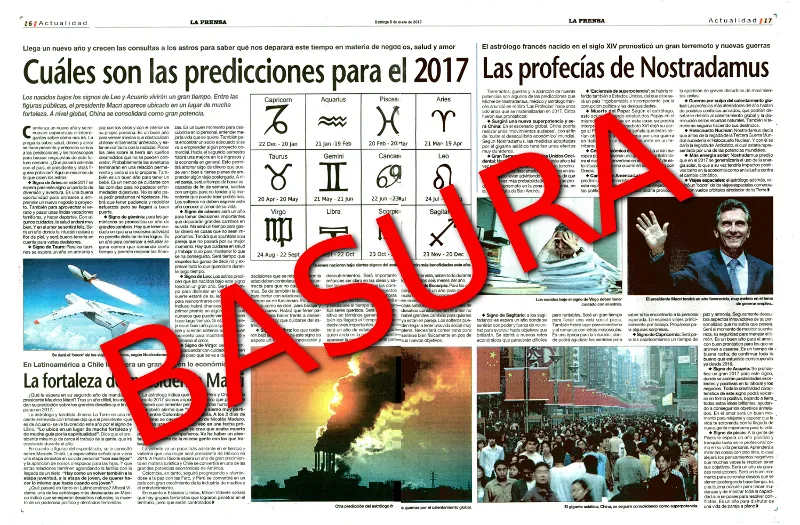
I will use a modified version of the concept of "post-truth" to evaluate two aspects of public discourses related to knowledge.
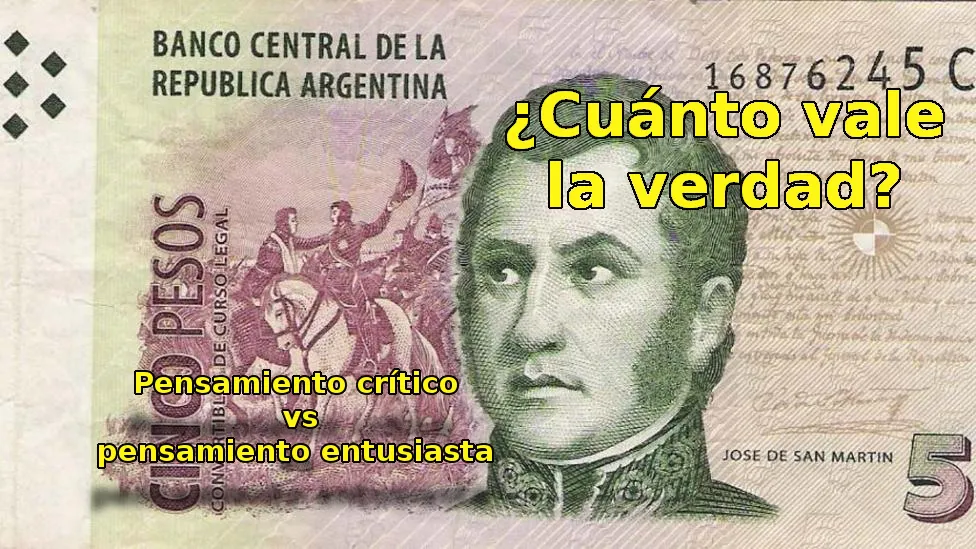
At this time of year, Argentines and Chileans are commemorating the bicentennial of San Martín's crossing of the Andes.
Is it true that San Martín crossed the Andes?
Apparently most people think so.
How did we come to DECIDE that this statement is true?
I am going to propose a thesis that would explain how we make decisions about whether a statement is true or not. But first, a reflection on the concept of "post-truth."
At the end of last year, the Spanish newspaper El País reported on the addition to the Oxford Dictionary of what was considered the word of the year, the English neologism post-truth. According to the newspaper, the word "denotes circumstances in which objective facts are less influential in shaping public opinion than appeals to emotion and personal belief" [1].
In an earlier article from the same outlet, it indicated when the term would have been used for the first time [2]. The note on the Grist site, written by David Roberts, has a revealing aspect when one wonders why the term includes a prefix that means "after." After what?
The writer argues that, contrary to what is usually said, voters generally do not know much about politics and laws, although there are things they do know a lot about (the American Idol program, sports teams, etc.).
Conversely, it is often postulated that voters gather data, draw conclusions from it, form positions on issues based on the conclusions, and choose a party that shares those positions.
This methodology would be the idealized vision of the Enlightenment.
So it is not far-fetched to think of it this way: During the Ancien Régime (Feudalism) thought was darkened, but then Greek traditions were recovered with the Enlightenment, which also brought modern scientific thought linked to empirical verification. This "modern truth" has been followed by this other "post-modern" form and hence it is indicated as "post-truth."
However, this other form does not seem very new, but rather similar to the dark medieval legacy.
Let us say, in passing, that I do not entirely agree with the idea that the Middle Ages were a "dark age." At least in the arts, it has been a prolific and valuable period.
Perhaps, instead of post-truth, we should think of it as pre-truth, a truth backwards, a regression and not a progress that surpasses the previous one.
Despite this, I will use the term to formulate an idea and contrast it with two examples.
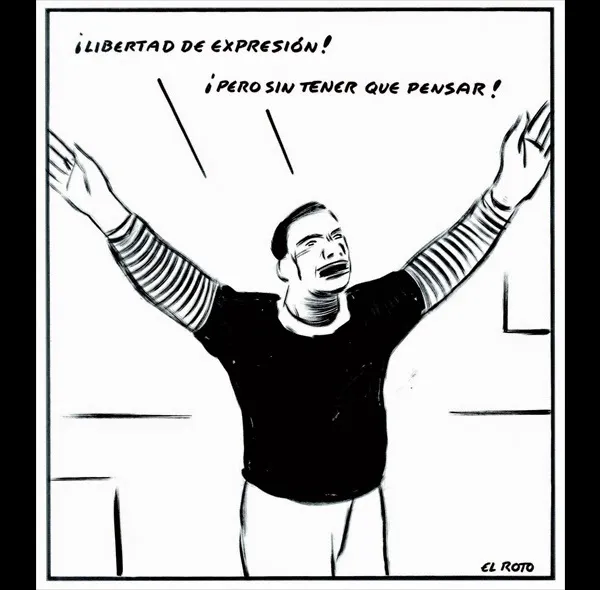
POST-TRUTH AND EVERYDAY LIFE
The pending question is how we, in our daily lives, decide which statement is true and which is not.
I postulate that we do this:
1-If the sender of the statement is trustworthy to us, we accept the assertion.
2-If there are no other senders in the social semiosis (the network of shared discourses) who say the opposite, then we accept the statement more.
3-From the above, we decide to accept or deny a "belief."
Do we know that the Sanmartinian feat is true?
No, we only believe it.
Am I saying it is false?
No, I am saying that the vast, enormous majority of us have not reached the conclusion that it is true through scientific thinking, but only through the three-point method described above, which is actually a decision of blind belief.
That this is the case is easy to corroborate: ask any Argentine what evidence they KNOW that indicates that the Father of the Country actually crossed the Andes. There will be no answers.
We are not taught in school what the historical documents are that support the statement, we are taught a story and we believe it unquestioningly.
I am not making a value judgment or questioning anything (for now), but a description.
That this is the chosen methodology for "believing" what is true or false is verified in another case: The arrival of man on the Moon.
Many people "reason" like this:
1-The U.S. says it has reached the Moon 6 times, but the USA is not a trustworthy country.
2-Many people say the opposite of the USA and they seem to be people who know.
3-Therefore, I do not believe what the USA says.
In this method, EVIDENCE matters ABSOLUTELY NOTHING.
But this is not entirely true. Evidence is taken into account, in a biased way, AFTER having decided on a truth. What we do then is accommodate a part of the evidence, the one that favors our point of view, to reinforce the belief. And we discard the rest of the evidence, ignoring it.
For example, there are those who -in line with New Age currents- postulate that when the human being evolves spiritually, they will be able to pass through walls, based on Heisenberg's Uncertainty Principle and the atomic model -which indicates that most of an atom's nucleus is empty space. They take a part of the scientific discourse, manipulating it as they like best (distortion) and omitting another part that contradicts them (the Pauli exclusion principle) [3].
We all do this. Think about how you decide what you consider true or false in your daily life. Scientists also do this in their daily lives, but not in their specific work task. That is called scientific work and although it is typical of such people-workers, it is not exclusive.
Any of us, depending on the degree of knowledge, can make use of scientific knowledge to know if something is true or false, in a qualitatively different way than we do in daily life.
In fact, it is also something we do when we are unjustly accused of something. In those cases, we demand evidence and we huddle in the principle of innocence.
But we do this for ourselves, although not for others, and we demand that someone suspected of something be imprisoned without wasting time, even if we do not know if they are guilty and conveniently forgetting the principle of innocence. Choosing that someone is guilty because we feel it is not the same as knowing, through evidence, that they are.
It is like the old case of the big-eared short guy [4]. If someone has a good face, we trust them; if they have a thief's face, we distrust them. We vote for some because they are charismatic, others not, because they are boring. We believe everything from some; we want to put the others in jail.
We do this until we are victims of this nefarious mechanism of thought.
We act like the witch hunters of old, relying on our subjectivist perception of whether a woman is strange or has a mole, then... to the stake!
If we were consistent and ALWAYS used this procedure, no one would be left on the face of the Earth.
SCIENTIFIC TRUTH
It is often said that science does not seek to know the truth, but is a social practice through which we try to get closer and closer to how reality works. And we do this despite making mistakes because it is preferable to being guided only by personal emotions or "intuition."
Historians do science. They are the ones who evaluate the evidence (documents of different kinds) to determine if what is said to have happened is true and how. We can trust historians and that is effectively what we do, since we divide the tasks: scientists evaluate reality empirically and logically, the rest of us collaborate in other ways, producing goods and services.
But this does not mean we should trust blindly. We don't do it when we go to the dentist or the doctor and notice signs that something is wrong.
Although for ordinary people evaluating evidence can be difficult, among other things because in many cases those proofs are fragile documents kept carefully and with restricted access, at least in a limited way we can do something more than just blindly "believe."
We can, if we have genuine interest, read a lot of what has been published, compare it, learn what the evidence is that historians say they evaluate, where it was found and who keeps it, etc.
If we do that, we WILL KNOW that the feat of San Martín and his army was immense. It is not the same as what we currently believe in ordinary life. Today we believe a little story. But if we do what is suggested, and we reach that great conclusion on our own, we will have taken a giant step.
This is, in short, critical thinking. Instead of taking for granted what we are taught or our particular experience of reality, we must ask ourselves if the ideas we form, whether by inheritance or personal praxis, are true.
But it seems there are still many people who fear critical thinking. Could it be that these "enthusiasts" are in favor of dogmas? [5]
It is important to note that the statement "San Martín crossed the Andes" will be a dogma (even if it is true) if we repeat it like parrots. We are not birds, in the first place, and on the other hand, if we wanted to have the apparent freedom of animals that fly, we must break with the chains of imperative statements, those that must be accepted or accepted. Only with critical thinking could we approach a notion of freedom. Like the one the hero wanted printed on a modest and devalued 5 Argentine peso bill.
Sources and related links
- [1]. ‘Post-truth’, word of the year
http://internacional.elpais.com/internacional/2016/11/16/actualidad/1479316268_308549.html - [2] The era of post-truth politics
http://elpais.com/elpais/2016/09/23/opinion/1474647422_293415.html - Post-truth politics
http://grist.org/article/2010-03-30-post-truth-politics/ - [3] THE WANTING AND NOT BEING ABLE TO WALK THROUGH A WALL
http://laverdadestaahifueraono.blogspot.com.ar/2009/01/el-querer-y-no-puedo-de-atravesar-una.html - [4] El Petiso orejudo on Wikipedia
https://es.wikipedia.org/wiki/El_Petiso_Orejudo
[5] In line with Peña, the PRO advisor for the enthusiasm seminars stated that "critical thinking is a negative value"
About the images
Initial image: Salta Diario http://www.saltadiario.com.ar/?p=4654
Image 2: Blog de Amparo Sampedro: Posverdad?… well, yes.
https://amparosampedro.wordpress.com/2017/01/16/posverdad-pues-si/
Credit: El roto (http://www.elroto-rabago.com/)