Several estimates of the galaxy's mass have already been made. Some of the latest ones indicate it would be less than previously suspected. What does the problem consist of?
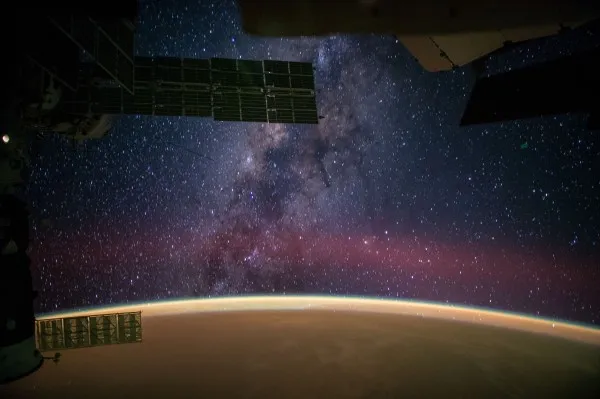
In astronomy, you cannot count. Counting stars, for example, to know the total of the galaxy or a cluster, is simply impossible. Therefore, professional astronomers must calculate the data, based on previous determinations and using inference transformed into mathematical methods and computer use.
This is an aspect of sciences in general (notable in astronomy for the values used, be it for distances or sizes) that some of us -amateurs- are dazzled by in the work of professional researchers.
As we should already know, the mass of an object is not its weight. In our daily lives we use both terms as synonyms. A more scientific approximation would be to consider mass as the amount of matter in an object, while weight is the relationship between that value and the gravity of the place. Hence, a person's weight is different on different planets even though the subject's mass (their matter) does not change. We call "matter" everything that occupies a place, has energy and changes (that is, everything known).
In the particular case of galaxies, estimating their mass has several complications: since the recently deceased Vera Rubin detected an incongruity between Newton's theory and certain galaxies to date, astronomers consider that there must be a type of matter that does not interact electromagnetically (does not shine) but does gravitationally: dark matter.
And since such matter would be the main mass component of the Galaxy, estimating the total mass is quite a challenge.
As if that were not enough, the methods developed until now used what are known as "tracer objects" which can be: complete or incomplete. In the first case, the proper motions are known, while in the second, only the line-of-sight velocities are known, that is, the proper motions are not known.
In 2010 Watkins and others developed separate mass estimators for both cases and then combined them.
To get an idea of the importance of the matter, here is a graph summarizing the different methods used by different groups with various results [1].
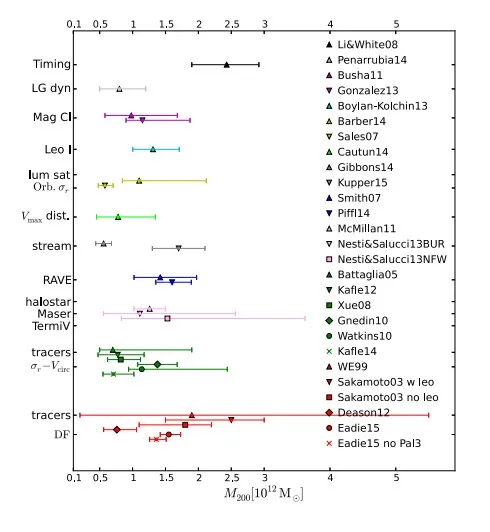
In this case, Gwendolyn Eadie, Aaron Springford and William Harris (all three at Canadian universities), used the distribution function and data from satellite objects like globular clusters to calculate the galaxy's gravitational potential, incorporating complete and incomplete data. The result implies a mass within 125kpc of 4.81 x 10^11 Solar Masses (Ms) [2].
Since 1 Ms is the mass of our sun, the Milky Way equals 480,000,000,000 (480 billion) suns like our star. Consider that the number increases if the "virial radius" [3] is considered, to about 6.14 x 10^11 Ms (600 billion).
If 1 Ms is 1.98 x 10^30 kg, then the galaxy's mass would be 9.5 x 10^41 kg and therefore it would be:
9 500 000 (5)
000 000 (11)
000 000 (17)
000 000 (23)
000 000 (29)
000 000 (35)
000 000 (41)
that is 9.5 million million million million million million million kilograms, almost 9.5 septillion kg!! (if my conversion doesn't fail me).
AND WHAT IS THIS FOR?
The astronomer has been researching these methods since her thesis in 2013. Eadie's result is lower than other estimates. Therefore, it is a result that has been changing and it is logical to expect that somewhat larger or smaller estimates will continue to be published in the future.
The usefulness of particular results will depend on their level of reliability and this is achieved by improving the methods and comparing them. The mass of the Milky Way can serve as a comparison with other galaxies, as well as to investigate the interaction with satellite galaxies or M31.
I also think it serves, at a popularization level, to understand that scientific work requires a significant level of theoretical-mathematical knowledge and, fundamentally, to understand something key in science: how can we approach complex knowledge with incomplete data? Isn't it admirable that beings so fragile and imperfect can aspire to know what seems impossible? In short, that is science: an approximation to reality. No more, no less.
Sources and related links
- [1] Estimating the dark matter halo mass of our Milky Way using
dynamical tracers
Wang et al (2015)
arXiv:1502.03477 [astro-ph.GA]
https://arxiv.org/abs/1502.03477 - [2] Bayesian Mass Estimates of the Milky Way: Including measurement uncertainties with hierarchical Bayes
Eadie et al (2016)
arXiv:1609.06304 [astro-ph.GA]
https://arxiv.org/abs/1609.06304 - [3] Virial mass on English Wikipedia
https://en.wikipedia.org/wiki/Virial_mass - Gwendolyn Eadie
http://www.physics.mcmaster.ca/~eadiegm/intro.html - NYT: Absolutely Every Bit of Our Galaxy, by NICHOLAS BAKALAR
https://www.nytimes.com/2017/01/16/science/milky-way-galaxy-mass.html - The Milky Way is lighter than we thought
http://www.ngenespanol.com/ciencia/el-espacio/16/06/1/explicacion-sobre-la-galaxia-estrellas-via-lactea/
About the images
Initial image
Credit: NASA/Reid Wiseman https://www.nasa.gov/content/milky-way-viewed-from-the-international-space-station
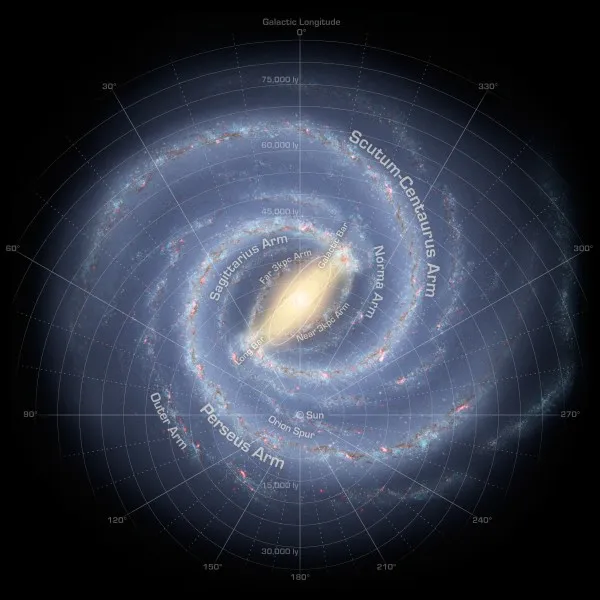
Galaxy map
Credits: NASA/JPL-Caltech/R. Hurt (SSC/Caltech)
https://www.nasa.gov/jpl/charting-the-milky-way-from-the-inside-out
Methods graph
Wang et al (2015)