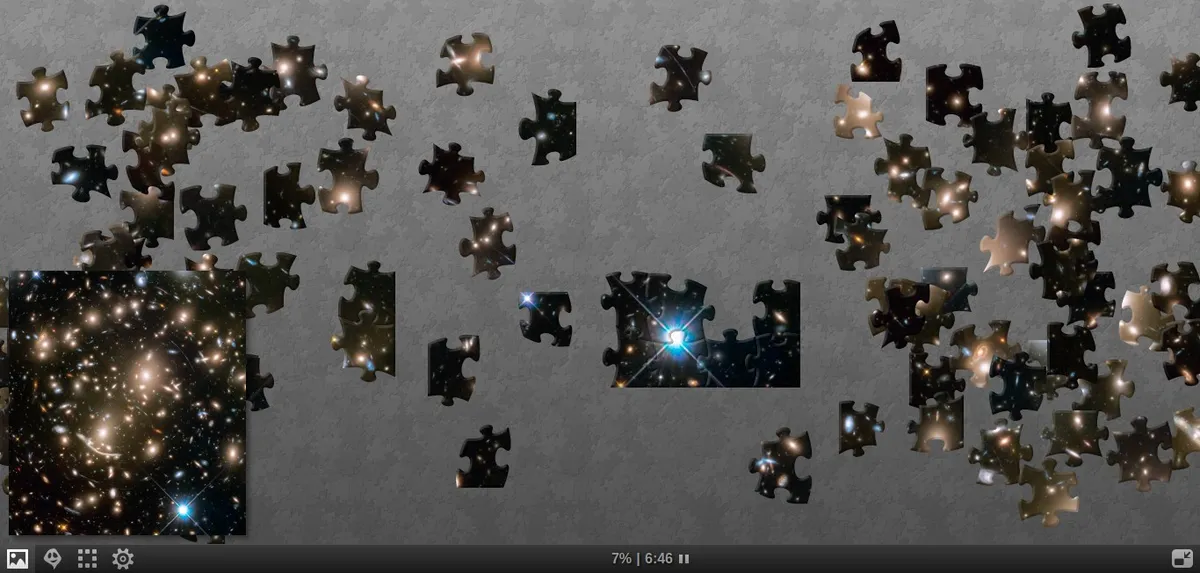
Can maps tell us what unexplored territories are like?
When we say that reality is deceptive, it may seem that we think the universe is intelligent, conscious, and intentional and deceives us for some twisted reason. It's not like that, although it seems so.
It happens that our brains evolved to work well for the everyday survival activities in relation to the stimuli received. But we want to use those abilities to understand what the universe is.
And by doing so, kaboom!, we get the big surprise. Everything seems twisted, for example, in the well-known gravitational lensing effect which is like a great game of mirrors that amplifies and distorts reality.
Astronomers try to study the cosmos as if it were a movie script, in the style of "Nothing is what it seems" (Now you see me, Louis Leterrier, 2013).
And for that, science researchers do their own magic tricks to deceive the "Great deceiver" which is none other than our own brain.
As one of the great modern mysteries of astronomy is dark energy and dark matter and both concepts are strongly related to gravity which also causes gravitational lensing, it is necessary to clear up the illusions caused by this psychedelic game of images.
The thing is like this: let's say there is a very, very distant galaxy and that between us and that galaxy there is an object of great mass. The powerful gravity of that intermediate object causes the light rays from the distant galaxy to deviate or curve and at the same time be amplified, like a magnifying glass. As a result, here on Earth, astronomers can observe galaxies that, because they are too far away, are too faint to be detected, but thanks to this amplification by the massive intermediate object, they can be studied, with the addition that the images are distorted.
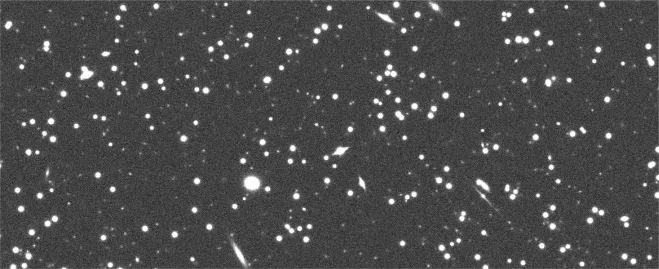
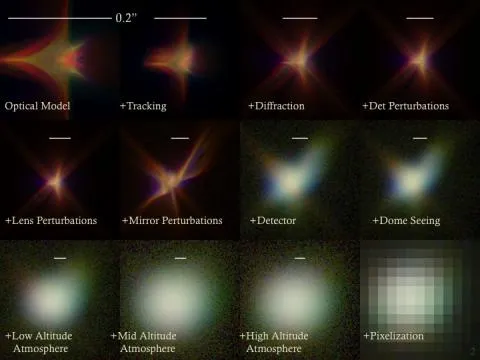
Rachel Mandelbaum, PhD in physics and professor at Carnegie Mellon University, explains in a paper published in 2015 [1] the challenges of dealing with gravitational lenses. Ultimately, as in The Matrix, everything is digital, and what astronomers manipulate are pixels of images. If the images have defects, whether due to imperfections in the detectors or atmospheric effects, the data of reality will be several times deceptive.
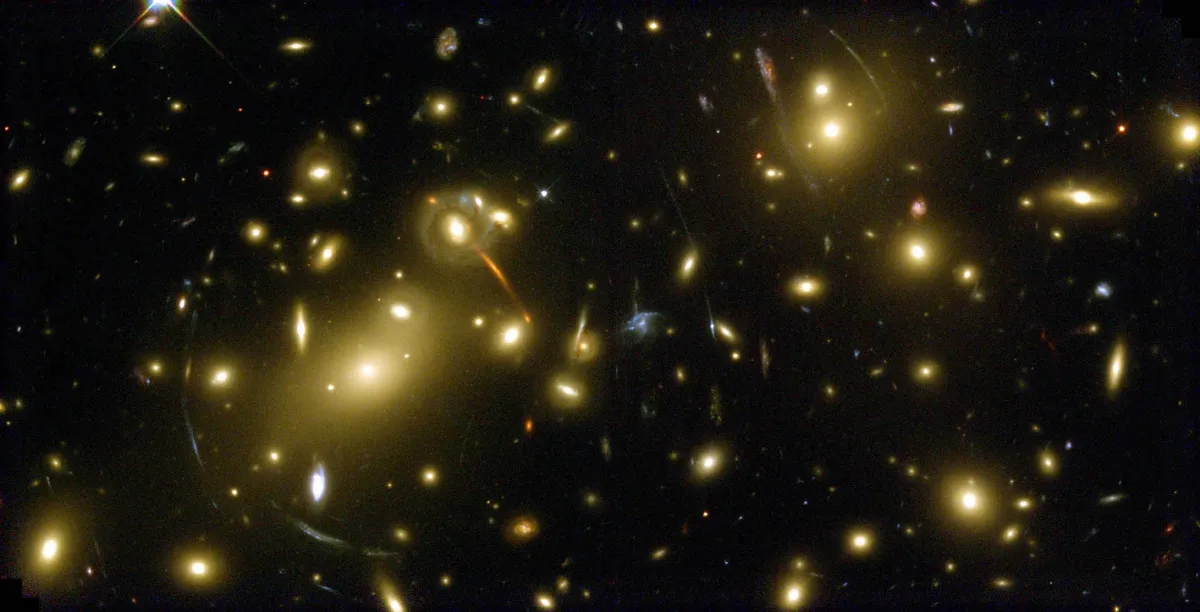
That said, get ready for what follows: It is called strong gravitational lensing when the effect is easily perceptible, as in the case of the images of cluster Abell 2218.
On the other hand, the possible existence of dark matter would imply that we see all galaxies somewhat different from how they are, although only slightly, say 1%. That is called weak gravitational lensing [2]. That is, "Nothing is what it seems" turns from fiction to reality... apparently.
Simulation and neural networks in astronomy
Hence the importance of simulating reality to know it. I think this could be understood with a simple example:
Suppose we have a camera with a fisheye lens, that is, a lens that distorts reality in relation to how we can observe it with our eyes. Let's say we have a photo taken with that camera and we want to know what that landscape really looks like.
One way to do it would be to have many images taken with that camera and also with other cameras with normal lenses of the same landscapes and compare them. That way we would learn how to transform one type of image into another.
Well, a group of astronomers that includes Rachel Mandelbaum, led by Barnaby Rowe, have been developing "intelligent" software to do something similar to the above: GalSim. The software is a simulator but also an analyzer of real images.
GalSim uses a form of "artificial intelligence" (AI) called Generative Adversarial Networks (GAN) instead of traditional neural networks. A traditional neural network would detect the difference between images only if they were labeled by people and include descriptions. Finally, that form of algorithms would learn to distinguish images without labels.
In GANs, labeling and description are not included in the process. An image generator produces real and false images and the network finally learns to distinguish between them, as indicated in ScienceNode [3].
GalSim and other projects date back a few years, but the topic of AI and neural networks applied to astronomy has been gaining use and space in the media. In February of this year, an article on the subject was published in Nature [4].
In the Nature article it is explained this way: "In a GAN, two neural networks are trained together with minimal external help. One network -the generator- produces false images; the other -the discriminator- tries to distinguish between true and false images. Although the first never sees real images, the second, by distinguishing better and better between them, teaches the first to produce better false images."
I think it could be said that then the two networks compete with each other as adversaries (hence the name) and in a kind of zero-sum game, what one wins, the other loses.
On the LSST page there is a section for GalSim which indicates that it is a modular, open-source software for simulating images of stars and galaxies using a range of mechanisms that were developed to support weak gravitational lensing analysis. It includes the ability to simulate realistic galaxies (based on observed data) and parameterized morphologies (Sersic profiles, named after the Argentine astronomer José Luis Sérsic).
There are other libraries or packages for similar objectives, for example, PhoSim, created specifically for the LSST.
Astronomy in the hall of mirrors
I can't help thinking that this modern practice of astronomers seems like a crossover of Borges and Lewis Carroll, a mix of Alice in Wonderland (and its sequel) with that very short story by Borges about the map and the territory (which curiously would have an origin in another work by Carroll).
I am referring to the text "On Exactitude in Science" which is part of The Maker [5] and which says:
In that Empire, the Art of Cartography achieved such Perfection that the Map of a single Province occupied an entire City, and the Map of the Empire, an entire Province. With time, these Exorbitant Maps did not satisfy and the Colleges of Cartographers raised a Map of the Empire, which had the Size of the Empire and coincided point by point with it. Less Addicted to the Study of Cartography, the Following Generations understood that this vast Map was Useless and not without Impiety delivered it to the Inclemencies of the Sun and the Winters. In the Deserts of the West endure fragmented Ruins of the Map, inhabited by Animals and by Beggars; in the whole Country there is no other relic of the Geographical Disciplines.
Suárez Miranda: Viajes de varones prudentes, book four, chap. XLV, Lérida, 1658.
The final reference is that of a false author, perhaps to generate the idea that the fictional text is real. That is, the text is a simulation. A simulation inside another, fractal, because at the same time the text implies the simulation of the map and the territory, to the point of becoming indistinguishable from one another.
In relation to gravitational lenses, one would have to add the distortion of the mirror and we would finally have a distorted map of reality that, by transition, could generate a distorted reality.
It is therefore to be expected that this does not happen with astronomers and they always remember that the map is not the territory, galaxies are not little dots on a screen and tools do not substitute for work.
Perhaps AI has become the modern White Rabbit that guides us to adventures to find the Black Hole. Until someone wakes us up.
Sources and related links
- [1] GalSim: The modular galaxy image simulation toolkit, Rowe et al, Astronomy and Computing
Volume 10, April 2015, Pages 121–150.
DOI: https://doi.org/10.1016/j.ascom.2015.02.002 - arXiv:1407.7676 [astro-ph.IM]
https://arxiv.org/abs/1407.7676 - [2] CFHTLens: What is Gravitational Lensing?
http://www.cfhtlens.org/public/what-gravitational-lensing - [3] Into the wild simulated yonder
https://sciencenode.org/feature/into-the-wild-simulated-yonder-.php - [4] Astronomers explore uses for AI-generated images
http://www.nature.com/news/astronomers-explore-uses-for-ai-generated-images-1.21398 - [5] Wikipedia: Del rigor en la ciencia
https://es.wikipedia.org/wiki/Del_rigor_en_la_ciencia - GalSim en LSST
https://www.lsst.org/scientists/simulations/galsim
About the images
Initial image: Extract of a simulation in GalSim of the Milky Way, Mandelbaum, et al.
Image of Abell 2218: Credit: NASA/ESA
Image 3: From LSST: http://lsst-desc.org/FeaturedProjects/Phosim-v3.3
Video Credit: picojeff's channel