New results from experiments searching for dark matter have come back negative and are part of an already long trend of constraints that leave physicists empty-handed.
That dark matter does not exist is a statement as coherent with modern empirical scientific thought as the assertion that the ether does not exist. There is no direct, let's say literal, way to prove that something that does not exist does not exist. How would we go about proving that unicorns do not exist? You can't. What you can do is postulate what unicorns would be like and search for them. If after many, increasingly precise searches, nothing is found, we begin to think the hypothesis is incorrect and, at some point, we abandon it, particularly if in the meantime alternative hypotheses appear that might be better and yield corresponding results.
This is how science works, both for unicorns and for the ether. There is no way to prove once and for all that there is no medium bathing everything in space-time. But if it is granted that it exists and has certain characteristics (a model), it can be sought. The ether has been sought several times without finding positive results. That's why physicists today say it does not exist. But perhaps it does exist and is hard to detect, right?
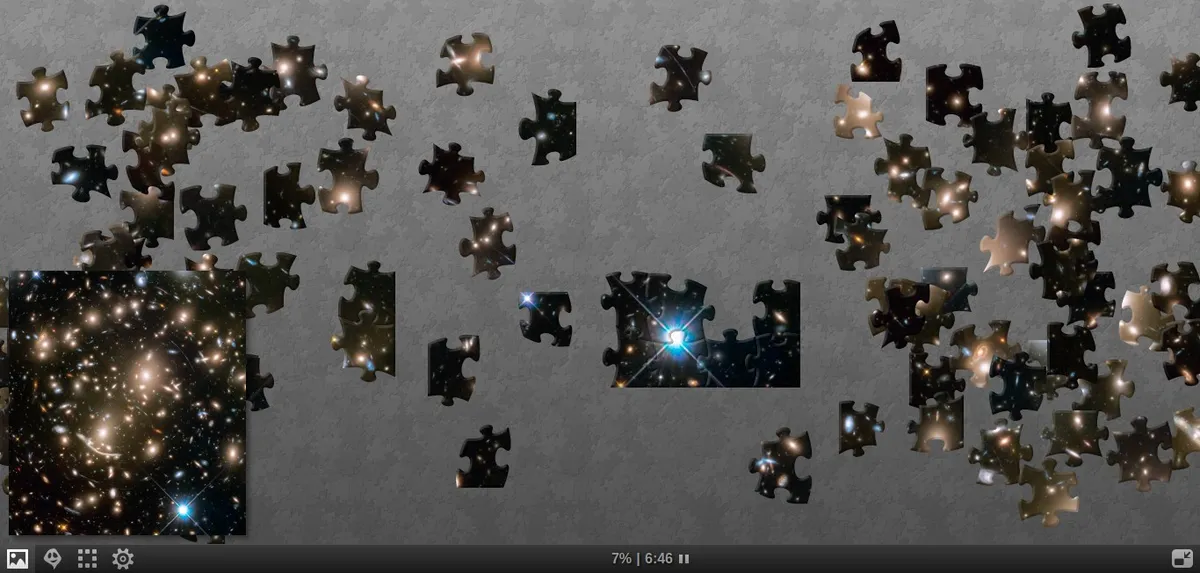
Well, this is the prevailing position regarding dark matter. The hypothesis of non-baryonic matter (that is, matter that has no electromagnetic interaction, but does have gravitational interaction) arises from the discrepancy between Newton's theory and various observations of galaxies. It's as if cosmologists are putting together a puzzle without having all the pieces. With the pieces they have, they assume the image they are composing is of a certain kind. But if that kind is correct, then they are missing a piece (in fact, several), but one piece turns out to be indispensable. And they search for that piece, which should have a very dark top and a straight part. And they search and search, without finding it. At some point they will have to think that perhaps that piece does not exist, that they are wrong, and that the image to be assembled is a different one.
As reported by ScienceNews, several experiments searching for a certain type of dark matter, called WIMPs, weakly interacting massive particles, have yielded negative results: the PANDAX-II, XENON1T, SuperCDMS, and PICO-60 experiments have not found what they were looking for. However, it would not be entirely true to consider these results as failures. The following analogy would be appropriate: a person lost their car key and knows they did not take it out of the house. They start searching in the living room, then in the bedroom, then in the bathroom. In each case, the result is negative: it's not there. But that also means that -if they started from the correct hypothesis, i.e., that they did not take the key out of the house- then they are getting closer and closer to finding it. They still need to search in other rooms, but several have already been ruled out. That is why it is said that these experiments "constrain" the possibilities.
When will they give up? Not only when these negative results accumulate further, but when they have a better alternative hypothesis. Some cosmologists have proposed that dark matter is neither cold nor hot, but warm, temperature terms that are actually based on the way these particles would interact with each other. Models have even appeared in which (as with neutrinos) there would be dark matter of different "flavors" that could even change from one to another (1).
So if anyone expects these negative results to cause such a turn that the central hypothesis is dismissed, they should wait seated because it is not going to happen, for now.
Therefore, a fundamental philosophical-logical issue is that not finding something does not necessarily mean it does not exist. It is possible that it does not exist, it is possible that it exists and is difficult to find.
Another note: even if dark matter were detected, what would be the mechanism by which it would have arisen? It is not known. No mechanism is known by which such particles would exist. Some physicists might quickly refute me on the grounds of what has been called "the WIMP miracle," since if dark matter particles were massive and interacting via the weak force, there would be a supposed "mechanism" for the formation of these particles in the early universe (2). But more than a concrete mechanism, it is a rather abstract idea. And it may be that dark matter is not WIMPs, but perhaps arose from some other unknown force.
Therefore: so far, dark matter has not been detected, nor is a mechanism by which it could form clearly known. In fact, it is difficult to do the second without the first, since the mechanism could be thought of only once there is a characterization of the particles, for which they must first be detected.
And these two issues (lack of detection and lack of mechanism) do not occur only in astronomy, but are also present in so-called pseudosciences. This is why refuting "occult sciences" is not enough by pointing out their lack of detection or lack of mechanisms, although these are very important aspects. But I will leave that for the next post.
A final reflection is worthwhile: the scientific "method," when recounted from negative experiments, can be thought to be incorrect, to fail. Using another board game metaphor: it seems that cosmology is "stuck."

But in basic and general terms, it is the same form that allowed for giant strides in recent centuries: The outermost planets like Uranus, Neptune, and the now dwarf planet Pluto, were discovered only in the 18th, 19th, and 20th centuries, respectively. And galaxies were discovered in the 1920s!
That is to say, for millennia the existence of galaxies was unknown, because they had not been detected, but they existed. But they were finally discovered. Why? Because they were sought. Pseudosciences seek nothing and will find nothing. THAT is the difference to consider, beyond apparent coincidences with science.
In the analogy of pastimes, doing science is like assembling puzzles, while pseudosciences are like painting mandalas.
Note: on the site http://www.jigsawplanet.com/ you can do an online puzzle (like the one in the opening image) with an image chosen by the user, with different levels of difficulty and number and shape of pieces. It's a lot of fun!
Sources and related links
- ScienceNews: The results from a slew of experiments are in: Dark matter remains elusive
https://www.sciencenews.org/blog/science-ticker/results-slew-experiments-are-dark-matter-remains-elusive - (1)Jennifer Kile (2013) Flavored Dark Matter: A Review
arXiv:1308.0584 [hep-ph]
https://arxiv.org/abs/1308.0584 - Flavour and Dark Matter
Event at CERN in September 2017
https://indico.cern.ch/event/653347/ - (2) The origins of dark matter
http://www.symmetrymagazine.org/article/the-origins-of-dark-matter
About the images
Image: Abell 370. Credit: NASA, ESA, and J. Lotz and the HFF Team (STScI)
from A Lot of Galaxies Need Guarding in this NASA Hubble View https://www.nasa.gov/feature/goddard/2017/a-lot-of-galaxies-need-guarding-in-this-hubble-view
Online puzzle with the tool from http://www.jigsawplanet.com/