Astronomers found a giant wave rolling through the Perseus galaxy cluster.
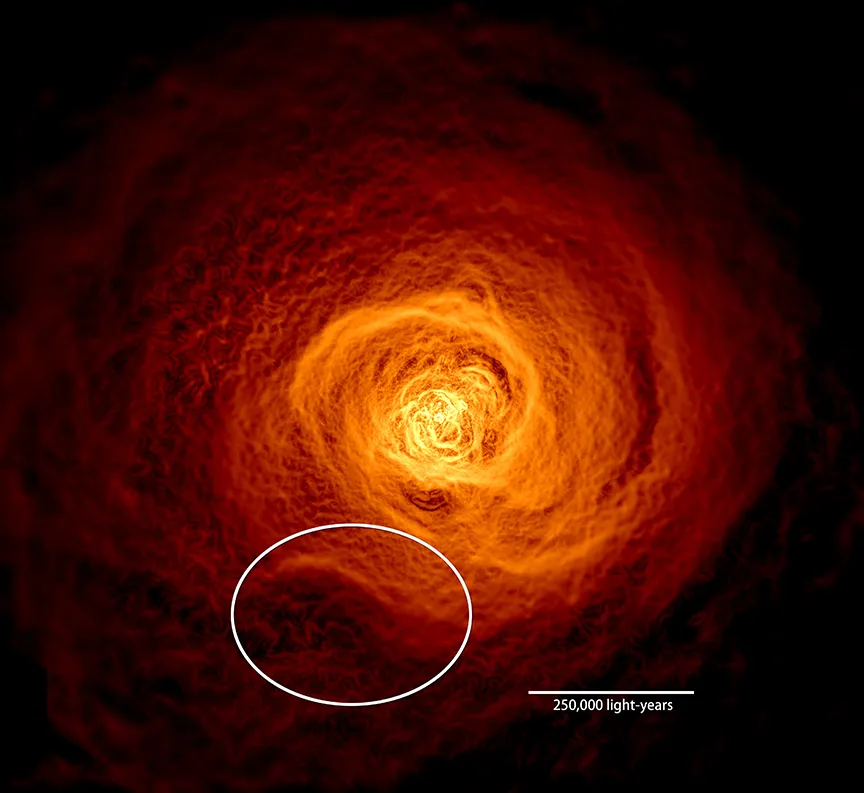
Combining data from NASA's Chandra Observatory with radio observations and computer simulations, scientists found a vast wave of hot gas in the Perseus galaxy cluster. With a span of 200,000 light-years in diameter, the wave is almost twice the size of the Milky Way.
Researchers think the wave formed billions of years ago after a small galaxy collided with the cluster and caused its gas supply to gather into an enormous volume of space.
Galaxy clusters are the largest structures accumulated by gravity in the present universe. With a diameter of about 11 million light-years and located 240 million light-years from Earth, the Perseus cluster is named so because it is located in that constellation. Like all galaxy clusters, most of its observable matter takes the form of gas so hot that it shines in X-rays.
Chandra data revealed a variety of structures in the gas, from large bubbles generated by the supermassive black hole in the cluster's central galaxy -NGC 1275- to an enigmatic concave formation nicknamed "the bay".
To investigate that structure, astronomers combined a total of 10.4 days of high-resolution Chandra data with 5.8 days of wide-field observations at energies between 700 and 7,000 electron volts. This image of X-ray data (above) in the cluster was created from those observations. The researchers then filtered the data in a way that increased the contrast at the edges so that more subtle features became more noticeable. An ellipse in the image indicates the enormous wave, located at 7 o'clock on an imaginary clock, found rolling in the deep through the gas.
Just as we might wonder who is the ninja spinning in singer Adele's video titled "Rolling in the Deep", astronomers wondered what that oval structure spinning around was.
To answer it, the researchers compared the edge-enhanced image with computer simulations of galaxy cluster mergers at NASA's Ames Center.
A Wave in the Perseus Cluster 200,000 Light Years Across.
A simulation seems to explain the formation of the bay. That simulation is shown above. In it, the gas in a large cluster similar to Perseus settled into two components: a central "cold" region with temperatures of 30 million degrees Celsius and a surrounding zone three times hotter. Then, a smaller cluster with several times the mass of our galaxy skirts the larger cluster, off-center.
This flyby created a gravitational disturbance that stirred the gas like whipped cream in coffee, creating an expanding spiral of cold gas. After 2.5 billion years, when the gas reached 500,000 light-years from the center, large waves formed that "rolled" to its periphery for hundreds of millions of years before dissipating.
Those waves are giant versions of Kelvin-Helmholtz waves that appear when there is a velocity difference across an interface of two fluids, like wind over water. They can be found in oceans, in cloud formations on Earth and other planets, in plasma.
These waves could also explain features found in other clusters, like Abell 1795 and the Centaurus cluster (Abell 3526). There's a prize for useless curiosity for whoever finds a centaur in Adele's video!
If the astronomers were paralyzed upon viewing the images, like victims of Medusa, they later managed to cut off the head of the problem as Greek mythology indicates about the hero Perseus.
But in science there are no heroes and villains, but rather, if anything, the hard battle to better understand.
The researchers stipulate that the size of these waves corresponds to the strength of the cluster's magnetic field. If it is too weak, the waves reach larger sizes. If it is too strong, they simply do not form. The study also allows investigating the average magnetic field throughout the entire volume of these clusters, a measurement difficult to make in other ways.
A paper describing the findings appears in the June issue of Monthly Notices of the Royal Astronomical Society.
Sources and related links
- Is there a giant Kelvin-Helmholtz instability in the sloshing cold front of the Perseus cluster?
S. A. Walker et al
arXiv:1705.00011 [astro-ph.CO]
https://arxiv.org/abs/1705.00011 - Wikipedia: Inestabilidad_Kelvin-Helmholtz
https://es.wikipedia.org/wiki/Inestabilidad_Kelvin-Helmholtz - Scientists Find Giant Wave Rolling through the Perseus Galaxy Cluster
http://chandra.si.edu/press/17_releases/press_050217.html - Adele - Rolling in the Deep
https://www.youtube.com/watch?v=rYEDA3JcQqw
About the images
Images and video: NASA/CXC/GSFC/S.A.Walker, et al.