How to see C/2022 E3 (ZTF) from the Southern Hemisphere. Is it rare that it looks green?
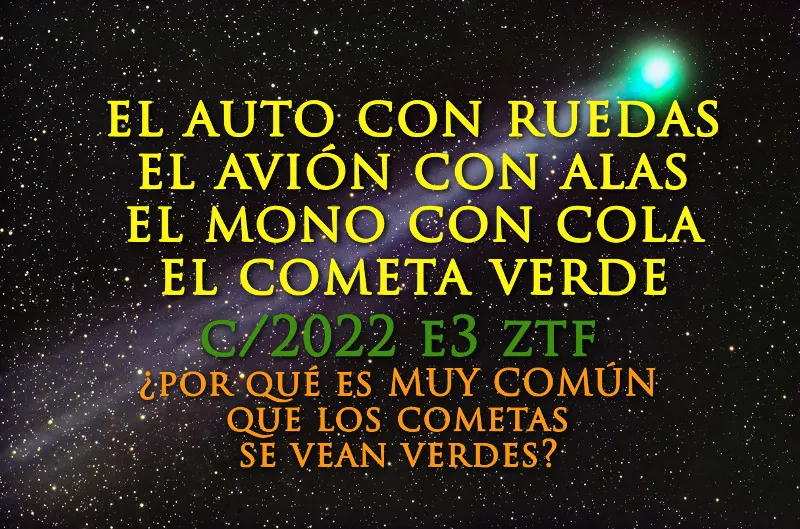
For a couple of weeks now, the media has been talking about the famous "green comet," so there isn't much to add.
Only now is the comet becoming visible in the southern hemisphere, but for a few days it will be very difficult to observe as it is near the horizon. In rural areas, without buildings and with a very dark night sky, it would be visible to the naked eye, as its apparent magnitude is around 6.
In large urban centers, we more than rule out this option, because light pollution restricts visible objects to magnitude 5 (approx).
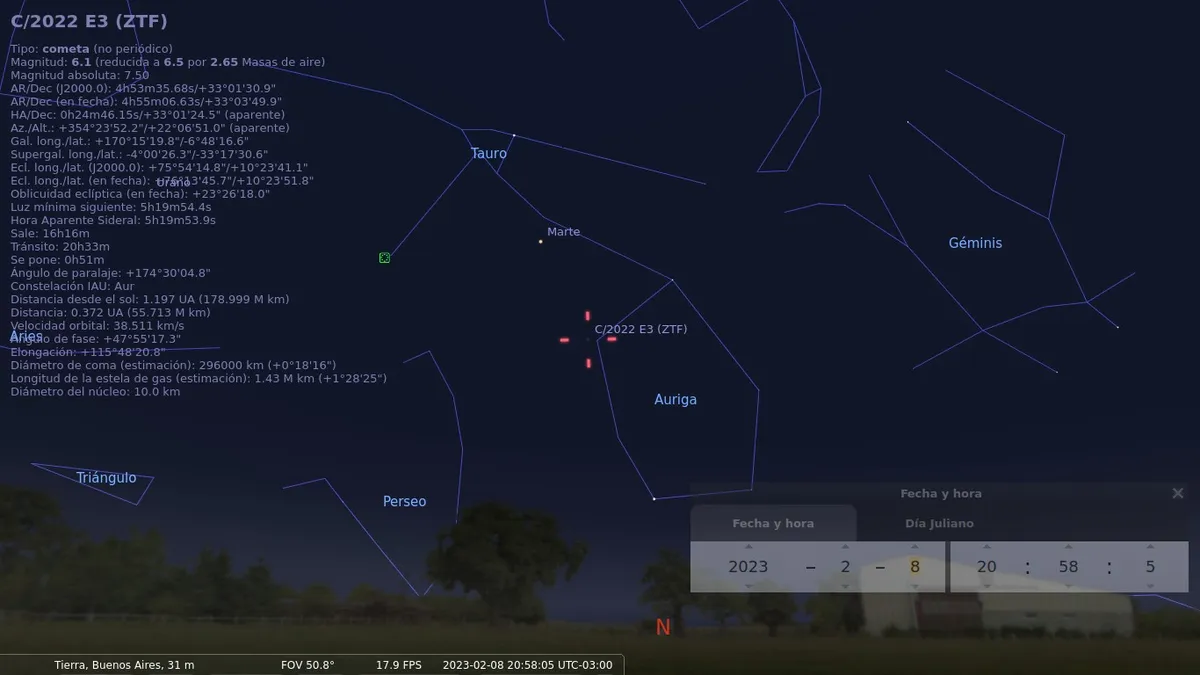
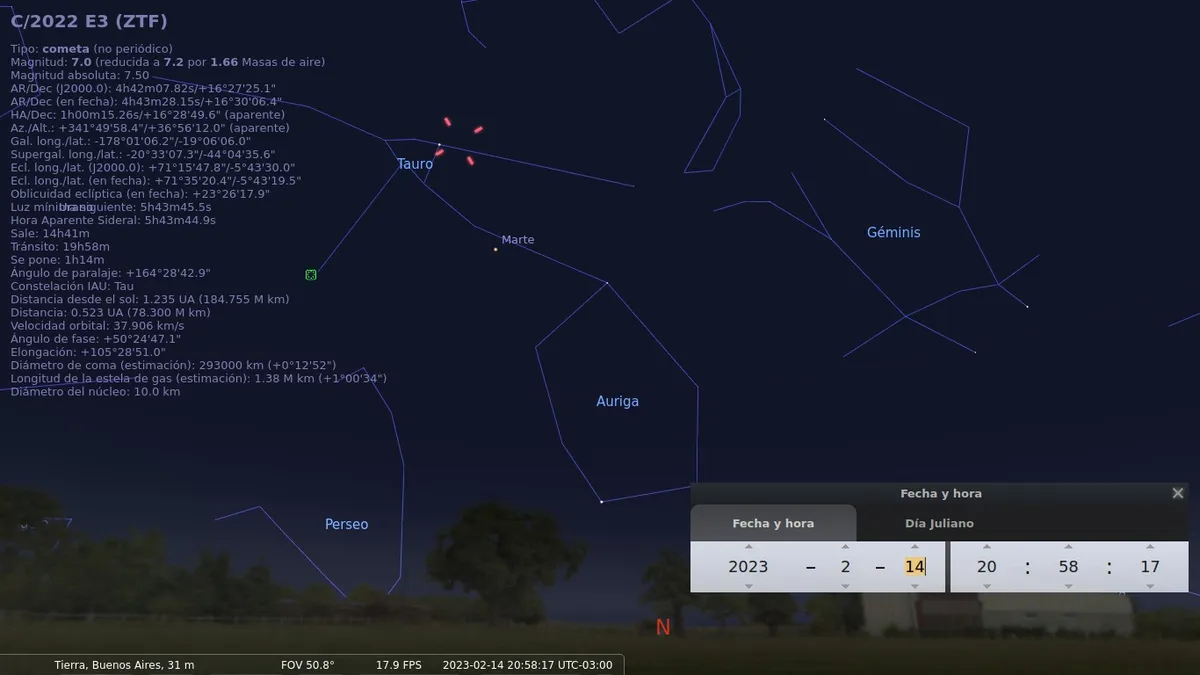
With binoculars or telescopes, from the 8th it will already be at a reasonable height to look for it from urban and peripheral centers, in Auriga, looking North, at dusk. In the following days, as it is seen higher, it will be less bright, but it will approach Mars and Aldebaran.
On 2/5 the moon will be 14 days old (full moon) which makes observing faint objects like this comet difficult. On the other hand, after passing near the Sun, cometary brightness is hard to predict. It's advisable to use maps and look for it, beyond brightness forecasts.
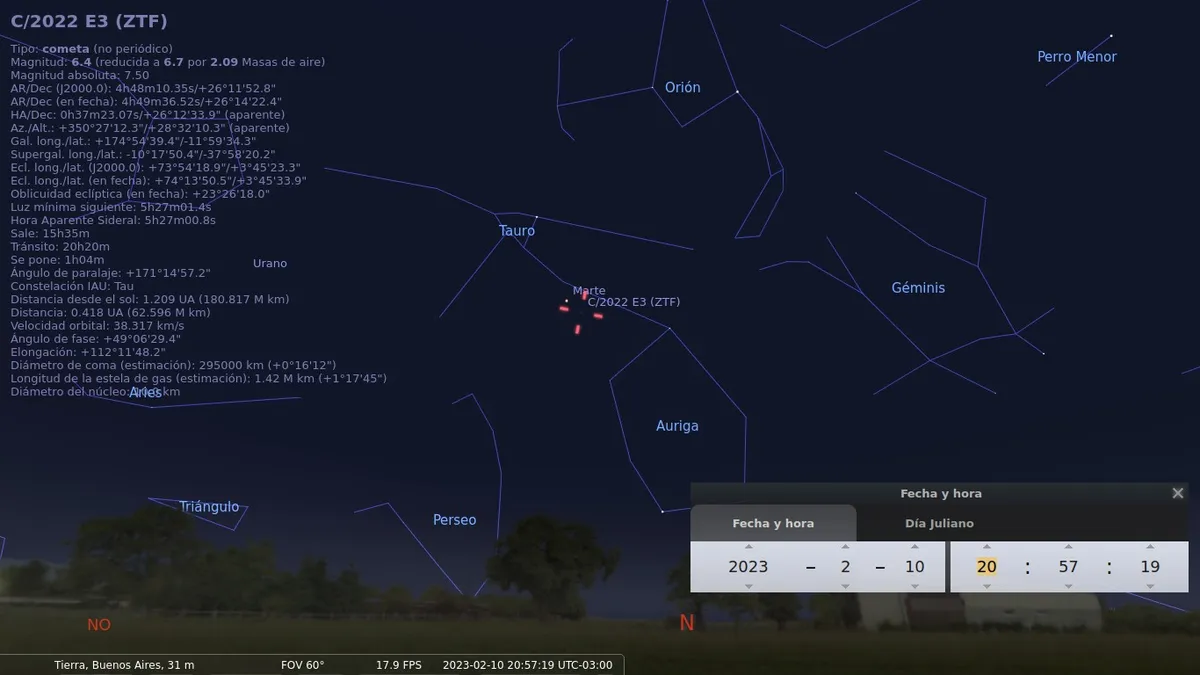
Here I leave some Stellarium images as references.
HOW TO ADD COMET C/2022 E3 (ZTF) TO STELLARIUM
The planetarium program has different versions: on the web, a mobile app, and a desktop application. In the first two, you don't have to do anything. In the third case, to add the comet, follow this simple guide:
Go to Configuration->plugins->Solar System Editor
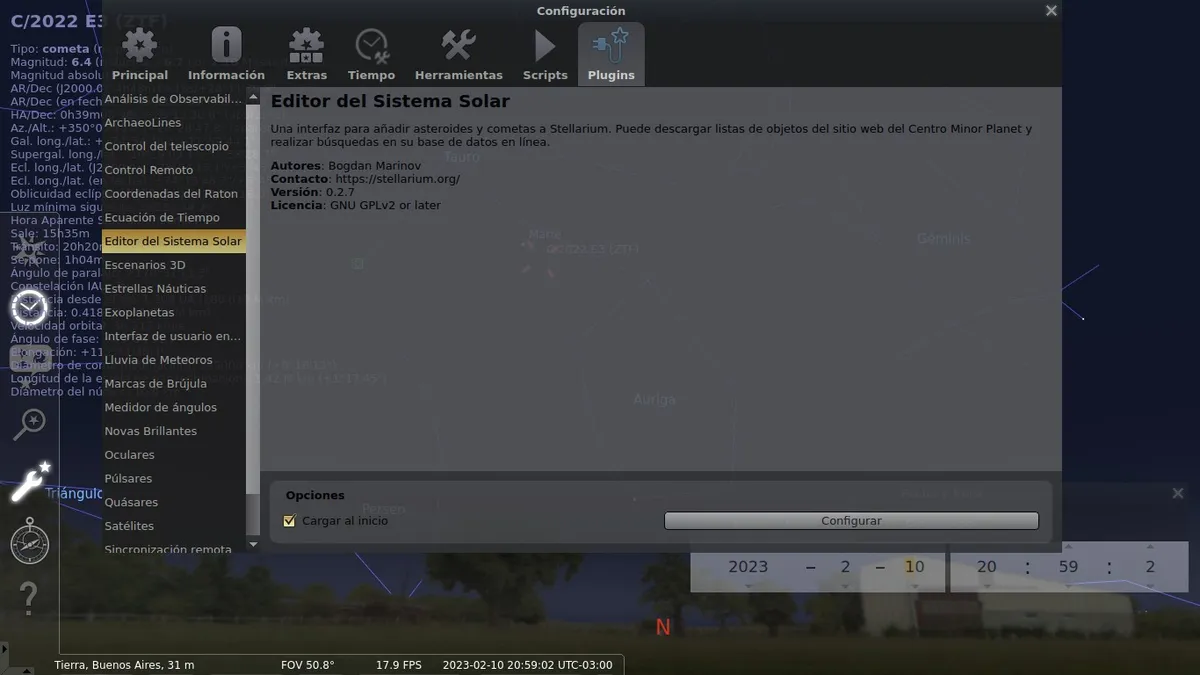
There, choose Solar System and the option "Import orbital elements...".
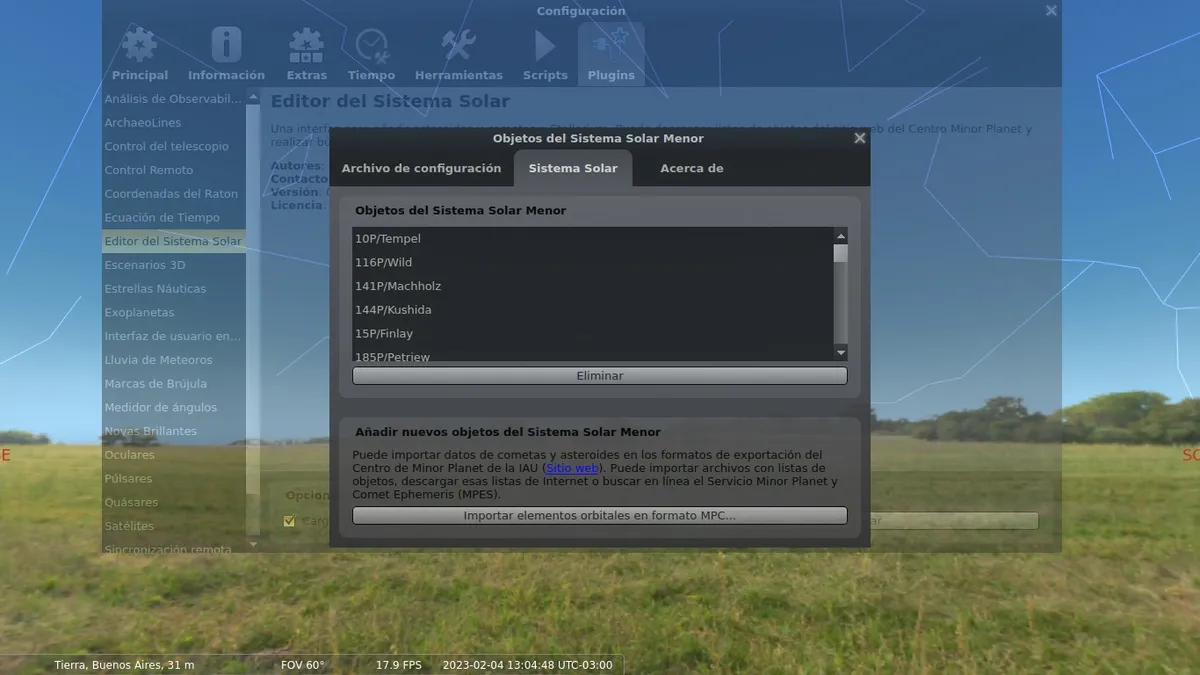
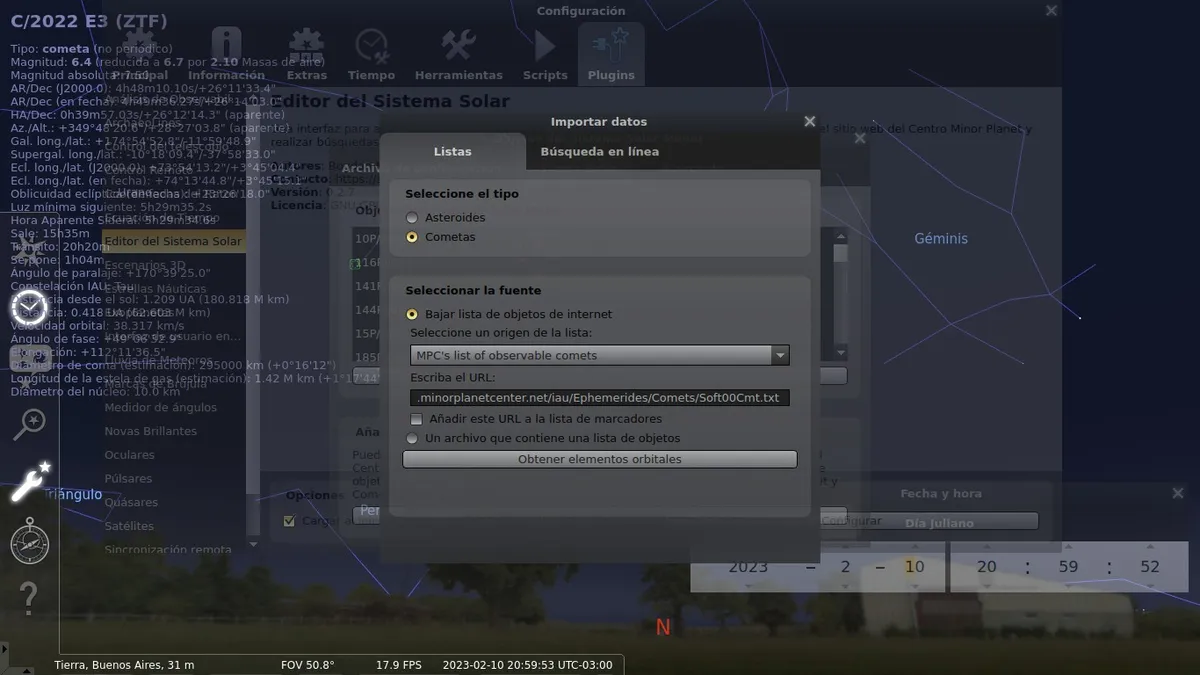
In the next window, choose Comets and "Download list..." MPC's list... and click "Get orbital elements..."
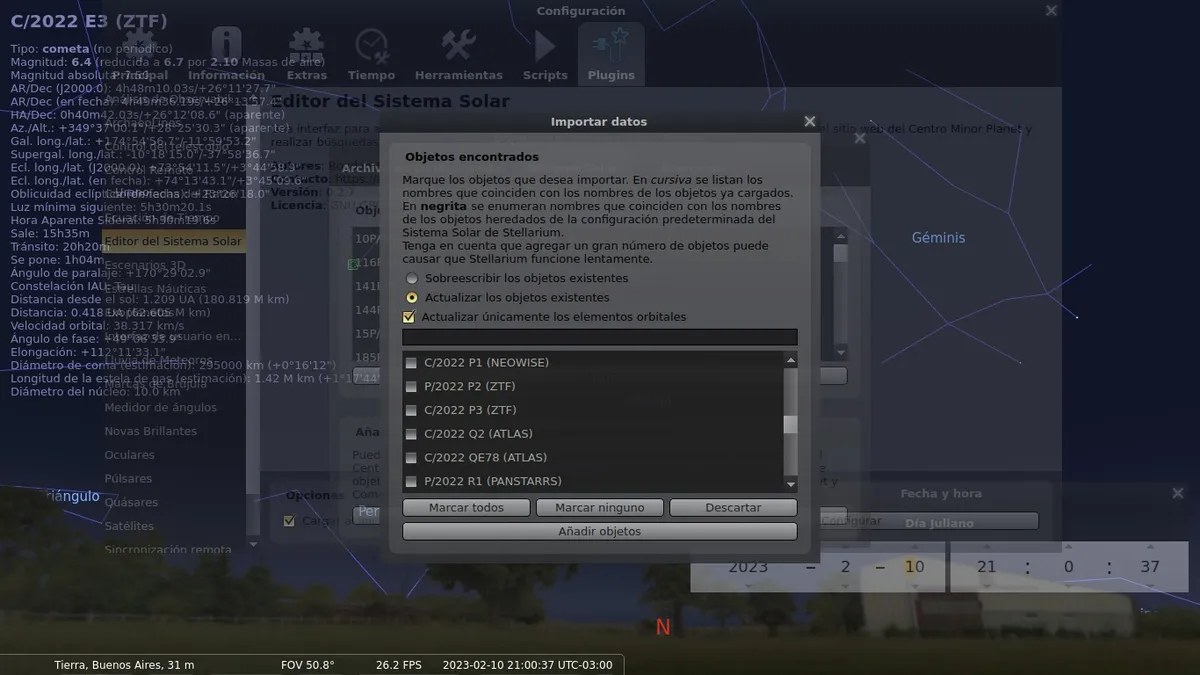
Then we will see a drop-down list to choose the object. We look for the one we are interested in and click add. Then we close the windows we opened. Done.
THE COMET OF PEROGRULLO
The mass media narrate this comet as "the green comet," which is almost like saying: Red bricks, the blue ocean, yellow wheat and other truisms. It is VERY COMMON for comets to appear green. With greater or lesser intensity, depending on the case.
The "rare" thing about the comet is not its color, but rather, if anything, its period. However, it wouldn't be very logical either to say that non-periodic comets are unusual, because they must be countless.
The initial photo of this post is of comet Lovejoy, from 2014. As is easy to notice, it also had a greenish coloration. Why does this happen?
Scientists suspected that the greenish glow of comets came from the diatomic carbon molecule (C2). To verify this in the laboratory, the researchers used an ultraviolet laser to strip chlorine atoms from the carbon chloride molecule (C2CL4, tetrachloroethylene) and then bombarded the C2 remnant with high-intensity light. Instead of absorbing one photon and emitting another green one, when the molecule breaks, the reaction requires it to absorb two photons. One excites the C2 to a semi-stable state and the other raises the energy to an unstable configuration. From there, the molecule decays and radiates the green photon, as reported in a scientific paper a few years ago. On the other hand, photons do not have color, it's a way of speaking, referring to a range of wavelength.
So when I hear or read about "the green comet" on news sites, I wonder, where's the chocolate?. That said: I wish you luck with the observations, obviously.☉
Sources and related links
- Green Comet Coming Close to Earth for First Time in 50,000 Years
https://science.howstuffworks.com/green-comet.htm - Why do some comets glow green?
https://www.science.org/content/article/why-do-some-comets-glow-green - Photodissociation of dicarbon: How nature breaks an unusual multiple bond
https://www.pnas.org/doi/full/10.1073/pnas.2113315118 - Diccionario panhispánico de dudas
https://www.rae.es/dpd/Perogrullo
About the images
Photo: JOHN VERMETTE
Stellarium screenshots https://stellarium.org/es/