Is cosmic inflation empirical science or mere superstition with airs of science?
In Argentina, the word "grieta" (crack) has become fashionable to refer to the strong disagreements between the dominant political party alliances. The term has been used to account for political differences in other countries like Chávez-Maduro's Venezuela or Trump's United States. It was also used in Brexit and now in relation to Catalan independence. Beyond politics, the binary concept can be used for any situation where there are two strong opposing points of view. Cosmology has its own crack, inflated.
Before accounting for a recent discussion, it is worth doing a historical review:
Around 1920 there was no scientific certainty about the existence of other galaxies. However, diffuse objects had been observed, which were called "nebulae" and which some considered to be too far away to be part of the only known galaxy - the Milky Way - and, therefore, should be considered "island universes", to use Kant's concept, that is, other galaxies. On the opposite shore, others suggested that such nebulae were not that far away and were part of the only galaxy.
A series of facts made it possible for Edwin Hubble and his assistant Humason to define the issue: they were galaxies, very distant. But the observations indicated some other things: there were three shapes of galaxies (the well-known "Hubble fork") and, most strikingly: except for some, all galaxies were moving away from us and those that were farther away were doing so at a greater speed.
It makes no sense here to delve into whether the interpretation of the expansion of the universe should be credited to Hubble or to the priest Lemaitre, but it was the theory that dominated, beyond other theories like "tired light".
If the universe is expanding and what is known so far is true, astronomers of the 1930s thought, then:
Energy is neither created nor destroyed, therefore in the past and in the future the amount of energy remains constant.
If the universe expands, then its volume was smaller in the past.
If the volume was smaller and the amount of energy is conserved, then, in the past, the universe was denser, and therefore, hotter.
Ergo, the past universe must be very different from the present universe.
However, it was not these ideas that had the greatest adherence in the incipient modern cosmology, but for a couple of decades the Steady State Theory was held, which was grosso modo like this:
The universe expands and its volume changed.
Energy can indeed be created, but on such a small scale that it hasn't been discovered until now.
If the energy that is created is proportional to the expansion, then the density remains constant.
And if the density remains constant and with it the temperature, the past universe must not be very different from the current one.
In the middle of the discussion, the idea of nucleogenesis appeared, but for this case, I will overlook it.
In the mid-1960s, the Cosmic Microwave Background radiation (CMB) was discovered, which bathes everything and is compatible with the idea of a very hot and dense primitive universe.
The Big Bang Theory seemed to have the last laugh. But soon it found its limit: if the past and present universe are so different, according to the theory, why is what is observed so similar? It was the problem of homogeneity.
In the early 1980s, physicist Alan Guth elaborated the inflation hypothesis. An ad hoc process by which the original expansion accelerated, separating regions of the universe, making it flatter and more homogeneous within the observable radius.
If we pull the string a bit (as we will do later) we will see that this idea goes hand in hand with another: the multiverse.
Cosmic inflation seemed to solve several problems at once, although it was a hypothesis that arose precisely for that, without having any idea of how it would have occurred.
From then until now, and despite a lot of water under the bridge, a deep question persists: can the inflation hypothesis be corroborated or is it necessary to blindly believe in this assumption? If it cannot be corroborated, then is it science?
This is, in broad strokes, the historical context of a gap or discrepancy that endures, as evidenced this year by a famous written debate between groups of physicists through publications.
THE COSMOLOGICAL CRACK 2017
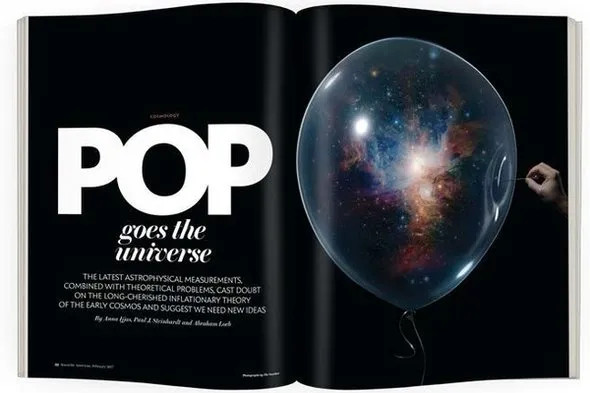
In February of this year, an article titled "POP goes the universe" was published in the magazine Scientific American (SciAm), illustrated with a balloon inside which there is a nebula and a hand with a needle trying to pop the balloon. Let's say that if a balloon pops it sounds similar to the onomatopoeia "Pop" and that there is a famous song from the eighties called "Pop goes the world" by the band Men without hats that some of us have danced to before having gray hair.
The article has three authors (Anna Ijjas, Paul J. Steinhardt and Abraham Loeb, from now on IS&L) who are renowned, although the second is VERY prestigious and it is pertinent to point out that he was one of the cosmologists who contributed to the development of the cosmic inflation hypothesis.
The article, to not beat around the bush, postulates that cosmic inflation cannot be proven or refuted empirically and therefore, it is not science.
Although the text is not very technical, I will simplify it even more by focusing on two aspects used by the authors to try to show logically why cosmic inflation is not only unnecessary, but also improbable and counterproductive, in their view:
1-There are at least two models of cosmic inflation that they illustrate with a double ski slope. One slope with a very regular incline, easier to go down, with a steeper slope, which according to the authors is a model ruled out by data from the Planck Satellite. And a less regular slope, more difficult to go down, not ruled out by Planck data, but much less probable. The blue slope would be the traditional model, more feasible because it would have fewer fine parameters to achieve, while the pink slope is the plateau model, with less incline and which requires finer parameters, more special conditions to start.
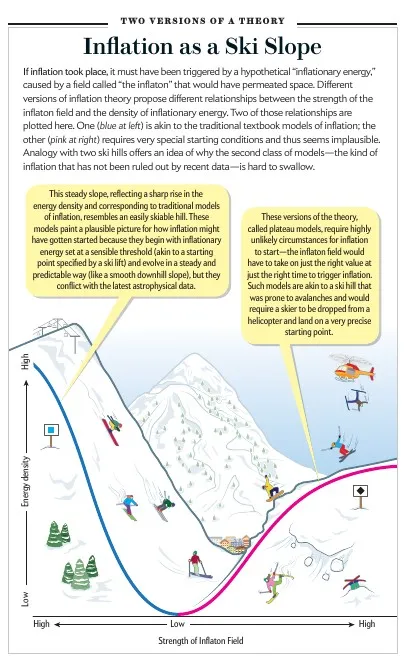
2-The inflationary model assumes a field, the inflaton. Fluctuations in spacetime would cause this field to be stronger or weaker in different zones, so some regions would have a longer or shorter period of inflation. If some of these fluctuations were not so small, the consequences would be drastic: a stronger jump would cause a region to extend its period of inflation while others did not. A small portion of space volume would grow exponentially, surrounding and swallowing those zones where inflation stopped. The swallowed zones would eventually stop, but again, some regions with larger fluctuations would cause the process to continue...ad infinitum. And therefore, this would generate zones sufficiently isolated from each other that each could be considered a universe and the set of all would be the multiverse. Each region would have distinct characteristics, so the idea of inflation that aimed to explain why our (supposedly unique) universe is the way it is would no longer make sense.
Let's be clear on this: if it were so, the inflationary model would "explain" our particular universe, as well as any other with other characteristics, whatever they may be. In this sense, the model that explains everything explains nothing and does not predict, since any other universe that could be detected and that had characteristics different from ours would also be "proof" of the inflationary model. It is, therefore, unfalsifiable, according to the authors of that publication.
IS&L propose a paradigm shift: from the big BANG to the big BOUNCE: Bounce means "rebound," so there could be a previous phase like a long transition of small contraction. There are different bounce models and, as I understand it, they don't mention it because they favor a particular one, but as an indication that it is possible to think of alternative models.
THE RESPONSE OF 33
The response to the article was not long in coming and was answered by a group of 33 reputable astrophysicists. Actually, the response was written by the first 4 and signed by another 29. I won't dwell much on the issue of number and prestige because the only thing that should matter are the arguments. However, it may seem somewhat "bullying" that many sign an article written by others and that those others are who they are: Sean Carroll, Hawking, Krauss, Juan Maldacena, Lisa Randall, Martin Rees, Smoot, Susskind, Vilenkin, Weinberg, Wilczek, Witten, Matias Zaldarriaga, and others. That is, the whole cavalry.
But, at the same time, if the letter had been signed only by Alan Guth and Andrei Linde we might have doubts about the position of the others, particularly the most prestigious ones, so the "33" show that they are not the "under," but the "mainstream," that is, they are not the counterculture, but the mainstream.
And the authors try to demonstrate that very thing with the first passage of their response: there are 14,000 papers written by 9,000 scientists on inflationary models, so, they say, IS&L are unaware of the work of the rest, which is the majority. Note the use of the Argument from authority.
The main argument of Guth and others is that standard inflationary models predict that the universe has a critical mass (geometrically flat, with the parameter Omega =1) and predict statistical properties of the CMB waves. These waves must be nearly "scale-invariant" which means they have the same intensity on all scales. Second, these waves are "adiabatic," meaning that the perturbations are the same in all components: ordinary matter, radiation, dark matter fluctuate together. Third, the waves are "Gaussian," in relation to the distribution as a "Bell curve." And fourth, they predict polarization patterns. And that since the COBE satellite in 1992 these predictions have been confirmed.
THE COUNTER-RESPONSE
The counter-response can be read, in English, below the article by Guth and others, although in more detailed form the authors drafted another response on a Princeton page (see links below). Besides going over the same points, the three authors add other reflections: Alan Guth himself wrote an article in 2007 against infinite inflationary iteration. Regarding the successful predictions listed above, IS&L point out that before the most current results were known, some of the signatories 33 indicated in their respective papers that the opposite of what is now known could be expected. That is, if a model is proposed as if it were a coin and it is indicated that such a coin can land heads or tails and then it lands heads, it was correct, and if it lands tails, it was also correct, so such an ambiguous model is not predictive. If it is said that it will land heads and it lands tails and then the model is modified so that the theory matches the data, such a model will be a better description, but then its predictability will have to be evaluated again: another coin is tossed and if it lands tails, it is confirmed, if it lands heads, it is not. But if the prediction again is that it will land heads or tails, it is useless.
SEAN CARROLL'S PERSPECTIVE
As the cosmologist indicated on his blog, he is not very inclined to think that inflation is part of the final answer. Many others, however, think that they will finally find the correct parameters, but for Carroll it is difficult to even think about the mechanism of the origin of inflation, particularly due to the low entropy it requires.
As is known, Sean Carroll is a proponent of the multiverse as he has said several times and on his blog he has told of some attempts to prove the possible existence of other universes. But even if it were not so, he considers inflationary models to be scientific based on what they can prove.
MY OPINION
First of all, it is these debates that characterize science in contrast to other "dogmatic" practices. When science is based on dogmas, it will cease to be such. That is why it is somewhat shocking that the argument from authority is used. History proves that majorities can be wrong. But it is understandable that Guth and others feel insulted by IS&L by implicitly labeling them as "pseudoscientists."
On the other hand, if a model doesn't quite work, it's not expected to throw it overboard, but to correct it. Logically, at some point, if successive corrections still fail to account for reality sufficiently, then alternatives will have to be sought.
Thirdly, like Guth and Carroll, I understand that the idea of iterated inflation and multiverse, which generate infinite possibilities, does not prevent testing the inflationary model for the case of our own universe.
Inflation models that can generate multiple universes might not produce very different zones, but rather very similar ones as long as the initial conditions of all are similar.
But even if that were not the case and each universe were different, let's think of a grotesque example like people in such universes being born with seven arms or five heads; that does not change the usefulness our model of people has today, since for the given conditions in this piece of space, children are generally born with certain characteristics and not others, and such a model is predictable. It will serve our region and not another, but it is testable.
Much has been written about what cosmologists call the "fine-tuning" of our universe, in relation to certain constants that, if they were slightly different, atoms or galaxies would not have formed and therefore we would not be here.
If other universes exist, such fine-tuning (which some interpret as "intelligent design") would be nothing more than a coincidence among many, and in terms of predictions for the multiverse, everything would be statistically possible, but not for our particular universe in which only some things are possible and not all.
We now know for certain that the universe had a beginning. Such a beginning did not necessarily arise "from nothing," but rather, as happens with everything known, it probably had a precedent. Human beings are born, that is, we have a beginning, but not from nothing.
What we call a beginning we could conceive as a qualitative leap or a significant change. That our universe had a beginning, in this sense, is undeniable because if the universe had no limits, there would be an infinite number of stars and, therefore, the night would not be dark (Olbers' paradox).
That does not mean, however, that before such a beginning there was another phase, something prior. Birth is a beginning, but also an end of something previous, the end of gestation.
Finding the right parameters for the initial conditions of such a universe would not only be useful for making predictions about the future, but also about the very distant past, as also happens in climatology.
However, describing and predicting is not enough. We have to understand the process. So far, the inflationary model rests on a "magical" process and, in this sense, is held together with wire. But this is common in science. All theories, from the origin of species to the construction of pyramids, have their problems. At this point, discussing better research methods, more reliable ways to separate the apparent from the real, are welcome in a frank and reasoned debate.
Meanwhile, inflationary theory will not be abandoned, unless someone develops a better model, with fewer problems.
I hope that people like IS&L develop alternative models and obtain funds to research and experiment. If their idea is better, it will prevail. At that point, there should be no crack because in science, methods are as important as results. But I think egos should be set aside in these discussions and cheap shots avoided because instead of enriching the debate, it only serves to inflate, rapidly, pride.
Sources and related links
- Is Inflationary Cosmology Science?, by Sean Carroll
http://www.preposterousuniverse.com/blog/2017/05/10/is-inflationary-cosmology-science/ - Cosmic Inflation Theory Faces Challenges (web version, “Pop Goes the Universe”, print version)
by Anna Ijjas, Paul J. Steinhardt, Abraham Loeb
https://www.scientificamerican.com/article/cosmic-inflation-theory-faces-challenges/ - A Cosmic Controversy, by Guth, Kaiser, Linde and Nomura (along with 29 other signatures)
https://blogs.scientificamerican.com/observations/a-cosmic-controversy/ - POP GOES THE UNIVERSE, counter-response
http://physics.princeton.edu/~cosmo/sciam/
About the images
Credit: Scientific American / Anna Ijjas, Paul J. Steinhardt and Abraham Loeb