Different "fake news" items on astronomical topics cannot be considered equally. Categorization is the first step in trying out a strategy.
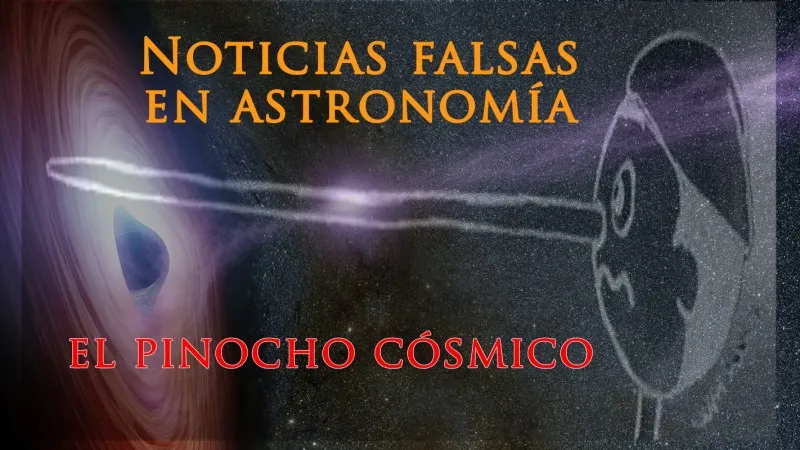
A while ago, I shared on this blog's Facebook page an interview that a Spanish media outlet did with a science communicator. I found the title interesting: "Fake astronomy news is on the hour on social media".
It is necessary, then, to reflect on the issue, because before complaining, it is vital to make a diagnosis and, for the latter, it is essential to have some definitions. Obviously, we must think about what is called "fake news".
One could define a lie as the lack of truth and truth as something that coincides with reality. However, nothing we think coincides perfectly with reality. We can think of a perfect circle, but when we draw one with a compass, we will have an approximately perfect circle, with very slight imperfections. For the practical uses we might give it, we could ignore those imperfections. So, what we call "truth" and "lie" could be posed as a range of difference from reality. Little difference will be truth, a lot of difference will be a lie.
Another way to think about it is in relation to intentions: if there is an intention to deceive, it will be a lie. If there isn't, it will be a mistake.
Thus, a false statement can be the result of a mistake (unintentional) or a lie (deliberate).
On the other hand, mistakes can be minor or significant.
Regarding mistakes, if they are such, that is, unintentional, then it will be possible to correct them. It's worth remembering that here I have told about a note with erroneous information published by BBC Mundo and my attempt to have the note amended, which, to this day, has not been corrected.
At that time, I suggested that perhaps it was an "automatic news" item, created from data in a database, without the intervention of a journalist.
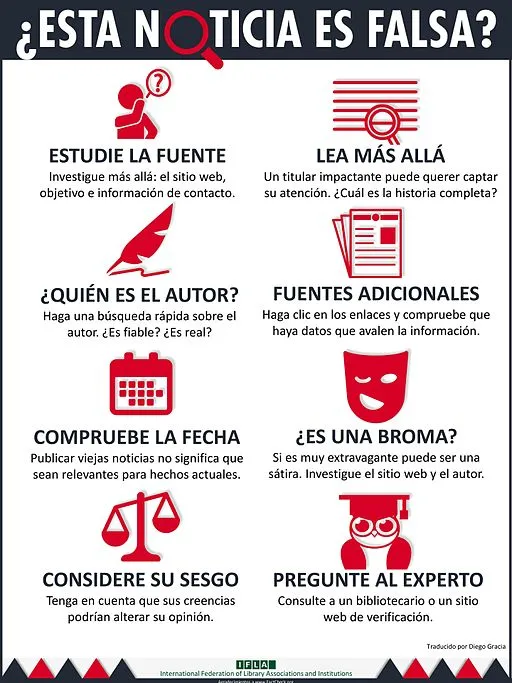
Other forms: a news item can be false in one sense, but not in another: for example, when a news item is old. In the age of the web, it is possible for someone to re-publish an old, outdated news item on social media as if it were current. On many sites, the publication date is not indicated. In those cases, in the absence of a date, one can search on search engines to find out if it was published previously.
Furthermore, ironic or satirical discourses should be considered, since it is often difficult to notice that type of humor.
And finally, there is the poorly explained didactic discourse. An example is the famous Ramanujan series: 1+2+3+4+5+...= -1/12.
There are some videos made by professional mathematicians, who cannot be said to have bad intentions, in which they try to explain this series using some mathematical "tricks" despite it being a divergent series. Others, on the other hand, have explained things better. At the end, links to videos on the topic, which could be taken as a case study for other similar circumstances applied to astronomy topics.
TYPES OF FAKE NEWS IN ASTRONOMY
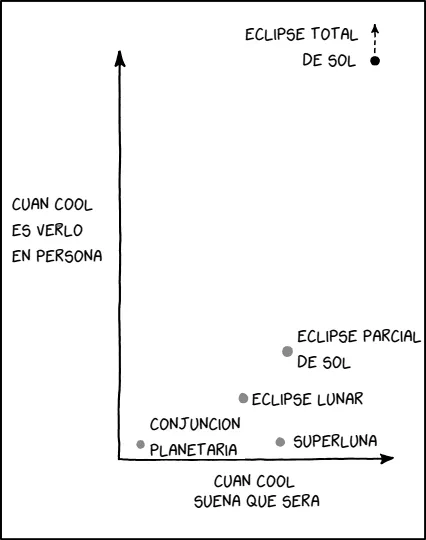
We already started a typification in previous posts: the cases of the supermoon and supermars are similar: exaggerations based on ambiguity, since they start from true data. This same thing could happen with any other object in the solar system in the future. So, faced with this type of falsehood, there is a general remedy: discourses that explain the distance-size-brightness relationship.
Fake astronomy news has some common elements, for example, they are alarmist, they narrate something that is spectacular (as positive or negative), they are striking discourses and therefore tend to be superlative: the biggest, the brightest, the smartest, the best, unmissable, spectacular, unusual...
In some cases, superlative adjectives are used in the title of an article, but then in the body of the article things are clarified.
Some examples:
Meteor showers: meteor showers are not such. Stars do not rain. Meteors do fall, small asteroids that enter the atmosphere and ignite. These showers are announced with great fanfare, despite the fact that in most cases, few "shooting stars" are seen due to light pollution in large urban centers.
"Sales" of astronomical objects: fraudulent sales of lunar soil, fraudulent sales of star names. Regarding the latter, the IAU (International Astronomical Union) intervened to explain how stars and planets are named.
Astrological discourse is frequently confused with astronomical discourse, which is why supposed effects of eclipses or the Sun's passage through certain places in the sky are mentioned, which in both cases is scientifically false.
Consequence of experiments: When the Large Hadron Collider (LHC) was inaugurated, speculation arose about the creation of a black hole that would annihilate the Planet.
The supposed ninth planet: there are scientific theories, supported by certain data, about the possible existence of a ninth planet, which are only hypotheses for now. But also pseudoscientific discourses about Nibiru or Planet X.
Intelligent life: much continues to be written on the subject, without clarifying that even if the probability of the existence of intelligent life outside the solar system is high, the probability of discovery is low, like finding a needle in a haystack.
Parallel universes: whether they are called parallel universes or extra dimensions, it is a speculation that, although it may have some scientific basis, remains just that, speculation. However, this should be distinguished from other types of pseudoscientific-religious speculations.
When these topics are addressed, it should be made clear that they are speculations, what their bases and scopes or limits are.
Dark matter and energy: similarly to the previous case, it is common to state that dark matter exists or similar formulations. However, until dark matter is detected, it remains a hypothesis. Something similar could be said about dark energy.
ACT/NEOs: near-Earth asteroids (NEOs) often cause alarm by not distinguishing proximity from danger. Not all proximity implies an impact risk.
Photomontages: a famous photograph is one of a tree with a full moon seen above it and the Sun above that. The Moon in full phase and the Sun cannot be seen simultaneously. Photomontages that are declared as such are not a lie, but they are fallacious when the reference is removed, whether on purpose or not.
It is also necessary to state and explain when an image is in false color, as happens with X-ray data. Also when an image is an illustration and not a photograph.
Galaxy collision: Based on some professional astronomical work, speculation has arisen about the collision of our Milky Way galaxy with another galaxy (Andromeda). Although that work is serious, it must be said that, if it occurs, it will be in billions of years. Furthermore, when two galaxies merge, collisions are infrequent because interstellar space is enormous. That, however, does not mean there wouldn't be gravitational effects, impossible to predict for a planet like ours.
The explosion of Betelgeuse: the gigantic red star is about to explode, we've been told. It is possible to find different "news" about it. Stellar evolution can last millions of years. Even if it were to happen within our lifetime, and although supernova events could be harmful due to the release of enormous amounts of energy, the distance from Earth to Alpha Orionis, 640 light-years, must be considered. It would, without a doubt, be an event of astronomical interest, but panic should not spread.
The end of the world and calendars: neither Mayan nor Aztec, nor Diaguita nor Tehuelche, neither ancient nor modern: the end of the world cannot be known in advance, much less with a day and time. On 12-12-2012, at noon, nothing out of the ordinary happened.
Bad explanations: There are many topics on which there can be well-intentioned but erroneous references, such as about centrifugal force, even about gravity itself, not to mention spin. And in these cases, a pendulum effect often occurs: either a lot is known, with a high technical level, or one falls into extreme simplifications that give rise to mistaken ideas. The constant training of those dedicated to outreach is a moral and professional obligation.
STRATEGY AGAINST FAKE NEWS
The humorist behind Korochi Industrias (now on Twitter) wrote: Fake News. In case of contact with eyes, wash with plenty of research. Research is Investigación. To put it another way: faced with an alarmist-superlative discourse, it is advisable not to stay only with the title and to contrast it with other sources of information.
On the other hand, since it cannot be prohibited that someone publishes something, even if it is false, then fake news must be denounced with the aim of having more discourses to contrast against.
THE PRINCIPLE OF AUTHORITY
A person is not right about something just because they possess a degree or say they possess one or present themselves as an "expert". But in daily life we need to trust, for example when we go to the doctor. That trust cannot be blind, but lucid. We trust for certain reasons, but we are equally attentive to the appearance of symptoms or signs that indicate we perhaps should not trust. So, what ultimately matters is to evaluate arguments. It is always better if what someone says can be verified.
And that is a way of knowing whom to trust: if what someone said in the past came true, it is logical to trust. If, on the other hand, what they said did not come true, perhaps not. However, it will be necessary to evaluate why it was not correct, and that is a fundamental issue: the validity of the arguments. It is better when someone explains why they say what they say, with solid arguments.
CONCLUSION
Not all "fake news" about astronomy fits into the same category. A differentiation lies in intentionality, even though in many cases it is difficult to deduce intentions. They can be errors, major or minor. Errors of concept or out of context. Errors of ambiguity or exaggeration. If they are errors, they can be corrected. If they are not corrected, they remain, and one could then wonder about the intentions of those who made such errors.
The best advice to avoid falling for the "con games" of fake news is: not to let our desire to believe or not believe in something interfere with our understanding. Understanding reality is not adapting some data from reality and forcing them to match our point of view.
Fake news exist because there is a supply, that is, those who produce them, those responsible. Also because there are those who republish them. But also, because there is demand, because there is an audience that accepts them and an audience that rejects them, but says nothing.
Scientific outreach discourses must not only provide information and knowledge, but also separate myth from logos.
Sources and related links
Victoriano Canales: «Astronomy fake news are the order of the day on social networks»
http://www.diarioinformacion.com/elche/2018/02/20/noticias-falsas-astronomia-orden-dia/1990412.html
Star Points: Fake news hit astronomy in a big way last month http://www.carrollcountytimes.com/lifestyle/columnists/cc-lt-star-points-020418-story.html
Beware The Astronomy ‘Fake News’
https://www.davidreneke.com/beware-the-astronomy-fake-news/
Fake news and Critical thinking http://www.astro4dev.org/astro4dev-ideas/fake-news-and-critical-thinking-4-december-2017/
Korochi Industrias Tweet https://twitter.com/korochi/status/977184144332591106
Philosophy: a constant passage from myth to logos http://www.xtec.cat/~lvallmaj/passeig/mitlogo2.htm
Myths and logos https://pitbox.wordpress.com/2009/11/15/los-mitos-y-el-logos/
IFLA
How To Spot Fake News https://www.ifla.org/publications/node/11174
Serie Ramanujan
Numberphile: ASTOUNDING: 1 + 2 + 3 + 4 + 5 + ... = -1/12 https://www.youtube.com/watch?v=w-I6XTVZXww
Mathologer: Numberphile v. Math: the truth about 1+2+3+...=-1/12 https://www.youtube.com/watch?v=YuIIjLr6vUA
Karma Peny: Response to Numberphile's ASTOUNDING 1+2+3+4+... = minus 1/12 (sum of natural numbers to infinity)
https://www.youtube.com/watch?v=BpfY8m2VLtc
Numberphile: Ramanujan Summation https://www.youtube.com/watch?v=8hgeIDY7We4
The Voyagers according to the BBC http://www.noticiasdelcosmos.com/2017/09/las-voyager-segun-la-bbc.html
About the images
Pinocho by André Koehne.
https://commons.wikimedia.org/wiki/File:Pinocchio_3ak.jpg
Shifting Coronas Around Black Holes (Artist Concept)
https://www.jpl.nasa.gov/spaceimages/details.php?id=pia20051