What stars, constellations, and deep-sky objects will be visible. Plus, a mnemonic for equinoxes and solstices.
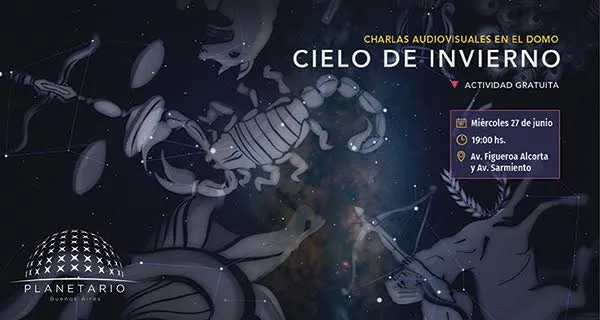
The Planetarium invites us to look at the sky again, learn to recognize celestial bodies, marvel at the telescopic view, and reflect on our belonging to the Cosmos.
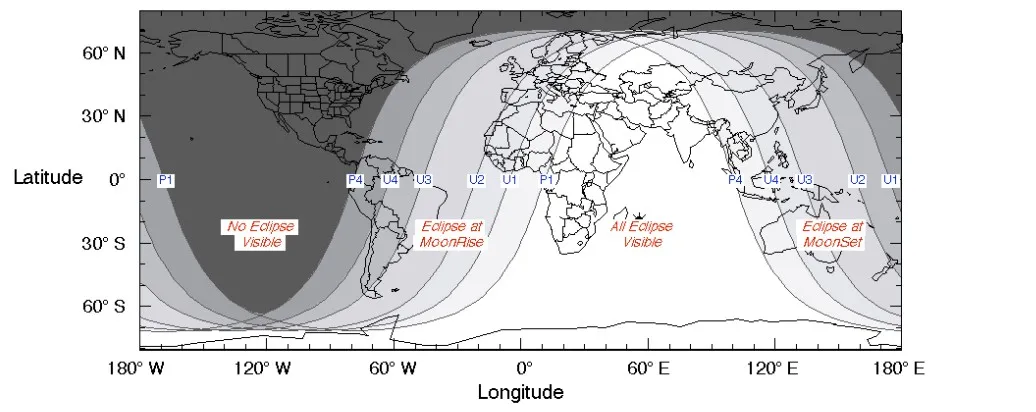
We invite you to discover the celestial wonders of the coldest and darkest season of the year. A group of science communicators from the institution will offer three audiovisual talks in the Show Room. The projection of the starry sky on the dome will allow for the identification of the main winter stars and constellations, as well as "deep-sky" objects and other astronomical curiosities. We will make special mention of the oppositions of Saturn and, very especially, of Mars (given its extraordinary nature), and the total lunar eclipse of July 27.
The presentations will be given by Marianos Ribas, Walter Germaná, and Rafael Girola.
The activity will begin at 19 h in the Show Room with a detailed description of the sky projected on the dome.
June 27 at 19 in the Show Room of the Planetarium/
Free admission / Reservations at www.planetario.gob.ar /
Capacity: 250 attendees
Planetario de Buenos Aires Galileo Galilei - Avda. Figueroa Alcorta and Avda. Sarmiento CABA.
MNEMONIC RULE FOR SEASONS
A couple of days ago, I received an email with the following comment: It is confusing that for the same time of year we talk about the winter solstice and the summer solstice. Wouldn't it be better to talk about the June and December solstices?
The reader is right that it is somewhat confusing, given that there are Spanish-speaking media (and countries) in both the northern and southern hemispheres.
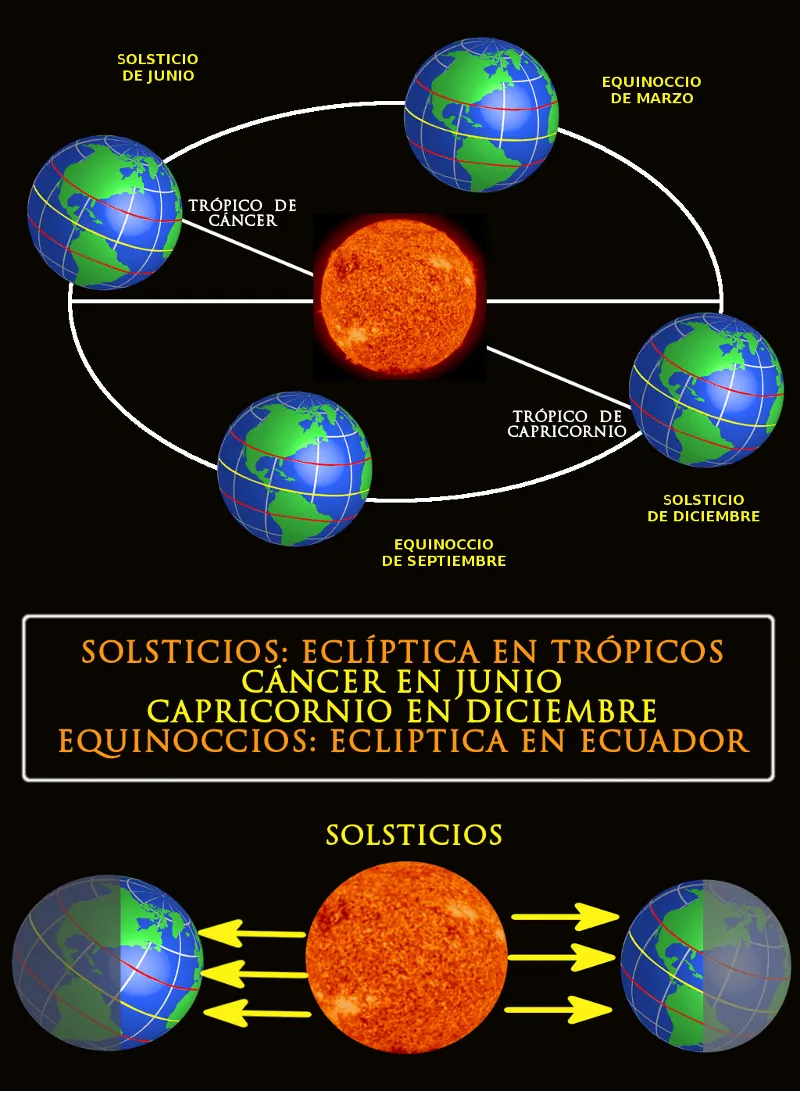
In light of this, I edited an image I had made a while ago and ultimately didn't use. The image (actually two images) serves as visual support for a mnemonic rule. A mnemonic rule or mnemonic is a way to aid memory. Probably in antiquity, thousands of years before neuroscience, our ancestors had already realized that relating terms and associating them with stories was useful for long-term memory. Perhaps that was one of the uses of the myths associated with constellations.
In this case, it is a rule associated with the two astronomical phenomena known as solstices and equinoxes:
Solstices: The ecliptic is located at the tropics. Cancer in June. Capricorn in December.
Equinoxes: The ecliptic is located at the Equator.
The ecliptic refers to the plane of Earth's orbit, which is also the apparent path of the Sun throughout the year.
The Tropic of Cancer and the Tropic of Capricorn are located in the Northern and Southern Hemispheres, respectively, at about 23 degrees and Earth's axis has a 23.5-degree tilt. It is the way the rays reach Earth that produces the seasons, not its greater closeness or distance from the Sun, since in January the entire Earth is closer to the Sun, and in July the whole world is farther away, but there is a temperature difference between the hemispheres.
Sources and related links
- Planetario Galileo Galilei
www.planetario.gob.ar - Infographic image: individual images from Openclipart.org.http://openclipart.org