Is the method of comparison between similars valid?
It is very common, both in daily analysis and in scientific analysis, to use the method of comparison between similars to extrapolate a conclusion.
This method is widely used in biology, physics, and also in social sciences. But is it valid?
It is, as long as we know it has a trap: the conclusions will be extrapolable if the similarity is "sufficient." And the problem lies in determining when and how much is sufficient in each case.
Mathematics can help us show a limit to this method, not to stop using it, but to know it is a fallible method. Ultimately, we will demonstrate what is already known: that appearances are deceiving. This can be demonstrated in many ways, since there are also different ways in which appearances can be misleading. A famous example is the Monty Hall doors.
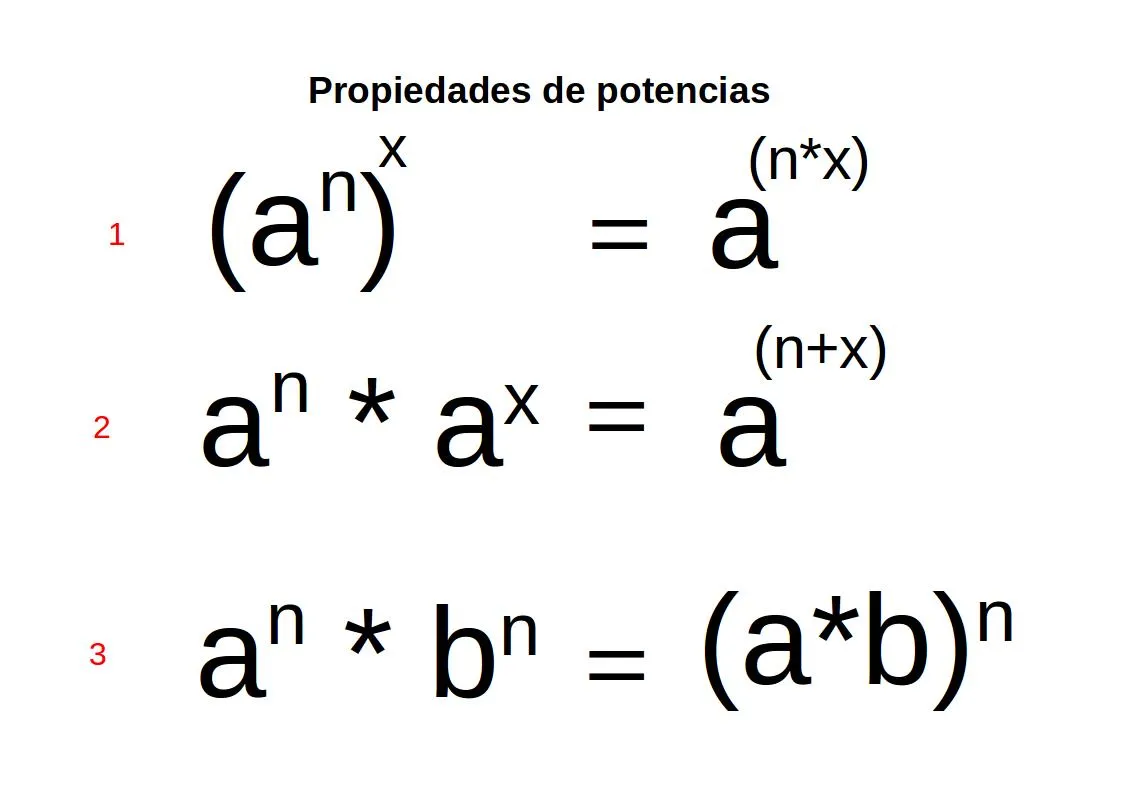
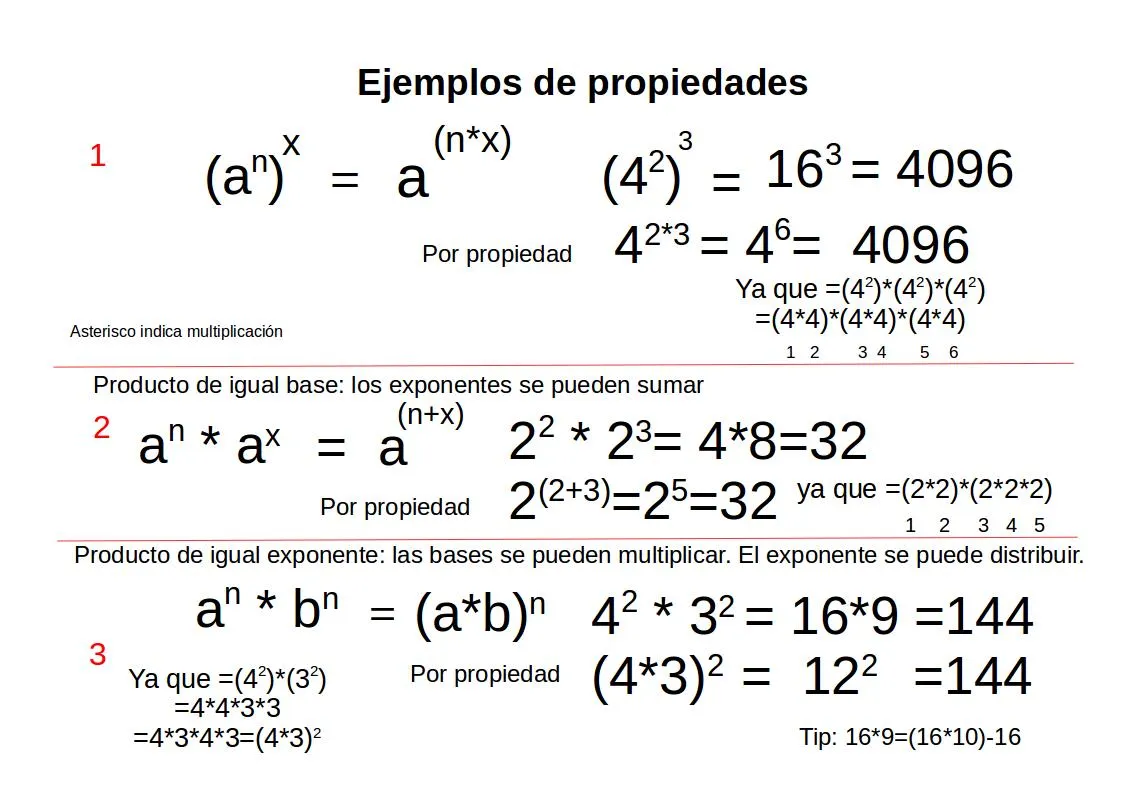
For this, I will propose four mathematical cases, all very similar to each other, based on exponentiation. The first case does not require much knowledge, but for the following ones it is advisable to review something we learned in high school, certain properties of powers, namely:
To develop the cases, I will use images, as it ensures the visualization is correct in different browsers and operating systems.
Before starting, I suggest you review a bit the properties indicated before. This also has another objective, which is to demonstrate that such properties work and have a logical foundation. It is important because I will use them here and it is well worth a brief review through examples I provide below:
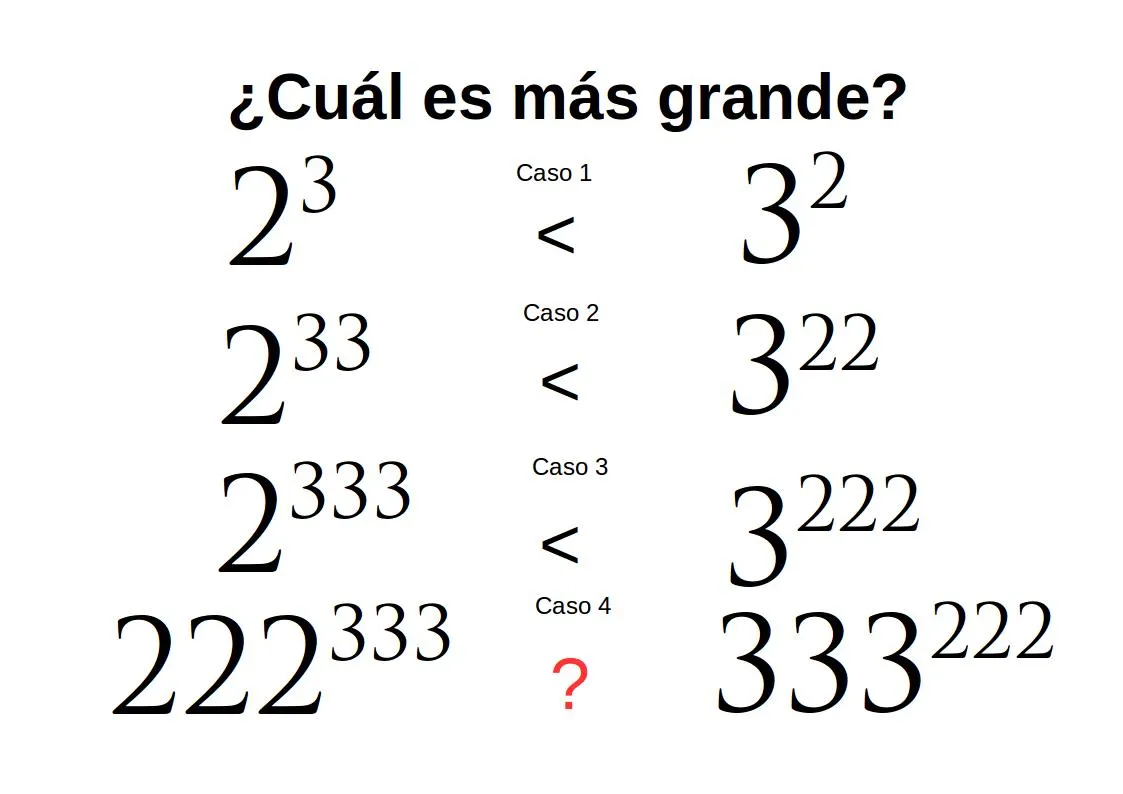
Now then. I will show the four cases I already indicated in the initial image, one by one. The idea is that, at a glance at the first image, I indicate that in the first three cases the larger number is the one with base 3. And I leave doubts about the fourth case which, by comparison, one might say that the number with base 333 is also larger. Let's see if appearances turn out to be true or not.
The first case is very simple: Which of these two numbers is larger: 2 cubed or 3 squared?
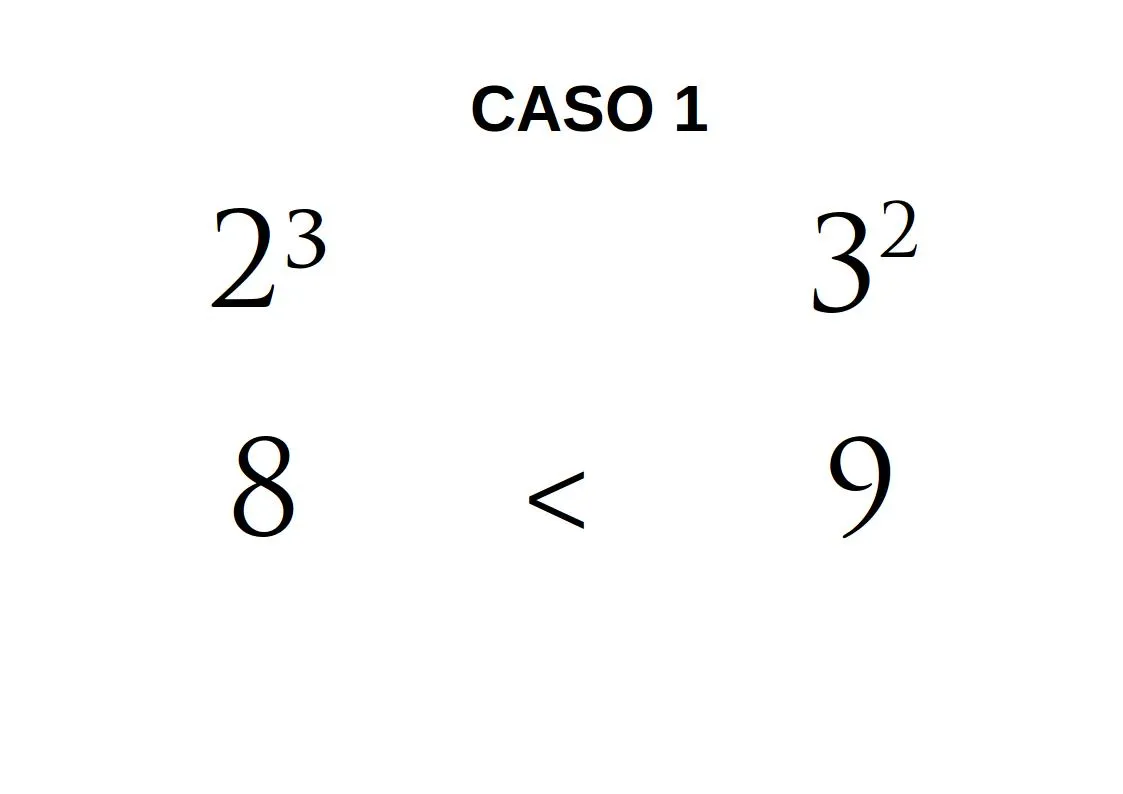
It's easy, since the first value is 8 and the second is 9.
The second case is very similar: 2 to the 33, versus 3 to the 22.
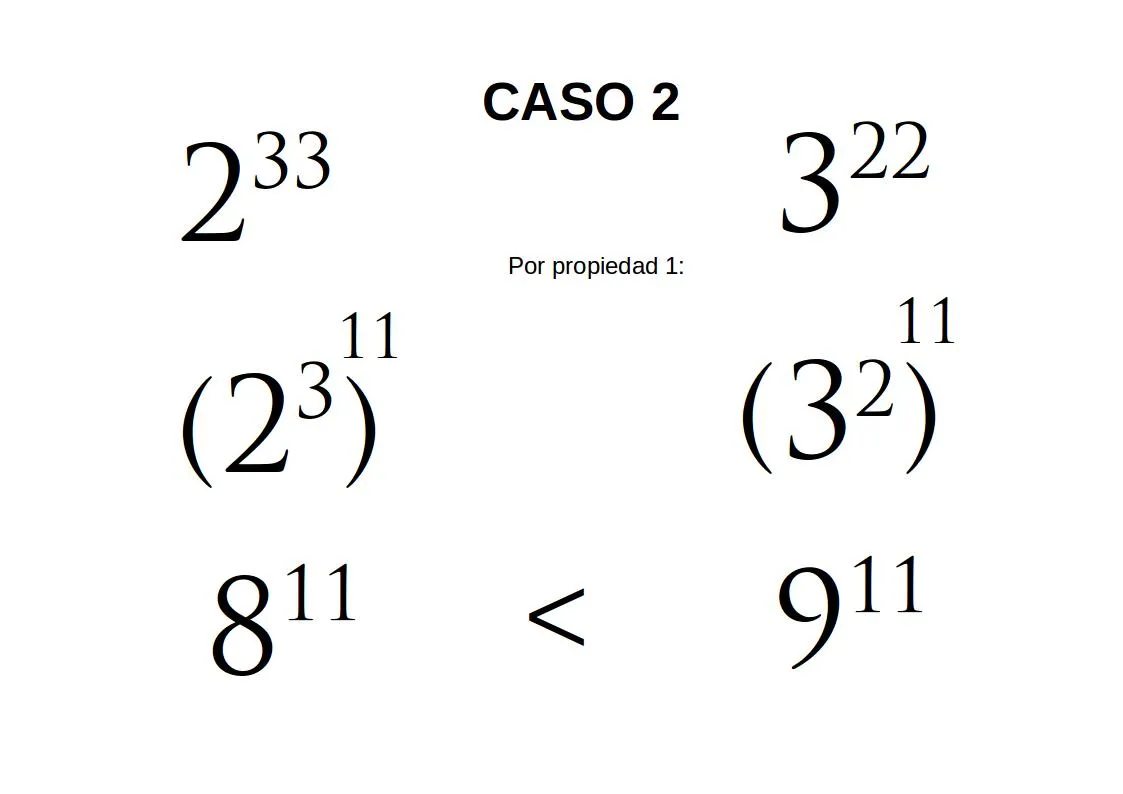
It is similar to the previous case, with the same bases, but with a change in both exponents, in the same proportion. If we apply the similarity method, without doing calculations, we will think that the second number is larger than the first. Let's see: By applying the properties mentioned before, we have that the first value is 8 to the 11 and the second is 9 to the 11. Therefore, the second, just as we thought by comparison, is larger.
So far, the comparative method seems to work. Let's continue with another example.
Case three is notably similar: 2 to the 333 versus 3 to the 222.
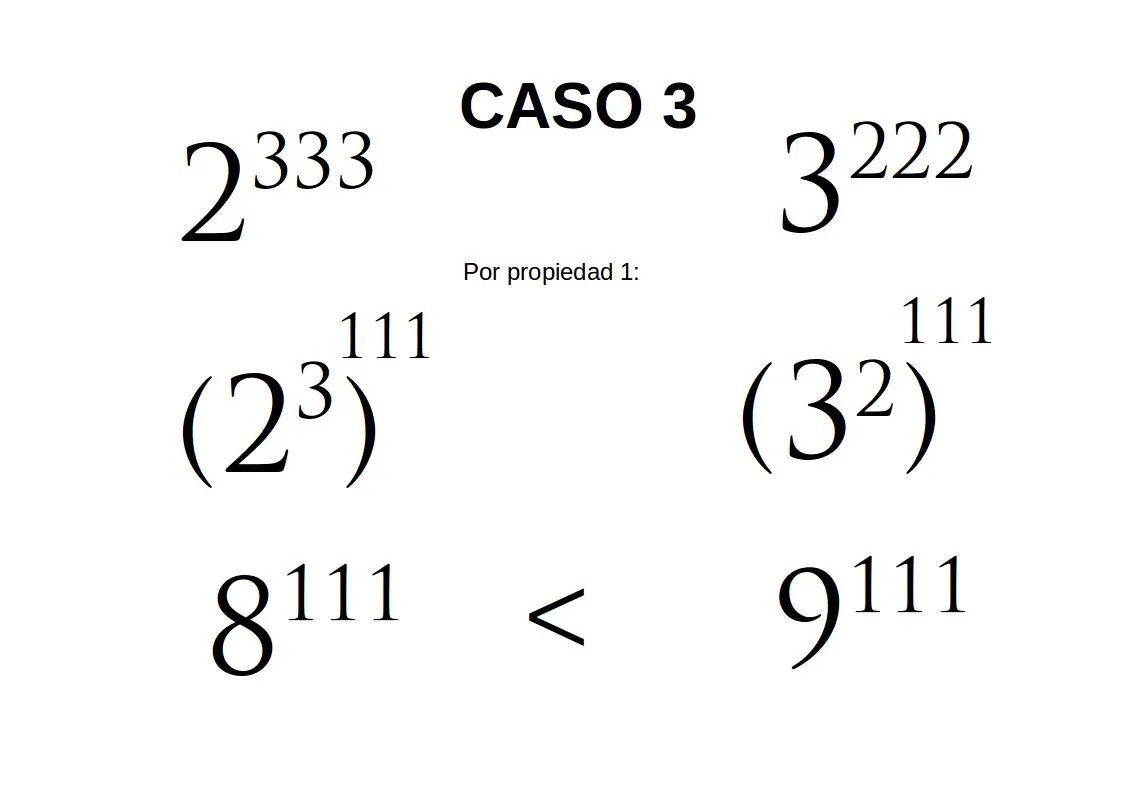
Same bases, increasing the exponents in the same proportion.
If we develop it, we will find that the first value is 8 to the 111 and the second 9 to the 111. Again, the similarity correlates with the arithmetic verification.
We can check it with a calculator or spreadsheet, although I will soon increase the bases and the results will have many digits, so calculators will not give the result.
On the other hand, with simple arithmetic and a little effort, we can know which number is larger without having to calculate it. In passing, we do cerebral "crossfit" and exercise a part of our cognitive skills, which is a way of exercising our humanism.
The fourth case involves comparing now between 222 to the 333 and 333 to the 222.
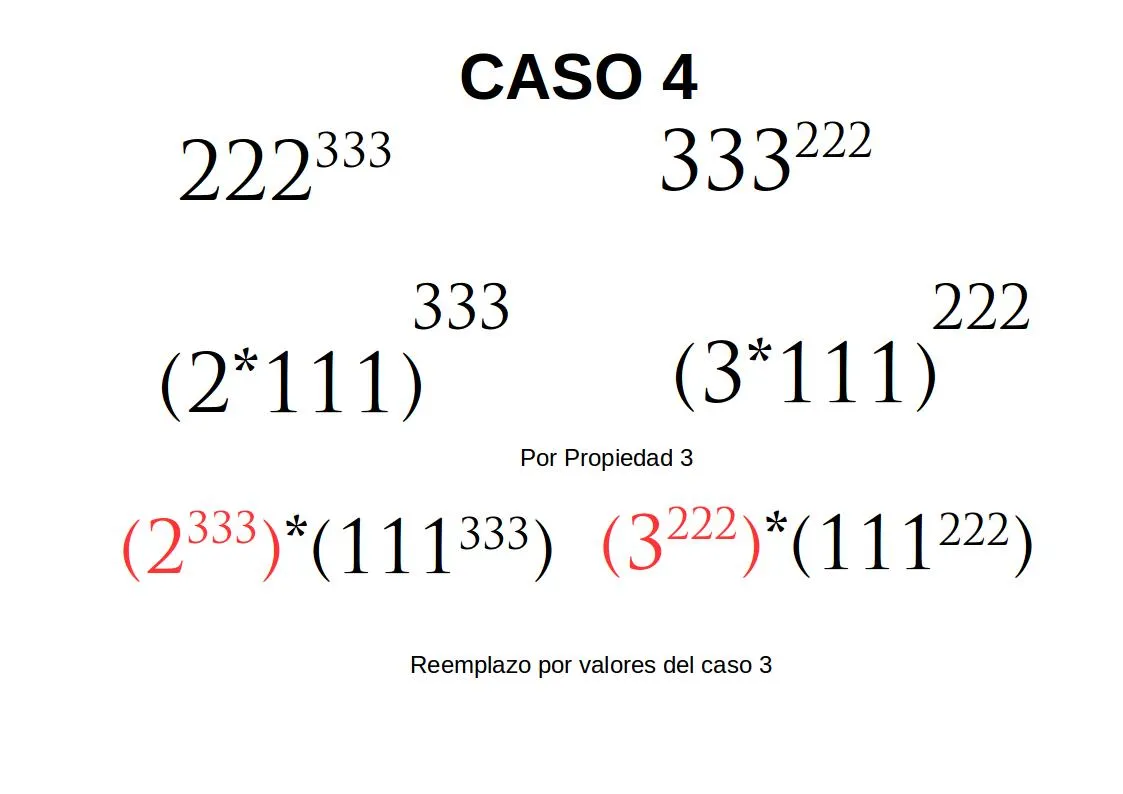
Now we have the same exponents as the previous case, but with bases 111 times larger. In the previous case, the difference between bases was only 1, now it is 111. In case 3, the proportional difference between one base and the other was 50% (since 2 plus half is 3), and in case 4, also, because 222 plus half is 333. Therefore, the bases have the same proportion as in the previous case. And the exponents are the same. Isn't it logical then, by comparison, to assume that the second number is also larger than the first in this case?
It seems logical, but it is false. The first number is larger. Next, I will do the demonstration. But I will leave something pending, how do we explain an "unexpected" result in light of what was said in the previous paragraph? (See aside)
I demonstrate:
First we decompose the bases as a product.
Then we distribute the power, which is possible because it is a multiplication. If it were a sum or subtraction we would have to do something else.
By doing this, in both numbers we have a product. And one of the factors, in each case, is equal to the values we had in the previous case, indicated in red in the image. Therefore, we can replace.
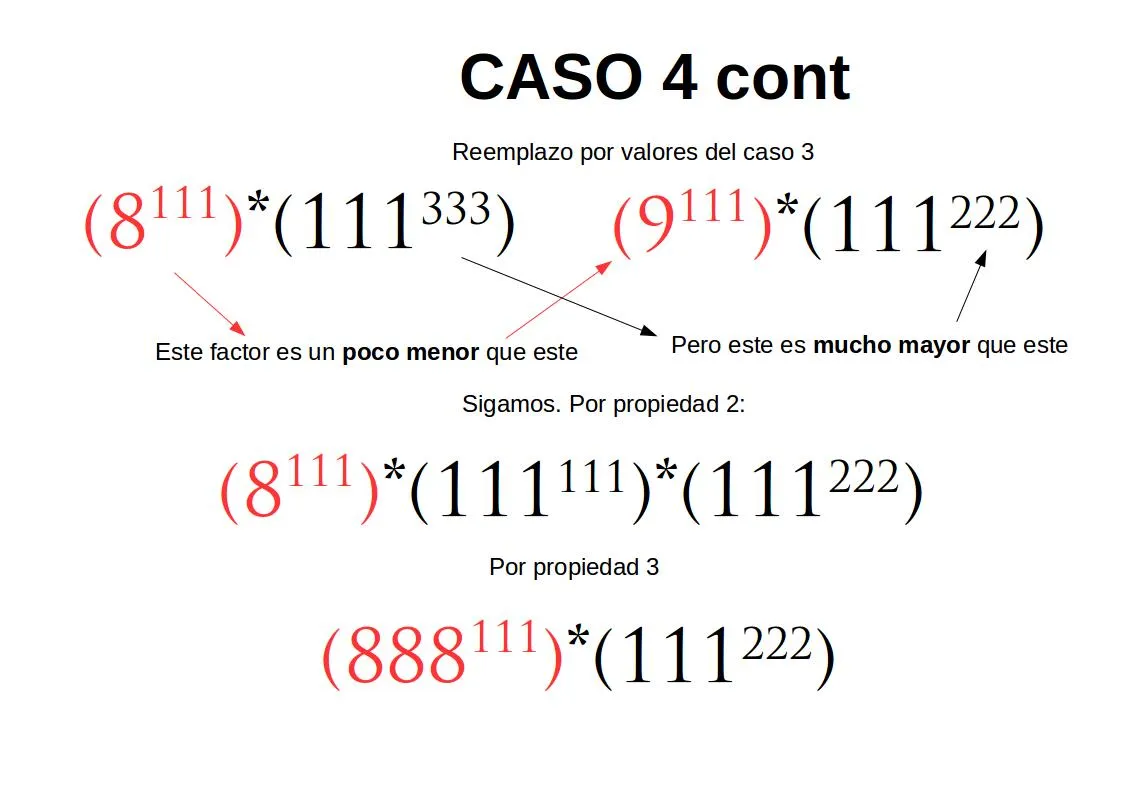
By doing so, we can already see why the first number is necessarily larger than the second. It happens that the first factor is a little smaller in the first number than in the second. But the other factor is much larger in the first number.
However, we will continue to reach the end.
Now, by another property, we decompose the exponent as a product of the same base, in the first number.
In the second number we do nothing.
Then, in the first, we use another property to multiply different bases with the same exponent and finally we have the expression of each number as a product.
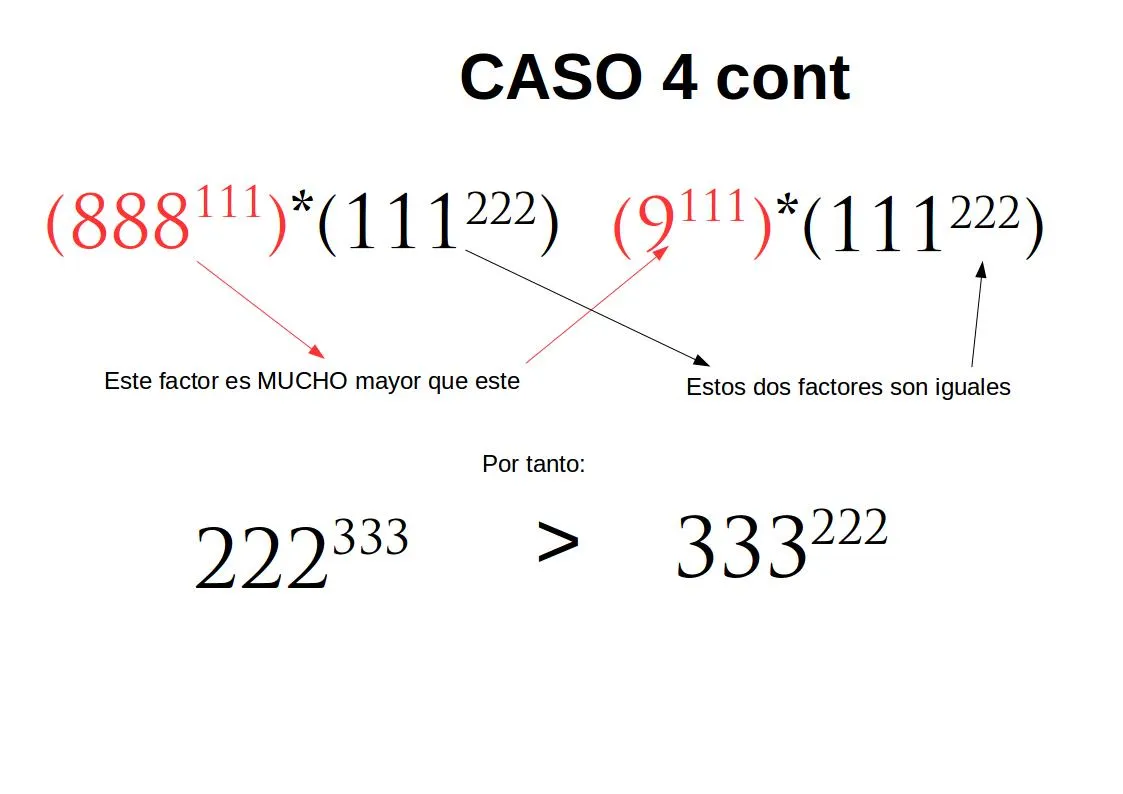
Now we see that one of those factors is the same in both numbers, but the other is a factor much larger in the first number than in the other.
We conclude that the first number is much larger than the second, even though it seemed otherwise.
This is a good gift for any occasion. It's nerdy, useful, and entertaining. Keep it in a little pocket of your mind and use it discreetly.
Aside: Why is it misleading?
I think the explanation is twofold: on one hand, we tend to think linearly, not exponentially.
Second, the chosen examples contribute to that: It is evident that in the first three cases the exponents were increased, not the bases and only in the fourth example the bases were notably increased, leaving the same exponents as in the previous case.
To make it clear, I will add below an example similar to those presented, but which was excluded from the analysis:
22^3 versus 33^2. The symbol ^ indicates exponentiation and is read "raised to".
The first number is 10 times larger than the second.
Ultimately, it seems like a logical comparison, but we are skipping examples, so we are comparing apples and oranges.
Look how different it is when I add these examples that were excluded from the previous cases:
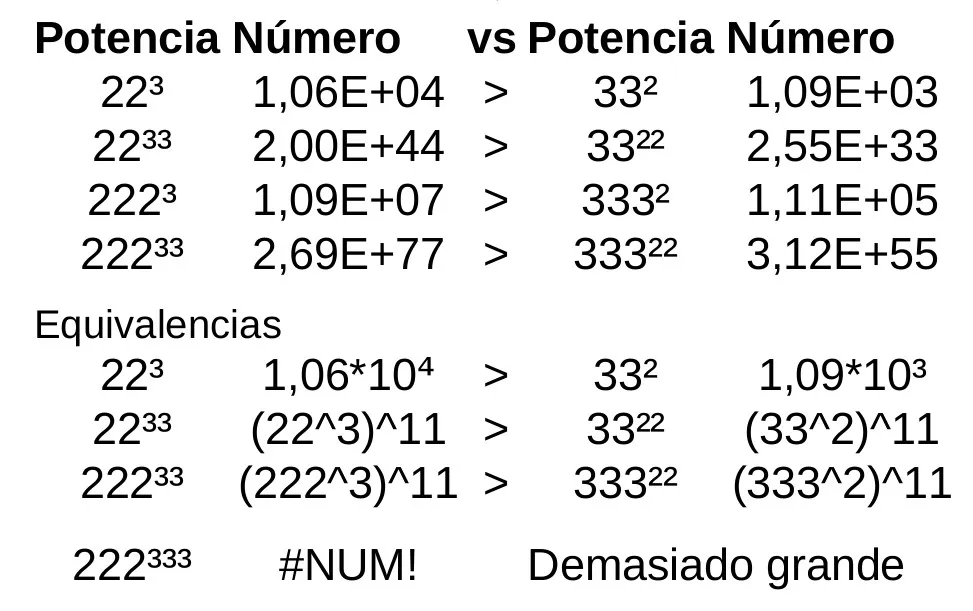
It's easy to deceive when using only the data that suits you and excluding those that don't. That's what differentiates astrologers from meteorologists. The former boast about the few times they are right, hiding the times they are wrong. Meteorologists do the opposite: they are wrong fewer times than they are right. But that is only perceived when you look at the big picture. That is the only thing astrology teaches: what not to do.
Tell that to those who live hanging on appearances.
Sources and related links
Can you answer without using a calculator? Which number is bigger 222³³³ or 333²²²?
https://www.youtube.com/watch?v=_U2SMP115xA