Determinisms and predictions in natural and social sciences.
Determinism is a current of ideas, doctrine or philosophy that starts from the idea that what we know of reality is a consequence of previous causes, therefore, if the causes are known, the consequences can be forecast.
These forecasts can be divided between truly deterministic and conditional ones:
The first ones suppose that given causes A and B, C necessarily occurs, that is, nothing else can occur, except C. Given A and B it is necessary and sufficient for C to occur. That is determinism.
While in most cases, forecasts are probabilistic: given A and B, C will probably occur, which leaves open the probability that C does not occur.
Among the sciences, astronomy has been one of the first and most deterministic, at least in forecasting the motion of objects in the sky. This is so because the causes of such motions are few and known: Newton's laws.
However, Asteroid Day will soon be here and today NASA also gave a conference on Near-Earth Objects: in both cases we are informed that the trajectory of the largest objects is very well known, and since the most massive ones are the riskiest, there is no major problem, but at the same time there are many objects whose trajectory is not known, so their risk of collision with the world is uncertain.
On the other hand, even in the motion of objects, which as said is relatively simple to do (as evidenced by very early and precise announcements about phenomena such as eclipses, transits and conjunctions), there is the "Three-body problem", which means that even in these cases one should be somewhat cautious when making very categorical forecasts.
We can already draw a conclusion: better forecasts will be made with the greater and better accumulation of data about reality.
At least two types of forecasts have been made about the soccer World Cup: the vulgar ones and the scientific ones.
Let's see what their similarities and differences are.
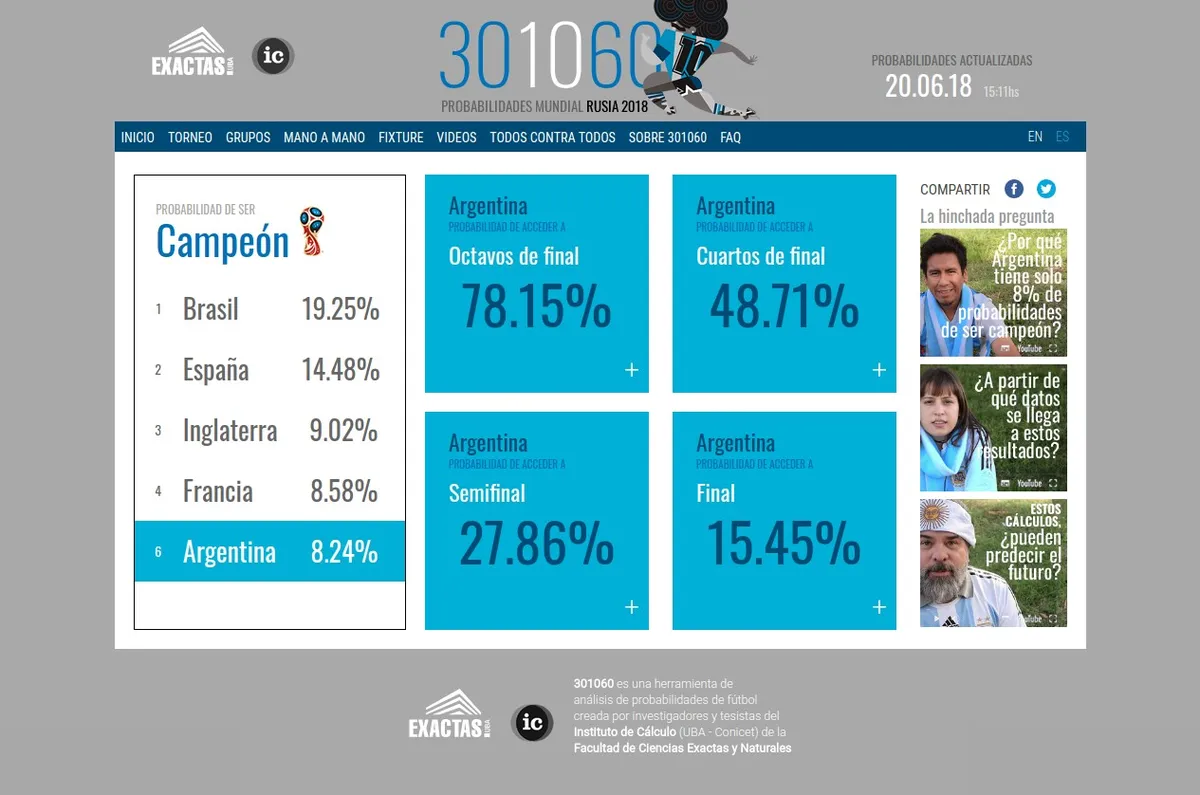
The Instituto de cálculo (UBA-CONICET) headed by Guillermo Durán put online the site 301060 where they show the results of World Cup soccer forecasts based on mathematical models. Furthermore, it is explained on that website how the analysis was done.
One way to approach the method used is through the FAQ.
A basic question: Does the past influence the present?
In probability it is common for people to make mistakes when addressing questions like the following:
If a rolled die came up 1, is the probability that when rolled again it will also be 1 greater or lesser?
The probability answer is this:
P(d.1)=1/6
P(d.d.1)=1/36
P is the probability. D is the time the die is rolled, therefore, d.d implies two times, 1 is the desired result.
The probability that when rolling the die once it comes up 1 is 1/6 because the total possibilities are 6.
The P that when rolling the die twice it comes up 1 in both cases is 1/36 (that is, 1/6 squared) because the total possibilities are 36, as is evident if we make a list:
Die1-Die2
1 1
1 2
1 3
1 4
1 5
1 6
2 1
2 2...
As we see in such a list, for each value of the first die there are 6 values for the second. And since the first die has 6 numbers, in total there will be 36 possibilities. Of all of them, only the first pair (1-1) will be the desired one, that's why the probability is 1/36.
As a result of this, someone will say that, then, the probability of the second 1 coming up is lower, but that is not so. The probability that when rolling the second die it comes up 1 is still 1/6. It is easy to notice if we say it like this: after having rolled the first die, and before rolling the second, the total possibilities are 6. That's why the probability that when rolling the second die it comes up 1 is 1/6, as in the first roll.
The die has no memory, no brain, it does not decide nor is it conditioned by the previous result.
However, on some occasions, the previous result does condition or determine the following result, as in the following example:
If in a bag there are 3 red marbles and 3 blue ones, what is the probability that when choosing at random two times in a row, a red one comes out first and then a blue one, considering that when taking out the first one it is not put back in the bag.
The last line indicates that when taking out the marble the proportions between reds and blues will change. At the beginning, the blue/red ratio is 50%, but after taking out the first one, the proportion changes. With the die this does not happen.
In soccer, does it include history?
In some sense yes, in others no. For example, if a country has a long soccer history, that implies it has a league, with several teams, with many people who have practiced that sport for a long time. If it has no history, it does not have all that. It is logical to expect that in the first case it is more likely that there are better players than in the second. A decade ago, the U.S. national team was "easier" for traditional teams than it is today. This is so because history conditions, it does not determine, since it is not the only variable. In fact, while I write this, Iran ties with...Spain! (Disallowed by VAR).
If the result of a match were known with absolute certainty before playing it, then it would not have to be played. For that very reason, a competition will be truly competitive if there is a certain level among all teams, while if the difference in level is significant, it will not be. For that very reason I have been critical of Los Pumas' participation in the Rugby Championship. The results demonstrate what was obvious before playing. Out of 33 matches, the Argentine national team won 3, drew 1, lost 29. Of the four national teams, once Los Pumas were third and all other times, fourth.
If they played for points, Barcelona (starting lineup) and Aldosivi (with substitutes) the probability that the team from Mar del Plata wins is...nil.
In the World Cup this does not happen. It is true, however, that the level of the teams is not equal. Iceland is not at the same height as Germany, Spain or Brazil. However, Chile or Italy have a longer history than Iceland.
That's why the long history can condition, but the recent history is more conditioning. According to the long history, Argentina is a tough team. According to the short history, not so much.
ANALYSIS OF THE ANALYSES: IS UBA'S FORECAST GOOD?
On the cited page, it's possible to do a "head-to-head" calculation: using that option, we see Argentina vs. Iceland (whose result we already know) gave this:
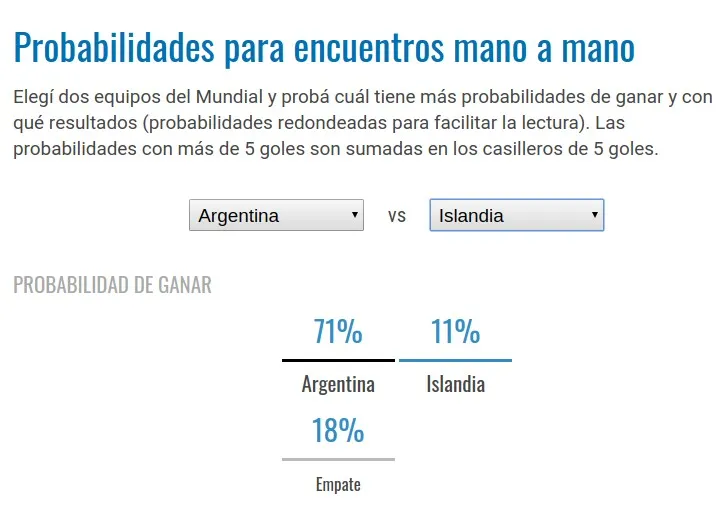
The UBA people calculate an 8% probability for the 1-1, while it yields 71% for an albiceleste victory.
Does this imply it's bad? Careful. Let's keep analyzing data, again with already known results.
Russia v. Saudi Arabia: UBA says Russia 74%. Russia won. UBA was right. (1 correct - 0 wrong)
Egypt vs. Uruguay: UBA Uruguay 54%. Uruguay won. UBA was right. (2-0)
Russia vs. Egypt: UBA Russia 45%. Russia won. UBA was right. (3-0)
Uruguay vs. Saudi Arabia: UBA 77% Uruguay. Uruguay won. UBA was right. (4-0)
Morocco vs. Iran: UBA Morocco 37%. Iran won. UBA was NOT right.(4-1)
Portugal vs. Spain: UBA Spain 53%. They tied. UBA was NOT right (4-2)
Portugal vs. Morocco: UBA Portugal 44%. Portugal won. (5-2)
Iran vs. Spain: UBA Spain 59%. Spain won. (6-2)
France vs. Australia: UBA France 75%. France won. (7-2)
Peru vs. Denmark: UBA Peru 40%. Denmark won. (7-3)
Argentina vs. Iceland. UBA Argentina 71%. They tied. (7-4)
Croatia vs. Nigeria: UBA Croatia 45%. Croatia won. (8-4)
Costa Rica vs. Serbia: UBA Serbia 43%. Serbia won. (9-4)
Brazil vs. Switzerland: UBA Brazil 66%. They tied. (9-5)
Germany vs. Mexico: UBA Germany 62%. Mexico won. (9-6)
Sweden vs. South Korea: UBA Sweden 55%. Sweden won. (10-6)
Belgium vs. Panama: UBA Belgium 73%. Belgium won. (11-6)
Tunisia vs. England: UBA England 62%. England won. (12-6)
Colombia vs. Japan: UBA Colombia 62%. Japan won. (12-7)
Polonia vs. Senegal: UBA Poland 51%. Senegal won (12-8)
So far the analysis of the results given up to today inclusive (June 20).
20 matches were played, UBA got 12 right (60%) and missed 8 (40%). This result is better than what we would get if we flipped a coin.
SIMILARITIES AND DIFFERENCES BETWEEN TYPES OF ANALYSIS
Among the different types of analysis there are similarities: no forecast is deterministic, but conditioning, assuming the existence of non-definitive trends, which can change according to contingencies.
In all cases of common forecasts, it is not indicated how the result is reached, on what basis they are made. Scientific forecasts are often not properly explained by those who make them either.
In both cases, forecasts are made with languages that are not free from ambiguities. In the case of scientific forecasts, the ambiguity appears because the scientific-technical language is not understood by the majority, which generates a certain hermeticism.
The differences between the analyses are noticeable both when validating and when verifying.
It must be clear, then, that to verify the results, it must be done in the plural, in a statistical form. With isolated results we know nothing. This is important when we compare this type of analysis with others, like the "prediction" of Paul the Octopus, which are normally made for a single case, or in this World Cup the poor cat is made to choose between two balls... In those cases, the correct guess is mere coincidence, normal or expected like flipping a coin. It's the same whether it's an octopus, a cat, or a coin.
The verification of forecasts must be statistical, taking the largest amount of data possible.
The same type of analysis done before can be done with all the results placed at the end of the World Cup. And if this modality continues, the other World Cups can be considered.
On the other hand, in this type of forecast it is clear when there is a correct guess and when there is not.
Fraudulent astrologers generally say nothing concrete. It is not clear whether they say a team will win or not, which makes it a useless forecast.
Some emphasize when from time to time some astrologer "gets it right", but leaving aside the times they did not.
But the biggest difference between these types of analysis is in the validation.
The UBA forecast has logic, it is based on data. The explanations were made in short videos with subtitles, so that everyone can easily understand them.
This is something that astrology cannot do. They cannot explain from what data and with what criteria astrologers reach the conclusions they reach. And the worst part is that no one asks.
Once again: astrology is not a science, even if it is presented as such. It cannot predict anything. It is just a set of prejudices.
Why is it called 301060?
On the site they leave the doubt as "homework", but indicate that the site's mark (isologotype) may be a clue. The drawing that characterizes the site is like Diego Maradona. When was he born? On the same date as millions of people in the world who did not do the same as him, because the date of birth does not condition or determine the personality and destiny of people.
Sources and related links
- Nexciencia: Who will be champion?
http://nexciencia.exactas.uba.ar/mundial-rusia-2018-campeon-probabilidades-chances-futbol-calculo-fixture-posiciones-guillermo-duran-matematica-computacion - 301060
https://301060.exactas.uba.ar/ - La Nación: How the UBA's statistical model was created to calculate the World Cup winner
https://www.lanacion.com.ar/2139933-como-se-creo-el-modelo-estadistico-de-la-uba-para-calcular-el-ganador-del-mundial - International Asteroid Day: June 30
http://www.un.org/es/events/asteroidday/