About a note in favor of astrology translated and published in Periodismo.com.
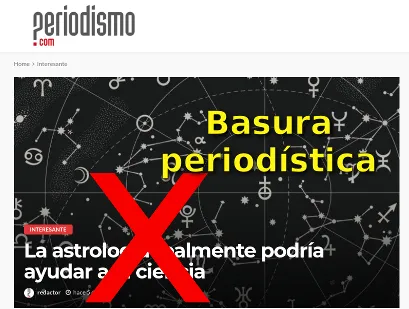
A note in English, signed by Michael Tabb, was published on the Quartz site. The article was translated and published on the Periodismo.com site.
This site, directed by Diego Rottman, is associated with Periodismo.net through which online journalism courses are taught, including a course in Scientific Journalism that I took several years ago.
Furthermore, it should be noted that Periodismo.com compiles examples of "Bad journalistic practice" every month. In the August 2018 version of that section, it states: "Fake news, manipulations, omissions, blunders and all the worst of last month's journalism, rescued by tweeters".
This characterization positions Periodismo.com as a sort of "commissioner" of quality journalism that points out what is done wrong and even teaches courses on how to do it right.
It is curious -or not so much- that on the site's homepage "crazy news" is often published which, while reporting on things that actually happen, can be classified under the heading of "sensationalism".
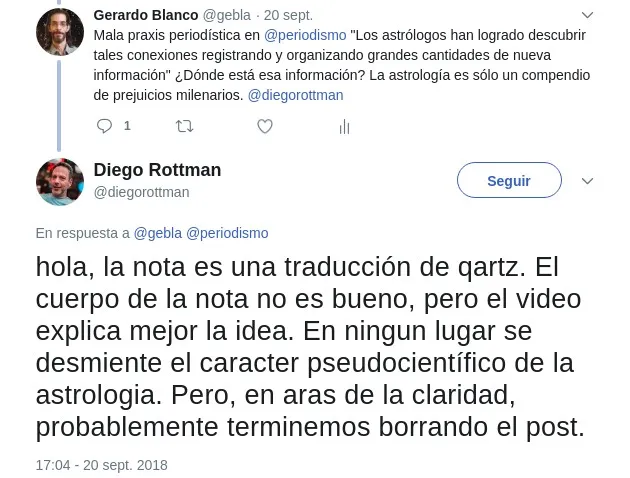
Regarding the unsigned translation published in Periodismo.com of the note in favor of astrology, I sent a tweet to Rottman making it clear that, in my view, the translation of such a note is an example to consider in the "Bad journalistic practice" they compile. His response was as follows: "hello, the note is a translation from qartz. The body of the note is not good, but the video explains the idea better. Nowhere is the pseudoscientific nature of astrology debunked. But, for the sake of clarity, we will probably end up deleting the post."
Beyond the lack of accent marks in Rottman's tweet, the central issue is this: there is no problem in addressing any issue, even astrology, as long as things are made clear, instead of falling into mere ambiguity, and making a "textual" translation is not an excuse for not doing so. By textual translation I mean not a literal translation, but one that is well done, but adds nothing to the original text.
On the other hand, once the note is published, deleting it could not only be considered a form of subsequent "censorship" (which I did not request), but it also clarifies nothing.
Therefore, I will do what others do not do, whether out of ignorance or laziness.
MYTHS AND TRUTHS ABOUT ASTROLOGY IN THE QUARTZ ARTICLE
First of all, it should be noted that the article on Quartz, translated in Periodismo.com, is accompanied by a video. I will refer to both things, the text and the video.
First, the article says that according to a poll more than 40% of Americans claim that astrology is “somewhat” or “very” scientific. And then it says "Blame the internet, blame atheism, blame our stressful times. The number is rising, and it’s even higher among young people."
Regarding this: atheism has very little to do with astrology because astrology is based on gods: the names of the planets, Saturn, Jupiter, etc., come from the Roman tradition. At the same time, astrology does not speak about the physical characteristics of the planets, their atmosphere, their gravity, their magnetism. What influence can a rock in space have then? The "cosmic effluvia" would be nothing other than the "spiritual" manifestation of the gods associated with the planets. Therefore, at least in one sense, it is a form of covert (pagan) religion. It is not exactly a religion, because for that you would need a ritual.
The article also states that: "astrology is essentially a set of stories based on millennia of observations." And then adds: "Astrologers have managed to discover such connections by recording and organizing large amounts of new information, currently, some are incorporating asteroid data, and proceeding by trial and error."
Where are those huge volumes of data collected over millennia? Nowhere. They do not exist. It would be very easy to disprove me by showing such data. No one will do it, they are nowhere. Astrologers do not collect any data. Perhaps some will say they do it privately and do not publish it, which is unverifiable.
If they existed, if there were a huge database, statistical studies could be carried out. We will refer to that shortly. But if it is said that there is a lot of data collected over millennia, a serious journalist (not a fourth-rate one), should ask and wonder where that data is and if they cannot find it, doubt its existence, instead of blindly accepting it. Is this taught in journalism courses or is it taught to publish anything without checking?
THE INFLUENCE OF THE ENVIRONMENT
The article also says: "Furthermore, astrology may have stumbled upon valuable knowledge about how the world around us affects us. Western sun signs tell us that the seasons (not the constellations) dramatically affect our personality. Chronobiology tells us the same thing: just as our bodies follow daily rhythms, according to our biological clock, they also seem to follow annual rhythms, affected by our environment."
Let's look at this, also addressed in the video. There are some statistical studies, not properly proven, but plausible, that establish a relationship between date of birth and diseases, based on a seasonal issue. To put it simply: those born in winter seem to have a tendency to certain types of diseases different from those usually had by those born in summer. This contradicts astrology, since for astrologers, a person born in mid-September is a Virgo, both in the Northern Hemisphere (where it is autumn) and in the Southern Hemisphere (where it is spring). Therefore, if such studies were true, it would make no sense to think of "people born in September (Virgo)", but of "people born in autumn".
On the other hand, these studies say nothing about personality. The influence of the Sun, which is a star and therefore emits light and heat, cannot be extrapolated to any other object that does not do such things. The Sun's influence on terrestrial life is undeniable, but how does the Sun influence personality? In no way.
The Moon also has its influence, given by its size and distance. At night, animals that hunt (or are hunted) will have a difference when the Moon is in its full phase than when it is in its new phase. There is an influence that obviously cannot be extrapolated to the planets: The presence or absence above the horizon of Mercury, Venus, Mars, Jupiter, or Saturn (the planets visible to the naked eye) does not change anything regarding night vision because although they are much larger than the Moon, they are much farther from Earth, so they are only seen as points of light, meaning that the light they reflect from the Sun toward our planet is very little. Their influence on nocturnal animals is nil. And regarding personality, their effect is the same: none.
If planets or moons influenced us by gravity, then it would be fitting to ask two questions: why does astrology ignore all the moons in the solar system, except ours? Jupiter and Saturn together have more than a hundred natural satellites that astrology ignores.
But also, if a piece of rock affected our personality by gravity (mass and distance), then that should also happen with...Aconcagua or Everest. In fact, in these cases, their influence would be greater, because although they have less mass, they are much closer to people. (Gravity is inversely proportional to the square of the distance).
ABOUT STATISTICAL STUDIES
Let's say we find that every time a male is born in a hospital, the traffic light at the corner of the hospital is lit with the red light. Does that mean that every time the traffic light turns red a male is born? Can that CORRELATION be used as if it were a causal relationship? A causal relationship implies a cause-effect relationship. Is there a cause-effect relationship in that case or is it just a coincidence?
Let's say the traffic light has three lights and all three are lit for the same amount of time, one minute each, then logically we would expect that when a male is born only one third would have been born just when the traffic light's red light was on. If a value well above 33% were found, it would be striking.
However, if the traffic light's lights are not lit for the same amount of time, the probability of being born with each light is not equal. If the red light is on for 2 minutes, then the yellow for 30 seconds, and then the green for 1 minute, logically we would expect most births to occur when the red light is on. But in no case is there a causal relationship, meaning the sex of the newborns is not determined by the traffic light's light, as we know for certain because ultrasounds exist.
Similarly, if we had a large collection of data linking astronomical phenomena with human events, certain statistical precautions would have to be taken when drawing grandiose conclusions.
Suppose, for example, that we had a database with records like this:
Date: 09/20/2015; Objects in the sky: Mars; Events: War in the Gulf.
Suppose we have many similar records. We would be tempted to think there is a correlation between Mars in the sky and wars. But, at that moment, was only Mars in the sky?
As we know from modern astronomers, there are dozens of different types of objects in the sky: planets, moons, asteroids, comets, nebulae, galaxies, stars of different types (variables, binaries, dwarfs, giants, etc.), supernova remnants, etc. Most of these objects (except the aforementioned planets and some stars) cannot be observed with the naked eye; they are deep-space objects that were only discovered and can be observed with telescopes. The ancients did not know that, which is why they did not take them into account. But they are there. Therefore, assuming there is a relationship between Mars and wars is...whimsical, unscientific.
Trying to explain diseases only by date of birth is as foolish as demonstrated in a simple example:
People with lung cancer were born in different places, at different times, they are not part of a particular "sign." On the other hand, cancer can be explained by the use of toxic substances like nicotine. That is, to explain what happens to us, we need to know what we do, not what planets were in the sky at the moment of birth.
AMBIGUITY AS A MARK OF THE ERA
It has been said that ambiguity is a mark of postmodernity. This indeed occurs today, although I doubt that this only happens now. But it is true that it is common to find statements like this: "Astrology is false, but Virgos are different from Geminis." Which is contradictory. The Quartz article, translated uncritically on Periodismo.com, goes in the same direction.
ASTROLOGY AS PREJUDICE
Astrology is nothing more than a collection of ancestral prejudices. Prejudices are ideas we form about people before knowing them well, without much data, only based on apparent issues. It is inevitable to form hasty ideas. However, if we are adults, we already know that appearances can be deceiving, so one thing must counteract the other. If we see a man with long hair, we might think "He's weird, must be a hippie," but not all men with long hair are hippies. What we do in those cases is a correlation between men with long hair and hippie-ness. But it is not a causal relationship.
Similarly, there are those who think that black people are inferior or "weird"; that women are inferior to men; that Jews are this or that, etc. They are prejudices because they are false ideas, given by a small amount of real data that cannot be extrapolated to the whole.
Therefore, a prejudice is an idea that may seem true, based on some data, but is actually false. Scientifically false.
If we are against prejudices, then we should be against astrology. Those born in June are different from each other, people's personality is not determined by the planets in the sky at the moment of birth: personality is a consequence of the socialization process.
That's why astrology has nothing to offer, except stereotypes, preconceptions based on outdated ancient knowledge, and it generates prejudices about whether people are this or that way without knowing them. How can anyone be in favor of that?
CONCLUSION
In any case, I could agree that the study of what astrology is and what it is not can help the social sciences, particularly to understand how we people form false ideas about others, how prejudices are formed and maintained, both in the past and in modernity. Nowadays, among other things, one would have to consider the influence of the media which, supported by the "tyranny of demand," offer audiences what they demand, even if it is false, questionable, distorted. If people consume it, if it gets "clicks," if money can be made, then it is published. That explains the "crazy news" on many portals. Facebook is now blamed for "fake news," that is, false news, and it is often said that they rely on the public responding emotionally more than rationally. But it is clear that this does not begin and end on some social networks.
It doesn't matter if I like something or not, nor if it is modern or ancient: to know if something is true, one must base it on evidence.
Sources and related links
- Periodismo.com: Astrology really could help science
https://www.periodismo.com/2018/09/17/la-astrologia-realmente-podria-ayudar-a-la-ciencia/ - Journalistic malpractice August 2018
https://www.periodismo.com/2018/09/03/mala-praxis-periodistica-agosto-de-2018/ - Quartz: Astrology, the beloved pseudoscience, could actually really help science
https://qz.com/1382407/astrology-the-beloved-pseudoscience-could-actually-really-help-science/