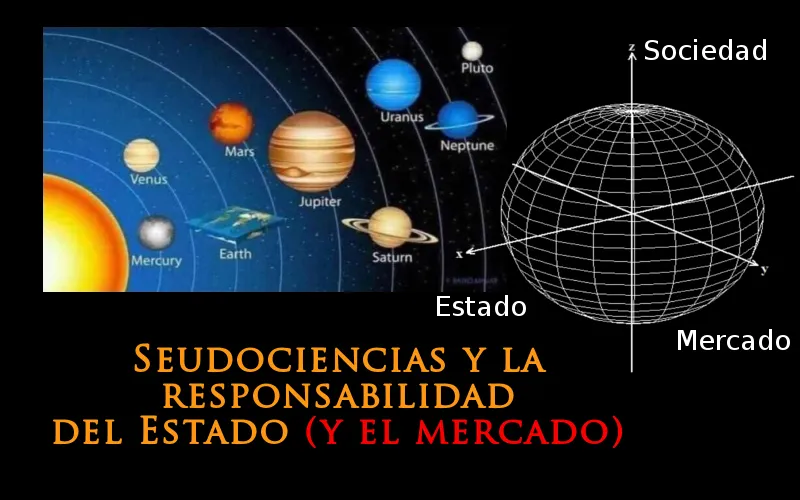
Some reflections on a comparison.
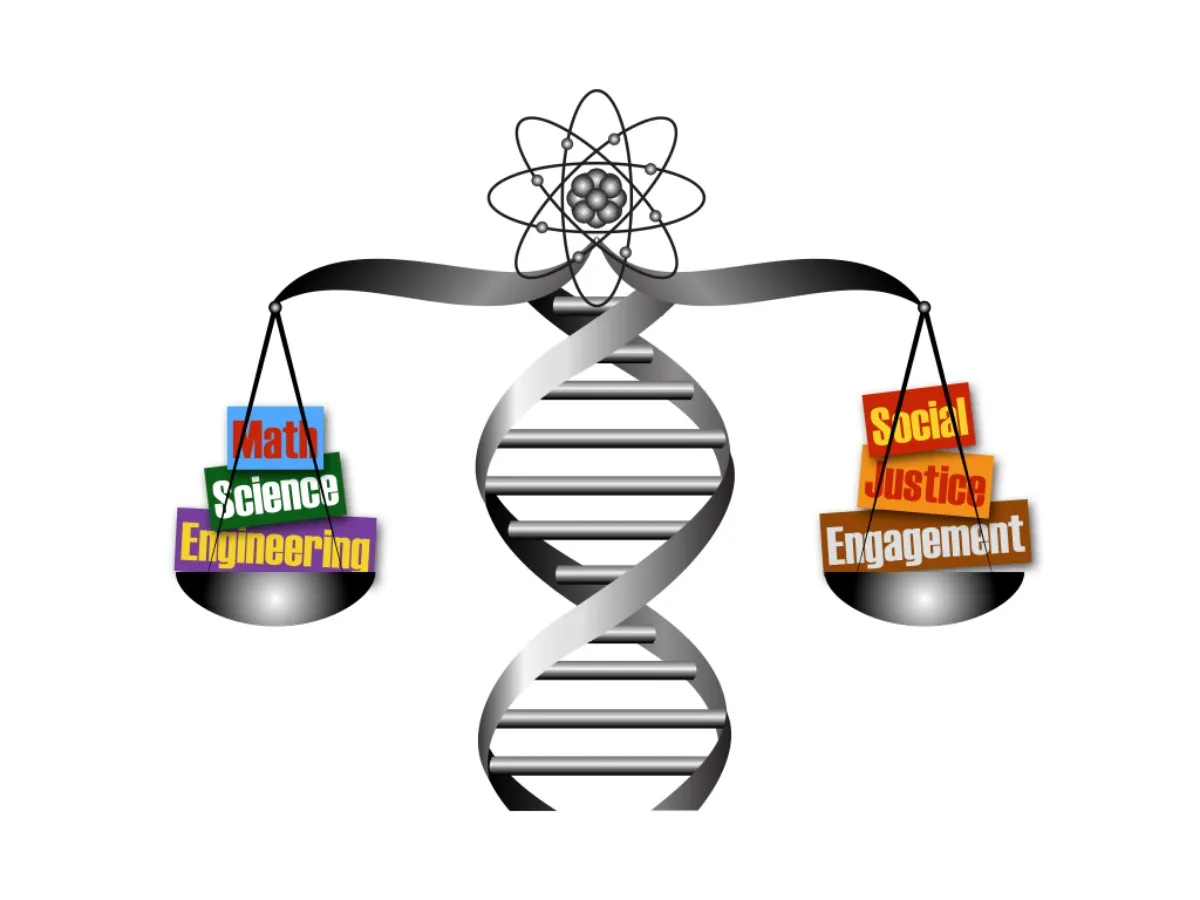
I have already said on another occasion in this blog that science can be compared to the judicial system. In one case and the other, the attempt is to know how, perhaps why, something happened. I am aware that, despite the similarities, science and justice are not the same. One of the differences is that in science, particular cases are investigated to reach general conclusions, which are then applied to other particular cases. The comparison, in that case, is more related to the legislative power that creates positive laws, later applied by the judicial system. Laws (both positive and scientific) are general, arising from particular cases and then applied to particular cases. For example: a person has a cough, conjunctivitis, fever and spots appear. Then another, then another. It is investigated and a common factor is reached: a virus (measles). Analogously, a person steals from another; then another case, and later another. Since that does not aim for the common good, a law is established that punishes the one who steals (when detected, and proven) under the general consideration that it will always be wrong, with some limitations or requirements: it must be a volitional and conscious act. The main difference is that justice tries to find culprits who are persons or legal entities and imposes punishments.
WHAT IS PROVING SOMETHING, WHAT IS PROOF
What I want to highlight, however, is that both theories in science and crimes in justice must be proven. What is proving something? How is something proven? Let's think.
Let's say that Fulano entered a jewelry store, for which he broke the glass door, and then put the merchandise in a bag and left. Suppose everything was recorded on video, does that video serve to prove the crime once and for all? Beyond what the laws say today, again, let us think:
If the person is clearly seen in the video, without a doubt, it could serve, but at no time does the criminal show his ID to the camera, so the only thing we can use to identify the person are physical features. Clothing could also serve, but it is highly likely that two people dress very similarly. It is also possible that there are several people with similar facial features. Even if the person's features are determined with great certainty, it may be difficult to identify them if, for example, it is someone who has an identical twin.
Now suppose we have a video of a person entering the jewelry store by breaking the door and then leaving with the bag, but nothing is recorded inside the premises, perhaps because the thief covered the interior camera or because it was not working. Is the entry-exit video enough to "prove" that such a person stole? Actually, what we would have "proven" is that such a person entered someone else's premises, but we have not "proven" that they took the merchandise. However, the jewels are not there and on the counter are the fingerprints of the identified person. It is logical to suppose, deduce, infer, that such a subject took the jewels. Or not?
This type of situation is common in justice, that is, there are no direct material proofs of all the facts of a crime. One does not usually have a video of every murder, robbery, rape in which all the details of an event are recorded. It is impossible to "prove" a crime in that way, except in rare exceptions.
Similarly, it happens in science. What is this about?
AN ANECDOTE TO SHOW A PROBLEM
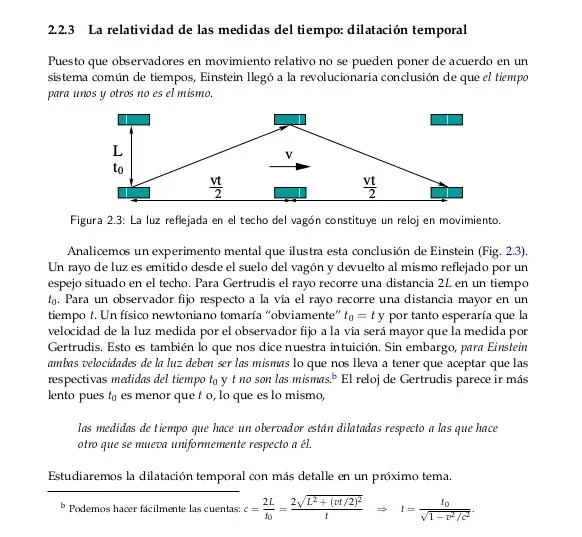
I go to the newsstand to get a new installment of the mobile solar system that is sold in parts (it's on number 22 of 104!) and the friendly newspaper vendor tells me that a new science collection has started to come out whose first issue is about Einstein. And he tells me that he read about the topic years before, but he couldn't understand it. So I took a notebook out of my backpack and made a drawing to explain something simple. It is an explanation that Einstein himself gave and is easy to find well developed in books and on websites, so I will only mention it briefly:
Let's say there is a room where we bounce a rubber ball that always moves at the same speed and bounces on the floor and ceiling with the same frequency, making a sound in each case. It's like a clock: tick, tock, tick, tock.
Let's change the ball for a photon, the particle of light, which always moves at the same maximum allowed speed (since it has no rest mass). It doesn't make a sound, but it is also a form of light clock. Someone is inside the room. And we are outside, seeing what happens inside because the wall is glass. We will see the same, measure the same. Now let's make the room move parallel to us, that is, the room is a ship, a train for example. What the one inside measures will not be the same as what we will measure, outside, although it is equivalent (using the transformation of the trio Lorentz + Minkowski + Poincaré).
And then the newspaper vendor says to me: "But it's a theory...". And at that moment I thought: what does he mean by "but"? The friendly vendor continued: "For example, the Big Bang as an initial explosion, it's a theory, it's something that cannot be proven...".
Then I said: "Actually, the Big Bang was proven when, in 1964, Penzias and Wilson detected the cosmic microwave background radiation." Immediately I corrected myself: "Actually, what was discovered was that radiation, with a wavelength, frequency and temperature that were later interpreted as remnants of a very dense and hot beginning". And the newspaper vendor said: "It's a theory, it cannot be proven..."
One might then ask what we expect a "proof" to be. We are not going to have a video of the Big Bang. Nor would we have one in the case of the jewelry store robbery as I presented earlier. If we had to decide in that case, with the video of entry-exit, plus the fingerprints of the man identified inside the jewelry store, plus the missing material, isn't that enough to "prove" the "hypothesis" of robbery? Or should we perhaps think like the newspaper vendor and say "it's a theory, it can't be proven"?
Because if that's how it should be, then almost no crime can be "proven," nor anything else (inside or outside the judicial system).
It is logical, however, that we be cautious, because if positive law is an attempt to achieve the common good -by punishing that which is contrary- then we should not blame an innocent person. We must be as sure as possible and if we cannot prove sufficiently, then there will be no punishment. If we are not rigorous, it backfires on us, as anyone could be accused of anything, without proof.
That said, both in science and in justice, things are attempted to be proven with the greatest possible certainty (or so it should be). This does not mean that "proving" is having a video with the details, since in the vast majority of cases it is not possible. Expecting science to "prove" things as if there were a video with all the details is naive, utopian. And the same applies to Justice.
SCIENCE, JUSTICE AND CURRENT EVENTS
What was said about the newspaper vendor is true and current. But the political and economic situation, these days, also allows us to think about robberies, proofs, and the common good.
If we have people who say they paid bribes and bags full of money with no legal origin and there were officials with assets that cannot be explained by their income, well, if that's not robbery, what is? What proof would have to be found so that there is no doubt? That question is very important, but it must be said, based on what we thought before, that there will always be some margin of doubt as long as everything cannot be "proven" with the minimum detail as if we had a video of all the events. We will have to infer, from concrete data, the missing events, as well as the possible intentions.
Stealing is wrong and that is why it is punished, as it does not aim for the common good. If it were right, it should be right for everyone to steal and if we all stole, the common good would not be achieved.
But once the law is made, the ideological trick is made. Because devaluing the currency, for example by 300%, is also a form of stealing, it also does not aim for the common good, but it is not considered "illegal." Affiliating people without their consent, presenting economic contributions from people living in poverty (meaning they are not in a position to contribute) is not only lying, but if one lies it is because one wants to hide something else, surely illegal. The one who tells the truth does not have offshore accounts. Cutting science and education budgets also does not aim for the common good and is not seen as an offense. Destroying jobs and diluting purchasing power do not aim for the common good and are not considered crimes, but they deserve to be classified as such. Is it necessary to prove that all this is true? Yes, it is necessary. Can it be proven? Yes, it can. Yes, it can!
ADULT BULLYING VS NEWTON
The term "bullying" has been used to refer to the harassment a minor suffers at school and on social networks, but it can also be used for harassment among adults. Suppose a person bothers me, hits me, steals from me, several times. I will try to avoid that, for example, by moving away. But if I can't, then I will have to defend myself, and the first and minimal way to do so is with a complaint, that is, expressing my disagreement. If, on the other hand, in the face of such harassment, I did nothing, it is logical to imagine that it will continue and worsen.
Therefore:
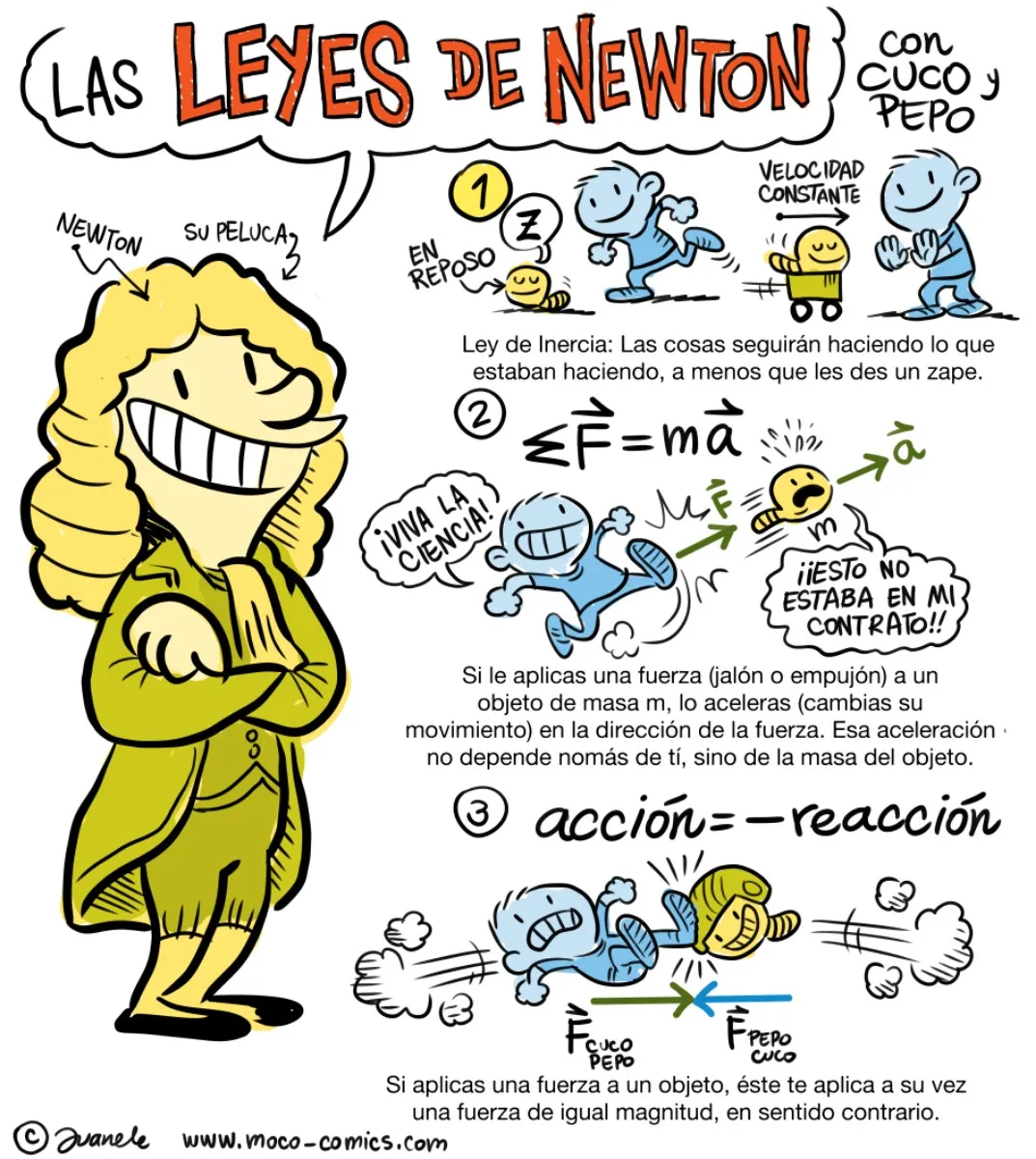
1-Every negative action or harassment will persist, unless forced to change by exercising the force of complaint.
2-The change will be proportional to the forces exerted.
3-Every action (positive or negative) generates an opposite reaction.
And this is a social Law, as scientific as Newton's Laws. If instead of acting like this, we stand by with our arms crossed under the criterion that "nothing can be proven, nor done," then, only a single force contrary to us will be exerted and society will collapse like a massive star into a black hole, which is like the Big Bang, but in reverse. It's proven.
Conclusion: you learn more by buying the newspaper than by reading it. Plop!
Sources and related links
- The Light Clock
http://www.emc2-explained.info/The-Light-Clock/#.W4nW9XX0nQo - José Ignacio Illana
2. Space, time and spacetime: Minkowski diagrams
https://www.ugr.es/~jillana/relatividad.php
About the images
Illustration by Punya Mishr.
Why science teachers should care about social justice? New article http://www.punyamishra.com/2017/03/06/why-science-teachers-should-care-about-social-justice-new-article/
Newton's Laws
Juanele, Moco Comics https://www.moco-comics.com/archivo-de-comics/