Two views on the same topic.
Recently there have been a couple of cases that, once again, bring pseudosciences into discussion and, furthermore, the role of the State. I am referring to the call made by the Argentine Consulate in the U.S. for a talk on astrology and the meeting of Flat Earthers with the collaboration of a municipal government.
One view on the topic focuses on the responsibility of public officials, that is, the responsibility of the State. Let's see what consequences this generates:
A journalist publishes an article in favor of astrology in a private media outlet, which has an owner.
Another journalist publishes an identical article in a public media outlet, which belongs to the State.
According to the previous view, the State will be objected to for publishing the second article, but the private media outlet will not be objected to. This assumes a position by which the State is considered to have greater responsibility than the Market, exonerating private activity and justifying that, in order to obtain profits, nonsense is published. Statements do not change their truth value depending on who makes them.
Another approach is scientific-realist, that is, a perspective based on the causes of problems and, by virtue of a diagnosis, evaluating possible alternatives or strategies.
The mere objection to the officials in charge is insufficient, it barely scratches the surface of the iceberg and changes nothing. Although such objections are logical, they are not enough. It is evident that the problem is educational. Subjects like "Introduction to scientific thinking" are not usually taught in high school -which has the greatest social reach- although they are taught in universities, and not in all of them.
A while ago, a journalist published a two-page article in favor of astrology in the youth supplement of a newspaper from the Federal Capital. Regarding this, I published a critique here and in response, that woman contacted me to say, among other things, that she is a sociology professor at UBA, an institution where that subject is indeed taught as part of the Basic Common Cycle.
Do people know what science is and how it works? Do they understand the difference between scientific conclusions and other types of conclusions?
How will people know if it is not taught? Or if it is taught poorly?
Instead of being content with an objection to the officials in charge, we should demand that scientific knowledge reach the majority of people and the best path is high school. This does not imply "indoctrination," but rather fostering the development of critical thinking. It would be very good if, in an educational context, students questioned the quasi-sphericity of the Earth and held a debate. The question is: what are the logically valid methods for reaching a conclusion?
Flat Earthers are based on the interpretation of certain writings they believe are "sacred." And those who are not based on that, or do not say so, believe that the images from space agencies are fake, the product of an international conspiracy. What would be the objective of such a conspiracy in favor of the quasi-spherical Earth?
Let's see an example:
A Flat Earther has a wife and she is murdered. After evaluating security camera videos, photos from occasional witnesses, testimonies and other documentary evidence, a presumed murderer is detained. The accused argues that all that evidence is the product of an international conspiracy against him, that the images are all fake. What attitude would the Flat Earther husband of the victim have? Will he agree that there is a conspiracy against the accused?
If it is valid to object to documentary evidence because we don't like it, then it is valid for Flat Earthers to do so and also for the murderers of Flat Earthers.
THE IMPORTANCE OF SCIENTIFIC EDUCATION
Scientific education is not necessary only for those who want to be scientists, but it is necessary in daily life, just like eating. However, we are not taught what scientific knowledge is and how it works, nor are we taught what nutrition our organism needs, in what proportion and where such foods can be obtained, in high school.
We learn those things not by action of the State, but by action of the market: magazines, videos, websites. As a consequence, we learn, but poorly.
That this is a problem is evident in the training of journalists, who in most cases also do not have training in this regard, although later they host programs or write articles about astrology or related things, in order to obtain an audience.
Scientific knowledge has no demand, it has no ratings: that's why newspapers usually do not have specialized journalists or science supplements. Even on science or documentary TV channels, programs like "Ancient Aliens" are produced, again in search of ratings.
Nor are public officials obligated to learn scientific knowledge. Anyone can be a mayor if they gather the required votes.
It is more serious because the idea that there is no contradiction between magical thinking (which includes religions) and scientific thinking seems very widespread. Thus, a consul or a mayor can say they are in favor of science and of astrology and Flat Earth, simultaneously, since they do not consider there is a contradiction. Several surveys from different countries indicate that the majority of people believe in the supernatural.
Choosing to believe, aside from the evidence or forcing the data of reality to fit a preconception, is nothing new, although now it is called "post-truth" or "fake news."
To make matters worse, some professional astronomer claims that the remains of a comet destroyed after approaching the Sun is actually an ET spacecraft, without sufficient basis for such a claim, except the desire to become famous.
The same private media outlets that called the Flat Earther meeting "unusual" publish astrology articles every week, which they do not consider in the same way.
A while ago, on the TV channel of the University of La Plata (where one of the three astronomy faculties is located) they invited the same person who organized the Colón meeting and the journalists did not have a critical attitude, but the opposite.
CONCLUSION
Objecting to the relationship between pseudosciences and the State is logical for those of us who are modern. Society is more diverse. Objecting only to the public sphere is insufficient, and can even be counterproductive since there is a risk that such objections are thought of as acts of censorship, instead of preferring to contrast magical thinking with scientific thinking.
Obviously there are other things that can be done and demanded, such as the incorporation of scientific knowledge into the entire educational system, from primary school, secondary school and including all tertiary-level careers.
Dr. Alejandro Gangui has shown -in his work "Didáctica de la astronomía"- that the teaching of astronomy in secondary school is scarce, but the worst part is that it is poor.
I prefer that astronomy not be taught and that nutrition be taught, because the latter is more important for everyone than the former. But without a doubt we must teach and learn what science is, how it is done, what the differences are with other forms of thought and why in some cases it is preferable to do science than to do other things.
Just as with mathematics, which often generates rejection and attempts are made to overcome that social inertia by showing that it is useful in daily life, the same should be done with scientific knowledge and critical thinking.
During the French Revolution, the Enlightenment impulse led to burning churches. Today, some centuries later, magical-religious thinking is alive and well and there is a reaction against science. Instead of "burning churches" or prohibiting flat-Earther meetings, we must promote scientific knowledge and contrast with logical arguments based on evidence.
The State has responsibilities and is part of the problem, as evidenced in Article 2 of the Argentine National Constitution. But the Market, with its "invisible hand," can have greater reach than the State. Journalists and teachers, from the public and private spheres, also have their responsibility. Therefore, the problem is not only what the State does, but also what it does not do.
About the images
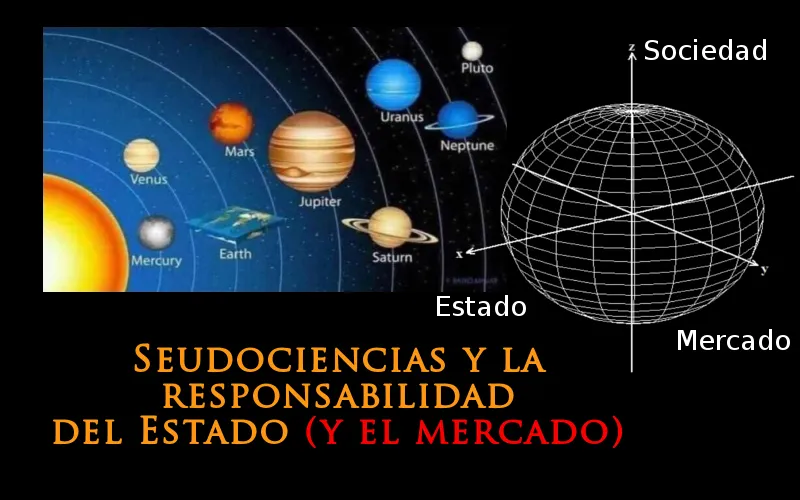
Combined illustration made from:
Illustration published by Micah Brening on G+ Science (on Pablo Della Paolera's blog, https://paolera.wordpress.com/2018/04/20/el-sistema-solar-segun-los-terraplanistas/); sphere illustration: Uned Repository: http://repositorio.uned.ac.cr/multimedias/metodos_numericos_ensenanza/glosario/mod1.html.