A wish for a prosperous future for the civil year that begins, which will be key in space exploration.
For this time of year, we remember that Christmas of 1968 when the famous photograph of Earth rising over the lunar horizon, known as "Earthrise," was taken.
There is no doubt about the importance of that photograph, but I think it is appropriate to bring up another memory, a "memory of the future." For those of us like me who are graying, some science fiction ideas flooded our adolescence, for example, a future with flying cars. Today, 30 years later, we are nowhere near having vehicles like those freely circulating and being commonplace as narrated in the movie "The Fifth Element." However, there is, was, will be a science fiction that became reality: The Space Shuttle.
The "shuttle" was propelled by rockets, but upon reentry, it descended like a plane and was reusable. It was a vehicle of the future, projected already in the late 60s and made real at the beginning of the 1980s.
Some salient facts of the "Shuttle" were the accidents of the Challenger and Columbia orbiters, but also the launch and placement into orbit of Hubble, as well as its first servicing mission.
We must remember that after Challenger, in 1986, the program was halted for two years. The report was damning, as the accident could have been avoided. In 1988, the program was resumed and several probes and satellites were launched. But the real challenge came in 1990 with Hubble. The journey to place the telescope in orbit was longer than usual, about 500 km, and was achieved with great success. Except for the fact that the mirror was poorly made, by millionths of a centimeter, and the telescope was nearsighted.
The first servicing mission, carried out in 1993, had five EVAs or spacewalks, in record time and very difficult, to place the corrections on the telescope.
If the STS was a futuristic space vehicle, the Hubble Telescope was, despite its failed "first light," a flagship instrument-ship for NASA until now. Perhaps we have already gotten used to the images obtained with Hubble, but it is necessary to remember that someone had a brilliant idea: to photograph, with long exposure, a seemingly empty portion of space, which gave rise to the deep field images.
During Christmas of 1995, the first deep field was made with 342 exposures over 10 days. In that region of Ursa Major where there seemed to be nothing, 3000 galaxies of the distant universe were found. The proposal had been made by Robert Williams.
The following year, the southern deep field was made and then came the ultra deep field images with the ACS camera after the 2002 servicing mission.
The telescope was not invented to observe the stars. That revolutionary use was given to it by Galileo 400 years ago. The vast majority of known and cataloged astronomical objects were detected in these last four centuries.
The use of Hubble, particularly with the deep field images, was also revolutionary and those images of the early universe would not have been made without the space shuttles.
Let's add the International Space Station, which was also a futuristic infrastructure. Its construction began in 1998, but it was dreamed of thirty years earlier, as testified by the movie "2001: A Space Odyssey." It was a replacement for the Soviet-Russian Mir station. Without the Shuttles and the Soyuz, the ISS would not be there.
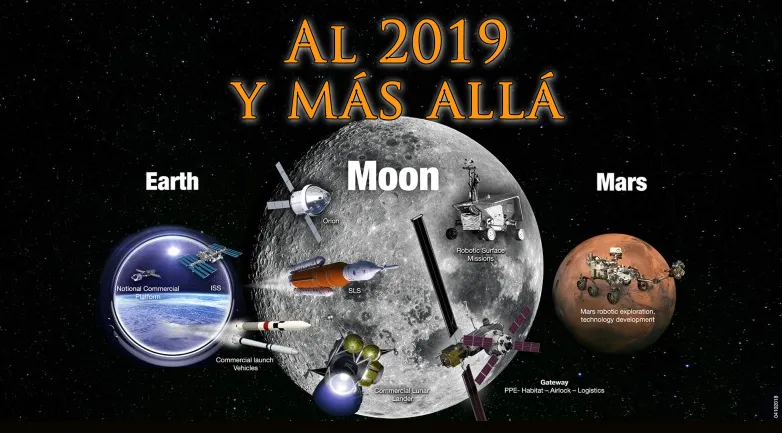
With the last flight of Atlantis in 2011, the STS program ended. Since then, NASA has been working on a replacement program: Orion. A test flight in lunar orbit is planned for 2019.
The new spacecraft of the future will be Orion and the SLS, the propulsion system. "Back to the Moon and on to Mars" is NASA's new motto and its new target date is the 2030s.
Surely our children or grandchildren will learn of Orion's arrival on Mars while stuck in vehicular traffic in some big city and flying cars will be a funny mention, a meme. Multipass!
Let us also populate our collective future with dreams of progress that expand our horizons.
More science for peace and work for all!
Happy 2019!
Sources and related links
- The Ins and Outs of NASA’s First Launch of SLS and Orion
https://www.nasa.gov/archive/feature/the-ins-and-outs-of-nasa-s-first-launch-of-sls-and-orion - This Week in NASA History: Apollo 8 Captures “Earthrise” – Dec. 24, 1968
https://www.nasa.gov/centers/marshall/history/this-week-in-nasa-history-apollo-8-captures-earthrise-dec-24-1968.html - NASA's Exploration Campaign: Back to the Moon and on to Mars
https://www.nasa.gov/feature/nasas-exploration-campaign-back-to-the-moon-and-on-to-mars - The Hubble Deep Fields
https://www.spacetelescope.org/science/deep_fields/
About the images
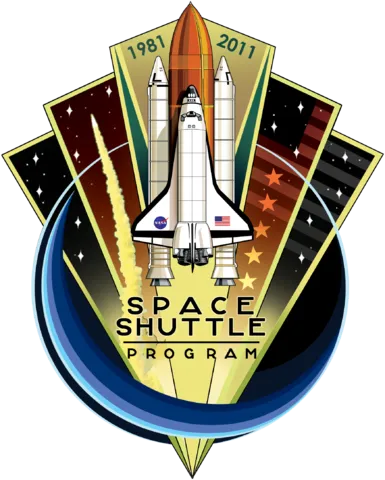
Illustration by NASA.
Logo: By NASA/Blake Dumesnil - http://spaceflight.nasa.gov/gallery/images/shuttle/general/html/jsc2010e079335.html, Public Domain, https://commons.wikimedia.org/w/index.php?curid=11667823