On the journalistic narrative of the Chang'e 4 moon landing.
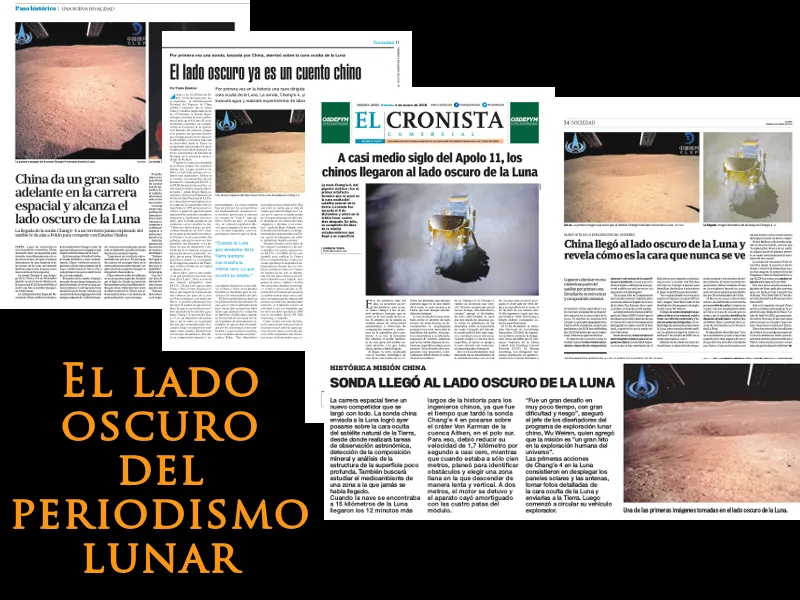
Several national media outlets today published news of the moon landing of China's Chang'e 4 probe, indicating in the headlines that the descent was on "the dark side" of the Moon. This was the case in reports from Clarín, La Nación, Página/12, Crónica, El Cronista. In contrast, the newspapers La Prensa, Diario Popular, Ámbito Financiero and BAE indicated in their headlines that the event occurred on "the far side".
It is interesting to observe that, despite the headlines, in all cases where the phrase "dark side" was used, in the body of the articles it is clarified that, in reality, it is -at most- the far side, although in some media the difference is well established and in others it is not.
It is striking then that, although journalists know it is not the dark side, they headlined it that way anyway.
If the phrase "dark side" is established in popular culture, why go against the majority?, several media outlets seem to think. Perhaps they assess that there is no need to go against the client. Between that and demagoguery there is little difference.
For the unwary, some clarifications are then worth making:
1-The Moon does not have a dark side, as is simply demonstrated by thinking of the New Moon phase, in which the only face that can be seen from Earth is NOT illuminated, therefore, the face that is illuminated during that phase is the "far" side, which therefore is not "dark".
2-We can see one face of the Moon because the natural satellite rotates and revolves at the same frequency, both rotation and revolution take the same time. If the Moon did not rotate, that is, if each "face" always looked at the same place, but it did revolve, then we would see both "sides". See previous post titled The dark side of the Moon's "dark side" (see links).
3-The Moon is a semi-spherical object, therefore, it doesn't make much sense to talk about "sides" in the geometric sense because it is not a polyhedron, therefore it has only one face. Furthermore, because the Moon also performs another motion (libration), over the course of a year, about 60% of the lunar surface can be observed, that is, more than half. If a "face or side" were only 50%, then in reality -in its annual revolutions- more than one "side" can be seen from Earth. For practical purposes, "face or side", in this case, means region or area.
4-The term "far side" is valid in a relative sense, for the common inhabitants of Earth. It is therefore a matter of perspective. In English the concept "far side" (the far side) is used.
ON THE HISTORICAL
It would be interesting to survey the use of the word "historic" in the media. It is clear that this word, like all others, has multiple meanings. One sense of the term is used to indicate something "related to History", in which case every event is historic, provided it has occurred, that it is real.
Another nuance of usage expresses that an event is notable and that it is so by virtue of being the first time it occurs. In this regard, I suggest reading a post previously published on this blog, titled: "The frequency of the unrepeatable in astronomy".
If something is notable for being the first time it occurs, then its frequency is 1. Let's do an exercise:
Juan crosses street X on the 3rd, for the first time.
Juan crosses street X on the 4th, for the second time (but it's the 1st time he does it on the left side).
Juan crosses street X on the 5th, for the third time (but it's the 1st time he does it at noon).
If we had to qualify any of these events as "historic" which one would it be? Evidently the first one. In contrast, the following two events would no longer be "historic" since they would have been performed previously. However, in each case, the events are different, they are not identical. History is not written on tracing paper, as if it were the movie Groundhog Day (Harold Ramis, 1993).
So that, since each event is unique, all events could be considered "historic", even if they have precedents and their frequency is no longer 1. But then, the sense of "unique and notable" vanishes, since every event is different from any other, although in many cases, the difference is subtle.
It was said several times that it was "historic" that Messi broke a record in soccer. If it is valid to use the word because they were events happening for the first time, the paradox arises that this type of event happened many times.
Instead of qualifying events as historic, they must be described with information. Then, each person will assess whether, in their judgment, that event deserves to be qualified in some way or not.
It is not the first time a spacecraft has landed on the Moon. The United States and Russia had already done it. It is not the first time China has landed on the Moon, it had already succeeded in 2013. It is not the first time information from the "far side" of the Moon has been obtained: The Soviet Union obtained photos of the "far side" in 1959 with the Luna 3 probe, which was an orbital probe, therefore, it did not descend on the surface of the satellite.
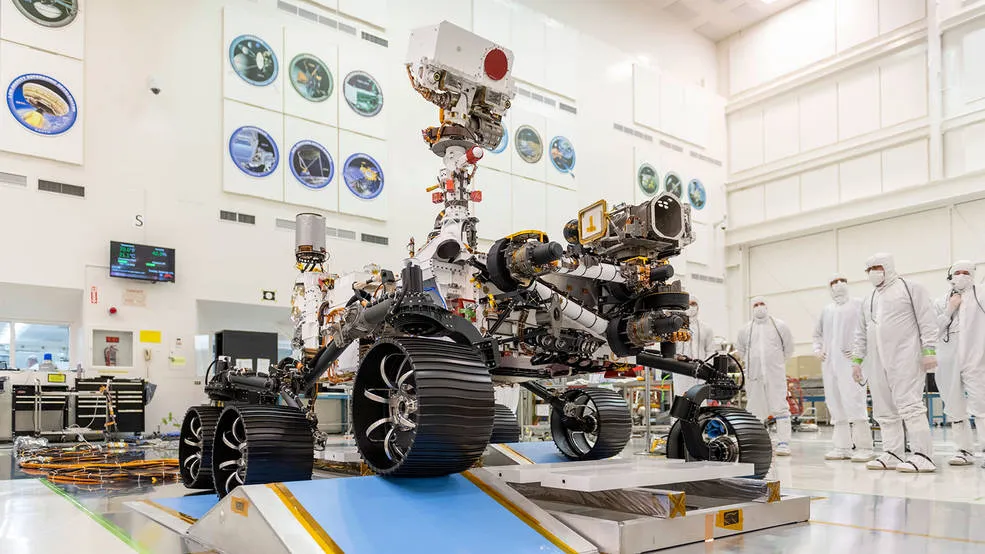
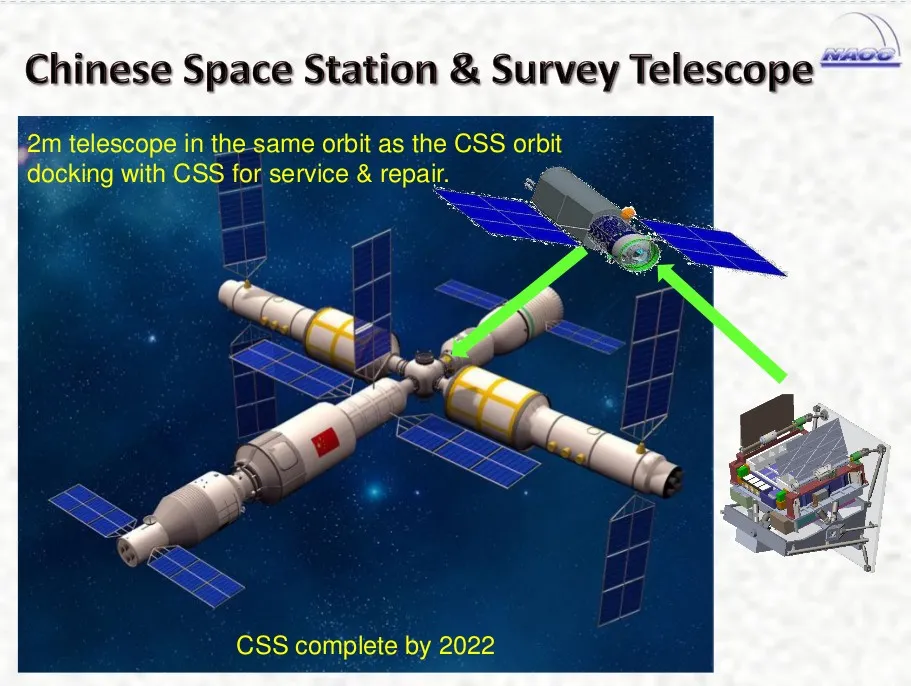
What it is the first instance of is that a spacecraft lands in that area of the Moon. One reason why no one landed there before is that receiving and sending data from and to Earth is difficult. To achieve communications, Chang'e 4 consists of three "spacecraft": an orbiter or relay, a lander or descent capsule, and a rover or explorer. It will be the orbiter that will enable the retransmission of data. The orbiter is, therefore, a satellite equipped with a 4-meter deployable antenna. Furthermore, it has equipment for taking low-frequency radio data.
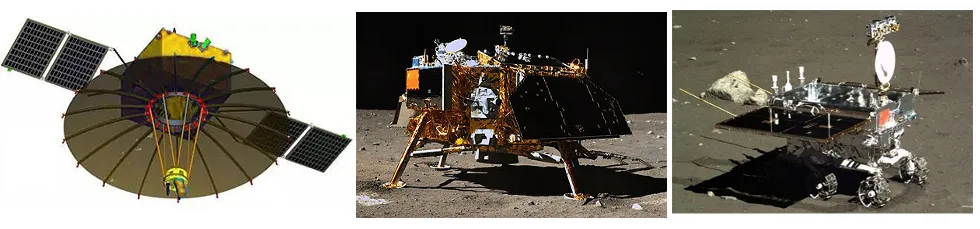
The fact is valuable and remarkable because it is difficult. It is not that landing in the "hidden" zone is more difficult than on the face always visible from Earth, the difficulty is not much greater. However, China has for a few years been one of the three countries to put a vehicle on lunar soil.
In this case, the novelty is that with the mission designed as I just pointed out, more and better data from that region can be taken. The photos recorded with Luna 3 were of poor quality, compared to those that can be made today. Additionally, other types of data will be taken. It is a small step for Humanity, but a great step for the Chinese.
In this new space race, China maintains the goal of landing a manned spacecraft on Earth's only natural satellite. As if the alarm clock had just struck, again, 6:00, history seems to repeat itself. Let's hope it's not a farce or comedy, like Groundhog Day.
Sources and related links
- Gunter's Space Page: Queqiao (Chang'e 4 Relay, CE 4 Relay)
https://space.skyrocket.de/doc_sdat/change-4-relay.htm - Wikipedia: Chang'e 4
https://es.wikipedia.org/wiki/Chang%27e_4 - Groundhog Day on IMDB
https://www.imdb.com/title/tt0107048/ - The dark side of the "dark side" of the Moon
https://www.noticiasdelcosmos.com/2016/12/el-lado-oscuro-del-lado-oscuro-de-la.html - The frequency of the unrepeatable in astronomy
https://www.noticiasdelcosmos.com/2016/06/la-frecuencia-de-lo-irrepetible-en.html
About the images
Images from Gunter's Space Page.