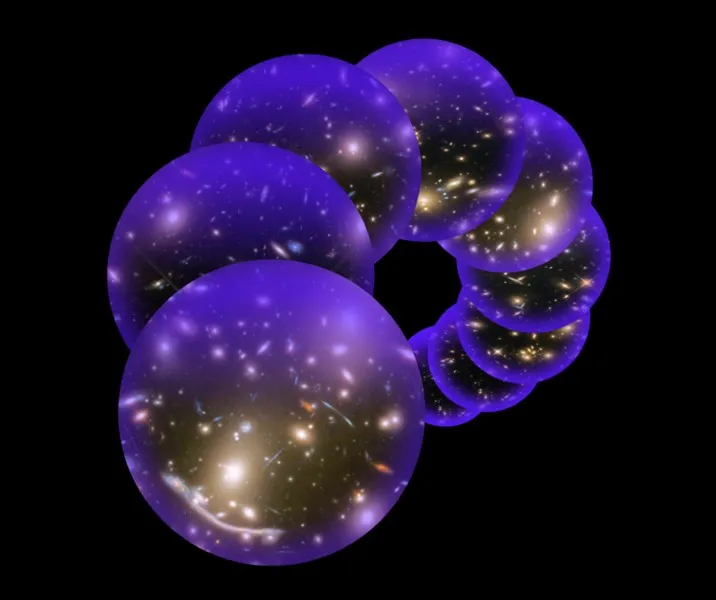
The period of scientific data collection to map an eighth of the sky with unprecedented detail comes to an end, although the work to learn more about the accelerated expansion of the universe has just begun.
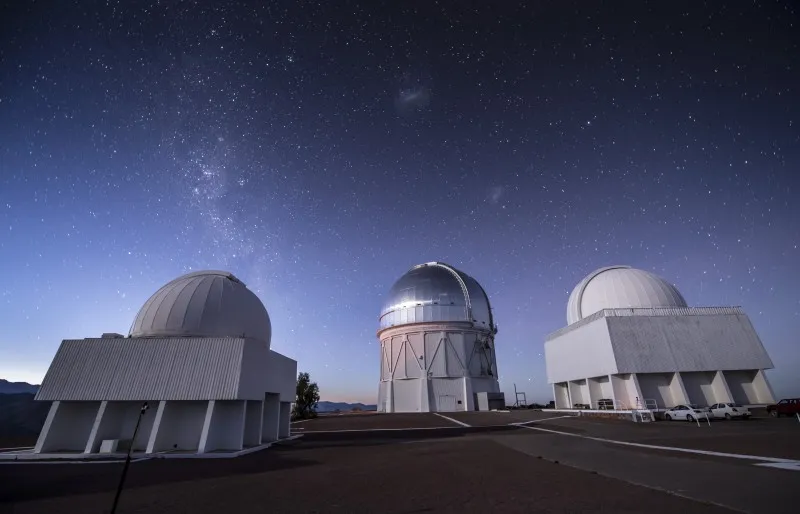
After deeply exploring nearly a quarter of the southern sky for six years and cataloging hundreds of millions of distant galaxies, the Dark Energy Survey (DES) ends its data collection on January 9.
The DES project is an international collaboration that began mapping a region of the sky of 5000 square degrees in area on August 31, 2013, with the goal of understanding the nature of dark energy, the mysterious force that is accelerating the expansion of the universe. DES scientists have collected data over 758 nights during six years, using the DECam instrument (Dark Energy Camera), a 520 Megapixel digital camera funded by the United States Department of Energy (DoE) and the Ministry of Science, Innovation and Universities of Spain, among other international organizations.
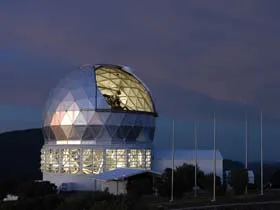
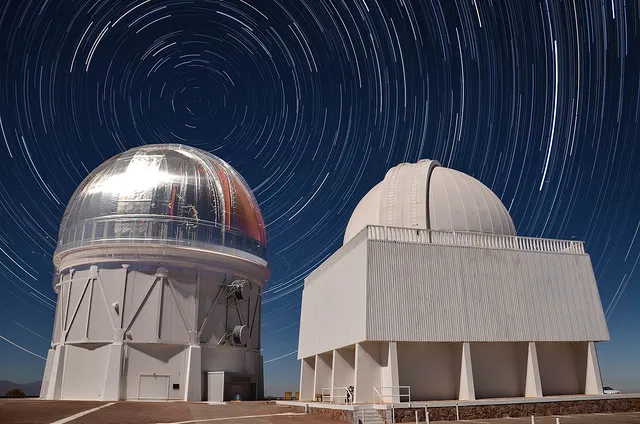
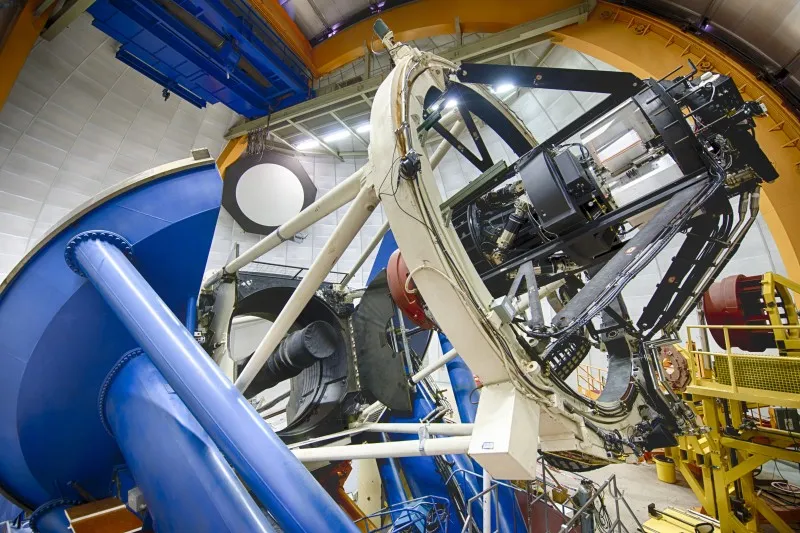
The camera is mounted on the 4-meter Blanco telescope, located at the Cerro Tololo Inter-American Observatory in the Chilean Andes, and belonging to the U.S. National Science Foundation. The DES-Spain collaboration had a notable contribution to the construction of DECam, as it was responsible for the design, verification, construction and installation of most of the readout electronics.
During all these nights, scientists have accumulated data on more than 300 million distant galaxies. More than 400 scientists from 26 institutions around the world contribute to the realization of this project, which is led by Fermilab (Fermi National Accelerator Laboratory) of the DoE. The collaboration has already produced more than 200 scientific papers, and will publish many more.
DES is one of the most sensitive and comprehensive surveys ever conducted. DECam is capable of seeing light from galaxies billions of light-years away, with unprecedented quality.
The survey has generated 50 Terabytes (that is, 50 million Megabytes) of data during its six years of observation. These data are stored at the National Center for Supercomputing Applications (NCSA), at the University of Illinois at Urbana-Champaign.
Now, the work of analyzing this data becomes the central activity of the collaboration. DES has already published a complete series of scientific papers based on data taken in the first year, and scientists are now fully focused on analyzing the rich cataloged image set from the first three years, searching for new clues about the nature of dark energy.
"DES is the first large galaxy survey that will study in detail the properties of dark energy. It has been a great success to have collected this enormous and precise dataset. Now it remains to analyze it. Perhaps it contains the signal of some important discovery." says Eusebio Sánchez, the lead researcher for DES at CIEMAT.
For his part, Enrique Gaztañaga, the lead researcher for DES at ICE (IEEC/CSIC) adds that "DES-Spain was the first international collaboration to found DES more than 15 years ago. In that time we have had the opportunity to gain experience in very different aspects of a first-line international project. These span instrumentation, organization, funding and science. It was our first project together and it has been the seed for the DES-Spain team to be able to take on new challenges. To initiate and even lead other equally ambitious projects, such as Euclid (euclid-ec.org), PAUS (pausurvey.org) or DESI (desi.lbl.org)".
The DES collaboration will continue to publish scientific results from the stored data. Scientists have presented the most recent results in a special session held at the winter meeting of the American Astronomical Society in Seattle, on January 8.
DES was one of the sky surveys that detected the source of gravitational waves in visible light, opening the door to a new kind of astronomy.
"With the analysis of only one-fifth of its data, DES has already achieved the most precise cosmological measurements to date. With the analysis of all the data, in the coming years, DES will subject the current cosmological model, which assumes that dark energy is due to the cosmological constant, proposed and later discarded by Einstein, to the hardest test it has ever faced", indicates Ramon Miquel, lead researcher for DES at IFAE.
For his part Juan García-Bellido, lead researcher for DES at IFT-UAM/CSIC, considers that "It is exciting to have been able to participate, thanks to DECam, in a discovery like that of the Kilonova, which began a new era, that of Multi-messenger Astronomy, and which has allowed us to independently determine the expansion rate of the Universe".
Recently, DES has published its first cosmological results based on supernovae (207 of them with spectroscopic follow-up from the first 3 years of data), using a method that provided the first evidence of cosmic acceleration 20 years ago.
The task of accumulating such an amount of data is not small. Throughout the survey, hundreds of scientists were required to operate the camera over several nights, in shifts, with the help of the observatory's technicians. To organize this effort, DES adopted some of the methods used in particle physics experiments, in which everyone who works on the experiment collaborates in some way in its operation.
DECam will remain mounted on the Blanco telescope at Cerro Tololo for 5 or 10 more years, and will continue to be an enormously useful instrument for collaborations around the world.
The DES collaboration will now focus on producing new results using the 6 years of data, including new observations on dark energy. Although one era is coming to an end for DES, the next era of the survey has only just begun.
Thanks to Begoña Bermejo, press staff at CIEMAT, for sending the information.
Sources and related links
You can follow DES news at www.darkenergysurvey.org, on Facebook:
www.facebook.com/darkenergysurvey, Twitter: www.twitter.com/theDESurvey and
Instagram: www.instagram.com/darkenergysurvey.
About the images
Image credits: DES Collaboration and Fermilab.