Why isn't the night sky so dark?
The astronomer Heinrich Olbers wondered why the night is dark at the beginning of the 19th century. Olbers assumed that the universe was infinite, had infinite stars, and was static. Therefore, infinite light should reach us, but the night is dark. How to understand this?
In a previous post to this one, I commented on the relative size of the observable universe. What is outside that boundary is light that cannot reach us. The universe expands and the light from distant objects that does reach us does so at long wavelengths that have temperature, but are not visible, like radio waves. Furthermore, the universe is probably not infinite. If something was born infinite, it always will be. But if something arose finite, it will never be infinite, even if it expands infinitely, because infinite means 'that has no end'. Some theoretical physicists, however, postulate that the universe could indeed be infinite if it had a certain type of geometry.
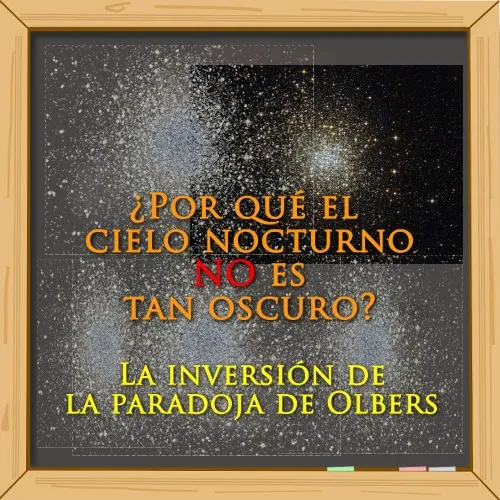
If this is the current way to answer Olbers' Paradox, we now have a new paradox: Why is the night NOT so dark?
The question is comparative: in certain places, the night sky is darker than in others; moreover, in other times the night was darker than it is today.
The answer is human progress. For a few centuries we have had electricity thanks to which we can artificially illuminate and work at night, hold nighttime shows, signs, public lighting. And we have large unpopulated areas, as well as high concentrations of people in large cities.
As a consequence, we can now observe fewer stars and deep space objects than before, except in protected or unpopulated places, on the outskirts of the largest cities.
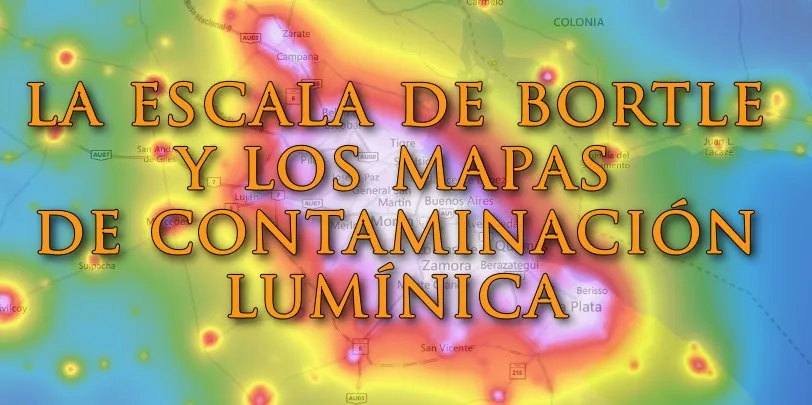
As indicated by the site Fundación Cielo Sustentable (by Ricardo Tohmé): "The effect called 'skyglow' is the result of the reflection and scattering of that artificial light by clouds, aerosols, and particles suspended in the atmosphere. The scattering propagates the effects of light pollution to distances beyond the position of the original light source, illuminating the night sky in its entirety and forming a kind of luminous dome or 'light dome' when observed from a certain distance."
Can this problem be corrected?
Obviously it is not a simple task. On the one hand, artificial lighting after sunset is essential for the development of various activities, just as public lighting is necessary for safety and the circulation of people and cars through cities.
Going back to the Middle Ages is not a solution. The challenge, then, is to combine human creativity in matters of public administration and technological innovation.
Among the ideas that have emerged in recent decades, at least two can be pointed out:
1- Replace old public lighting, which generally illuminates 'upwards', with fixtures focused 'downwards', since the idea is to illuminate the streets, not the sky.
2- Legally protect -and effectively- specific parks and areas, which also promotes astronomical tourism.
Just as it is necessary for there to be green spaces in the 'concrete jungle', it is vital that countries protect areas from light pollution and promote efficiency in public lighting.
On the other hand, there are two more things that can be done and are being done through different initiatives:
- Develop a better diagnosis of the problem, through systematic measurements, like those carried out in the Globe at Night project.
- Disseminate the problem among the general population, to increase public awareness from the bottom up, from the general population to the political system that administers cities.
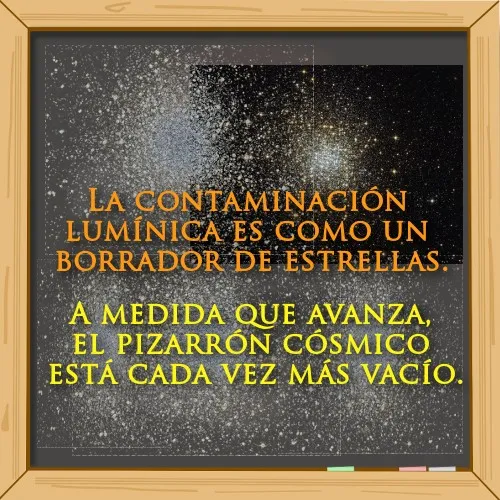
Nature teaches us through its own natural blackboard: the night sky. Light pollution is like an eraser of stars. As it advances, the cosmic blackboard is increasingly empty.
THE IAU'S CALL: DARK SKIES AMBASSADORS
The IAU (International Astronomical Union) created the Dark Skies Ambassador program in which it invites enthusiastic individuals and organizations to apply as ambassadors and spread the problem of light pollution.
The idea is for them to organize outreach events, for example around UNESCO's International Day of Light, May 16, 2019.
The site to sign up is https://darkskies4all.org/home/
There is also a list with the current 24 ambassadors, which includes the following people from Argentina:
Diego Galperin (Bariloche), Ricardo J. Tohmé (Bahía Blanca), Carlos Alberto Acebal (San Luis), Denis C Martínez (Cipolletti), Beatriz García (Mendoza).
The registration form contains the person's data, a field to list recent activities carried out, a relevant public quote (on the topic) in less than 140 characters, a photo. Regarding the quote, I think it's a good opportunity to think of one. They could be used on the aforementioned website, as is the case with the following:
"A world without stars would be like a world without flowers"
Silvia Torres-Peimbert, former IAU president
Sources and related links
- Fundación Cielo Sustentable
https://cielosustentable.org/ - IAU: Become an IAU Dark Skies Ambassador to promote the importance of dark skies
https://www.iau-100.org/darkskies-ambassadors-call
About the images
Combined image using an Openclipart (https://openclipart.org/detail/281559/blank-chalk-board) and a photograph of the Palomar 2 cluster, credit: ESA/Hubble & NASA (https://www.spacetelescope.org/images/potw1315a/)