As part of the IAFE lecture cycle at the Planetarium, celebrating the institute's 50th anniversary, Dr. Alberto Marcos Vásquez will give a talk.
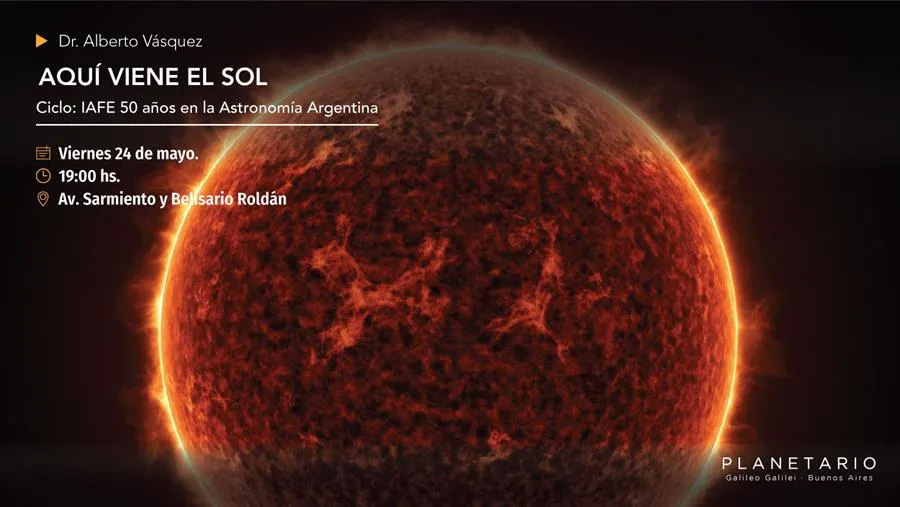
"Here Comes the Sun"
Dr. Alberto Marcos Vásquez*
May 24, 19 h.
On July 2, 2019, a total solar eclipse will occur, visible from the Argentine provinces of San Juan, San Luis, La Rioja, Córdoba, Santa Fe and Buenos Aires. The spectacular astronomical event will allow us to observe with the naked eye the stunning solar atmosphere, usually obscured by the star's brightness. Reaching temperatures of millions of degrees, the solar atmosphere continuously expels matter, forming a solar wind that impacts the planets of the Solar System. Also, the violent storms that occur in the solar atmosphere eject gigantic structures of solar material into interplanetary space. These phenomena modify the space surrounding Earth, shaping its so-called space weather and affecting human technology.
In this lecture we will discuss these phenomena, studied from Earth and space. We will talk in particular about NASA's revolutionary Parker Solar Probe, which has been flying since August 12, 2018 and with which we collaborate from Argentina. Its advanced technology will allow it to dive into the solar atmosphere to a record distance from our star of only four solar diameters, providing unprecedented scientific data to help us unravel its mysteries.
*Dr. Alberto Marcos Vásquez is a CONICET scientific researcher at the Instituto de Astronomía y Física del Espacio (IAFE), under CONICET and UBA. He developed his doctoral thesis at UBA and the Harvard-Smithsonian Center for Astrophysics. His specialty is space plasma physics with an emphasis on the study of the solar atmosphere. He has collaborated with various solar space missions and currently develops tomographic techniques used by NASA's Parker Solar Probe. Dr. Vásquez works as a university physics professor at UBA and UNTREF.
To reserve a spot (250 seats available in total), see the website (below).
Lecture cycle
The Planetarium joins IAFE in celebrating its 50 years in Argentine Astronomy.
The Instituto de Astronomía y Física del Espacio was born in the midst of the space age boom, thanks to the initiative and drive of Dr. Jorge Sahade.
Its goal: to achieve the joint work of physicists and engineers dedicated to space physics and astronomers dedicated to observational astronomy and theoretical astrophysics.
IAFE is currently a thriving Institute, under the Universidad de Buenos Aires (UBA) and CONICET, located within the grounds of UBA's Ciudad Universitaria. Its mission is research in the field of space sciences. But over these years it has also stood out in the continuous training of young researchers and in outreach.
The Planetarium joins the 50th anniversary celebrations by offering a lecture cycle with researchers from the Institute.
Sources and related links
- Planetario Galileo Galilei
https://planetario.buenosaires.gob.ar/50-anos-del-iafe-encuentro-ii - IAFE
http://www.iafe.uba.ar/