On July 2, a total solar eclipse will occur, visible in its totality from the Argentine provinces of San Juan, San Luis, La Rioja, Córdoba, Santa Fe, and Buenos Aires. The Planetarium is organizing its 'Science Encounters' around these impressive phenomena.
On Friday, May 31 at 19 h, Lic. Yael J. Aidelman will address this concept from a broader perspective and introduce us to Eclipsing Binary Stars.
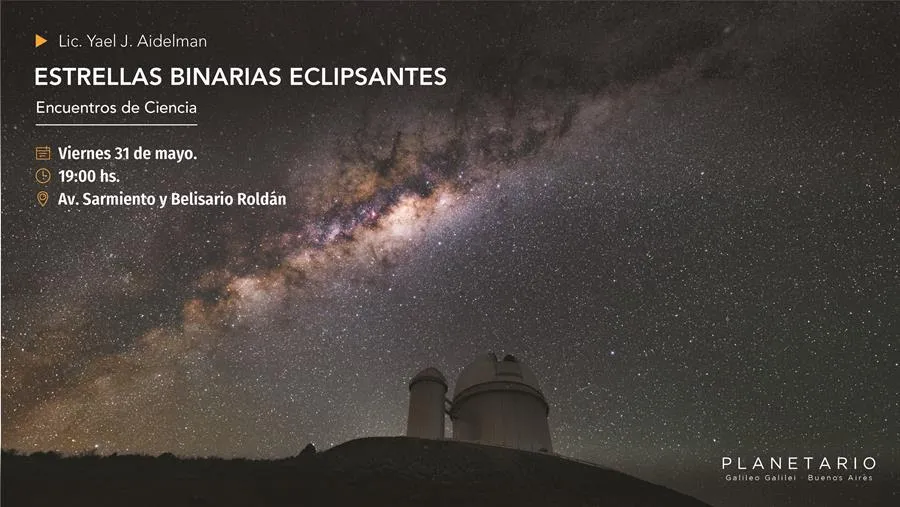
Eclipsing Binary Stars
Lic. Yael J. Aidelman*
Friday, May 31 - 19 h - Free activity
«Contrary to what we intuitively think, the vast majority of stars are not isolated, but are members of stellar systems. Binary stars constitute the simplest of these systems. They are composed of two stars gravitationally bound that revolve around a common center. In some cases, the orbital plane is oriented in such a way that it is possible to observe (from Earth) when one star passes in front of the other; these are eclipsing binaries. The importance of studying binary systems lies in the fact that it is possible to precisely determine the masses of the stars that compose them.
Currently, more than 64 thousand binary stars are known, but we only know the orbital parameters of just over 1%. Technological development applied to both ground-based telescopes and space telescopes has allowed us to study them in detail. So much so that planets have been discovered orbiting stars belonging to binary systems.»
Yael J. Aidelman
Yael J. Aidelman earned her Bachelor's degree in Astronomy in 2010 from the Faculty of Astronomical and Geophysical Sciences of the National University of La Plata (FCAG-UNLP) and has been a Doctor in Astronomy since 2016 (FCAG-UNLP). She is also a professor at the National University of La Plata and a CONICET postdoctoral fellow.
She currently also works at the La Plata Institute of Astrophysics (CONICET-UNLP). Her field of research is peculiar stars of spectral type B (stars between 3 and 15 solar masses and temperatures between 10 thousand and 30 thousand degrees Kelvin) using spectroscopic observations in the visual range.
Online registration is required (see link). Limited to 250 seats.
Planetario de Buenos Aires
Avda. Sarmiento and Avda. Figueroa Alcorta.
Sources and related links
Planetario Galileo Galilei https://planetario.buenosaires.gob.ar/estrellas-binarias-eclipsantes