Do numbers have real existence?
I will address here, as on a previous occasion, the dilemma of whether numbers "exist". But to do so, it is first necessary to lay the foundations of an earlier debate, which is whether mathematics is an invention or a discovery.
On the meaning of words
Every word has more than one meaning. I don't think it's appropriate to enter into another debate about whether it's good or bad that this is so. It's worth at least being clear that this happens and we could add that it's impossible to change it. This does not imply, however, that we should surrender to the Tower of Babel, because we can define, despite having another underlying problem: to define we must use other words, which would also have to be defined. For this specific purpose, I will use here two meanings of the word "invention" to contrast (or not so much) with the word "discovery".
FIRST MEANING OF INVENTION
I say that an invention is an artifice, something produced by human beings. The opposite is the natural. In that sense, everything we call "culture" is an artifice. We can make a double list:
Artifice/The artificial: washing machines, perfumes, cups, watches, cars, paintings, museums, stairs, scarves, ravioli...
Natural: Sun, stars, sea, fish, cat, plants, electrons...
We could well say, moreover, that among the artificial are ideas, since these are not "natural", but produced by human beings.
And as a consequence, also among the artificial is all of science, all hypotheses, theories, conceptual frameworks. Science is a human production and, as such, is an artifice.
Note that I do not use the word "artifice" in a negative (or positive) sense, just as I do not use it in the word "natural". They are two categories, not a value judgment.
Therefore, mathematics is always an artifice, and thus, an invention. Theories have to be made, invented, constructed. That does not mean that an artifice is something false or bad.
SECOND MEANING OF THE WORD INVENTION
An invention is also an imaginary idea, a story, a tale. But there are two types of tales:
The "realistic" tales and the "fanciful" ones. I can imagine that electrons exist and then FIND that they indeed exist. And I will say they exist insofar as they have proven existence outside our individual brain. When that is the case, we say that such a thing exists "objectively", because it can be demonstrated by other people. In contrast, my intimate memories, the memories of my life with Rey, the house cat, are "subjective" because I have no way of proving them. Such memories exist, but not "objectively". [Here goes Memories of Green, by Vangelis.]
And we also have fanciful tales, for example, unicorns, elves and other ideas that have no real, objective existence outside our brain. For example, the idea that we live in a meritocratic society....
NATURAL DISCOVERIES
If the discovered objects or phenomena can be natural, we could well agree that every discovery is also an artifice, if it is a consequence of scientific research, for which theories and experiments must be constructed, invented. Because, in some way, discovering requires inventing. But...
Without being scientists, we can "discover" that there are trees outside our brain. In fact, before seeing a tree, there is no idea of a tree in our brain.
Berkeley argued that things exist because we look at them. Trees can exist even if no one looks at them. But the idea and the word tree can only exist when there are people. Ideas (and words) are human, not natural.
The same happens with colors (segment of existing radiations), which we "discover" without any invention. But I cannot discover in the same way, so unelaborated and merely a product of the senses, quarks or electrons.
In an analogous way, we can "discover" certain "quantities" without knowing anything about mathematics: one tree, two rabbits, three cucumbers... But I can hardly find in the same way, unelaborated, by mere observation, irrational numbers, which cannot be expressed as a ratio of two numbers, as a fraction.
This is why mathematics is so powerful. It allows us to discover that the natural numbers (including zero), that is, the positive numbers, are as many as the integers (which also contain the negatives), even though it sounds absurd.
This was discovered thanks to a brilliant invention by a brilliant mathematician. Let's think:
Put the highest negative number you want, say "-1,000,0000" in one column. And below, continue writing the subsequent numbers until zero. In the other column, we will put the natural numbers, starting with zero and enumerating the following ones. If you want, you can do it with the help of a spreadsheet, and to simplify, let's use smaller values, for example from -100.
It will look something like this:
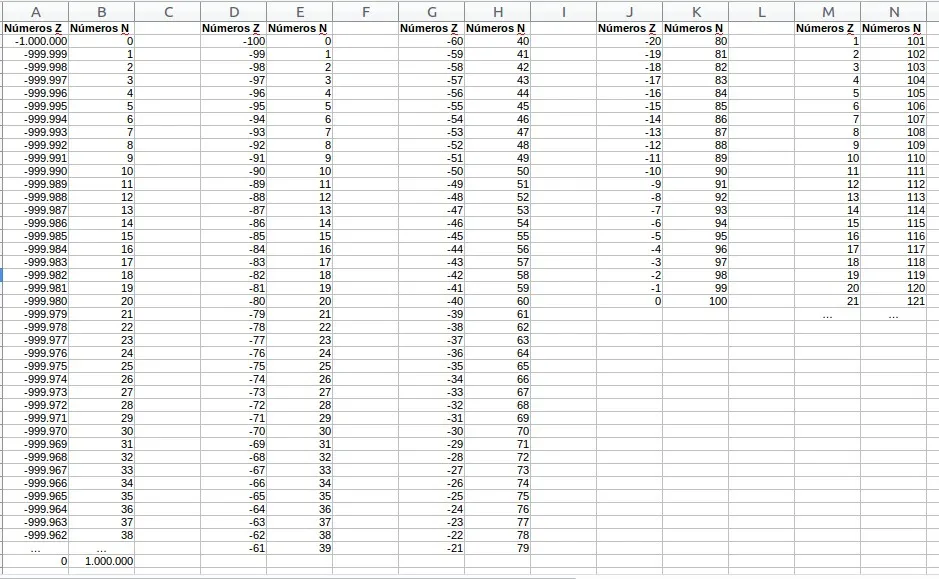
As you will notice, for each Z number (Integer) we can make correspond an N number (Natural). Now think about this:
If I have a bag with 10 spheres and another bag with X cubes, an unknown number of cubes. And I don't know how to count, what can I do?
I put a cube next to each sphere. If I have as many cubes as spheres, then the cubes are the same quantity as the spheres, that is, in this case, 10.
If I have as many Z numbers as N numbers, then the quantity of both sets is the same. Even though this sounds illogical because in one case we have all the positives and all the negatives and in the other only the positives (which should be half of all the previous ones).
Therefore, there are things that exist outside our brain that we can discover without much effort and others that are not so easy to discover. That's what we have science for!
Mathematics is very powerful and also somewhat limited. For example: can we know if the fifth root of five is an irrational number?
How could we know?
It has been "discovered" through human ingenuity that the square root of two and the number Pi are irrational. But can it be proven that any number with infinite decimals is irrational? This type of proof, when it was "found", was based on great intellectual effort, that is, thanks to work. That knowledge is not a product of nature, like rain, it does not fall from the sky nor is it evident.
UNIVERSAL KNOWLEDGE
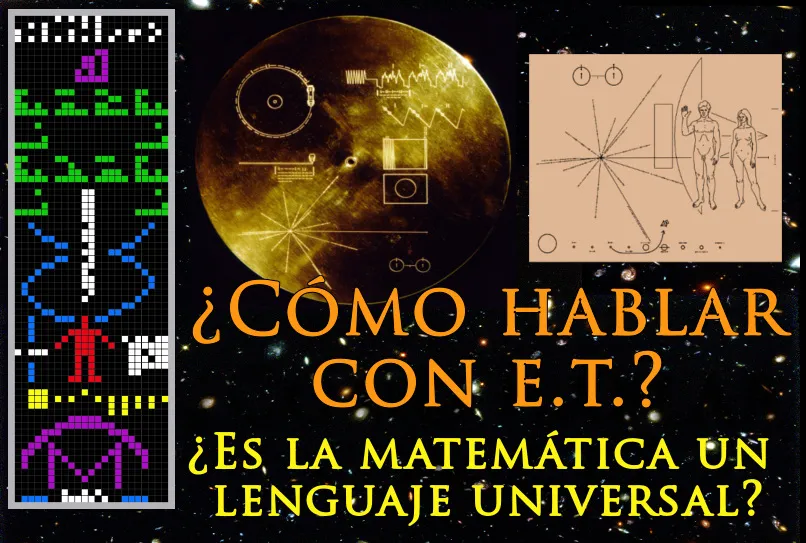
It is sometimes said that mathematics would be a "universal language". The reason is that it is argued that certain ideas are equally valid anywhere, for example, that in any circle, the perimeter will be the product of its radius (squared) and the number Pi. And, without interruption, it is argued that any other intelligent civilization would reach the same result.
However, "language" is mixed with "ideas." It is quite unlikely that other civilizations would write "Pi," or that they would use the symbol "3" to denote the quantity three.
On the other hand, there are several methods for multiplication that arrive at the same result. It is highly likely, then, that other civilizations use other mathematics, with other languages and techniques, even though the result is the same. Because mathematics is an invention used to discover. The invention will be different, the discovered knowledge will be the same.
ON MATHEMATICAL LANGUAGE
Mathematics, besides being a logical method, is a language and a system that has conventions. Some of these conventions are the names given to "families" of numbers. Z, the integers; R, the reals; N, the naturals. Both the "integers" (which can be divided) and the "imaginary" numbers are numbers that belong to groups with names given by a convention that says little about such numbers. They are not an "ontological" category. To summarize: Integers do not imply that there are other "broken" numbers; and that we call other numbers "imaginary" does not mean that those and only those are in our imagination. Imaginary numbers are not fantasious. Or, if they are, the others are too.
METHOD TO KNOW IF NUMBERS ARE FANTASIOUS OR REALISTIC
Therefore, I elaborate two new categories: realistic numbers will be those that have "real, objective existence" outside our brain. And fantasious numbers will be those that do NOT have existence outside the mind.
What does it mean for a number to have "real objective existence"?
We could pose it like this: I take a number, which is an idea of quantity, and we see if that idea can be applied to describe or explain something that exists outside our brain. If we succeed, we will say that this idea is not a mere fantasy, but has real, objective existence.
For example, the number SQRT(2) we can "find, discover" in any square of side 1, since its diagonals will measure that and will also be the hypotenuse of respective right triangles whose value we can find by the Pythagorean Theorem. It was proven that this number is irrational, which does not mean the number is crazy...
And then we will make another list:
In one column the number, in the other if it is realistic (R) or fantasious (S).
The smallest natural numbers are realistic. We can verify this in daily life. One grapefruit, two eared doves, three River goals...
But how do we know if any number, a number we can IMAGINE, has objective existence or not?
Well, we would have to go out and search in Nature (or in social processes). And there we already have a big problem:
Mathematicians do not do that. For this reason, it is said that mathematics is not a science, since it lacks the empirical element. They are logical sciences, at best. Mathematics is proven...with mathematics, without experiments or observations (although some mathematicians were inspired by natural phenomena).
On the other hand, we do have empirical sciences, like astronomy or physics or chemistry or the social sciences. And in such sciences, numbers are needed to describe reality (also "operations").
So, let's do this:
Think of the largest number we are capable of IMAGINING:
10 to the 100 to the 100...which is the same as (10 to the 100) to the 100; or 10 to the 100*100.
Or better:
10 to the (100 to the 100), which is much larger.
And let's search if with such a number we can describe something that exists outside our brain. If we find it, we try with another, perhaps larger:
10 to the (1000 to the 1000) and so on.
There is a "mathematical philosophy" that can be expressed this way: there are infinite fantasious numbers, which one day will cease to be so. We must go out and look for them, because they are there, waiting to be found, stranded on a universe-island in the cosmos...
WHAT HAPPENS IF WE FIND NOTHING?
That we do not find something that can be described or explained with a certain number we imagine, NOW, does not mean it does not exist. Perhaps it is hard to find. But it has to be something we can "count," even if it's as we did before with cubes and spheres, by comparison (it's said by correspondence, because to each element of one set corresponds another of a different set, not because we send letters!).
And we can also try with very small numbers, like 10 to the -44. Will we find it in some "place" or "time"?
Can we count 10 to the minus one million, of seconds? Can we divide "something" into such a tiny fraction?
Ahh...minutes are so small they should be called "minute," said the poet in that youth he remembers like a melted clock...
CONCLUSION
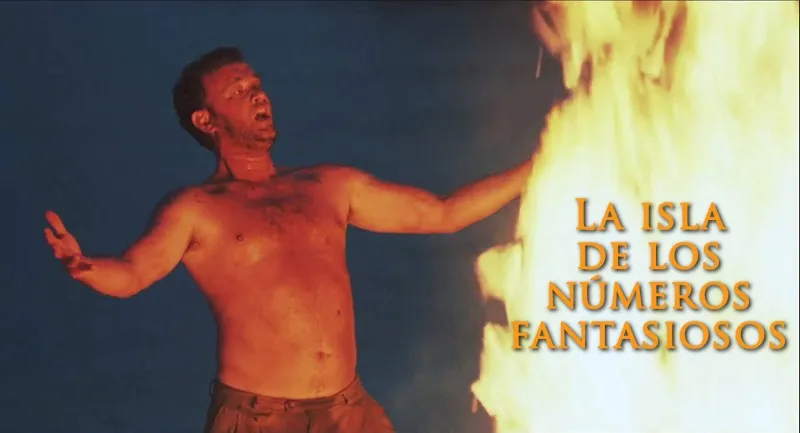
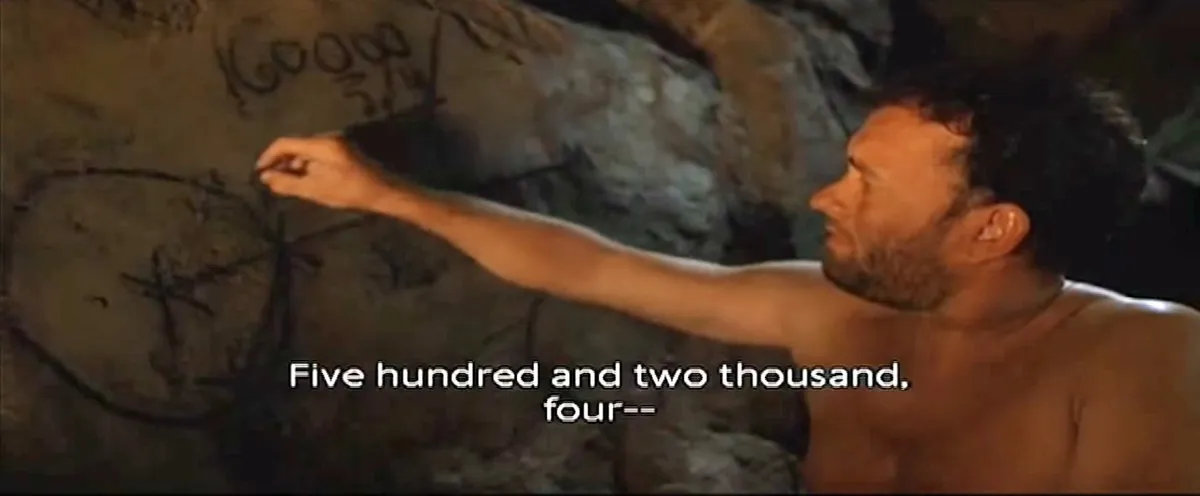
Mathematics is an invention, a fantastic, brilliant one, of which we should be proud, boast, beat our chests. Like in the movie "Cast Away" (Cast Away, Robert Zemeckis, 2000). "Fire! Look what I have created! Fire!" said Chuck Noland, the mailman played by Tom Hanks.
[What a surname they gave him!: "Noland," "no land," "without land"...]
Inventions are human and require effort, work, ingenuity. They are not products fallen from the sky. Mathematics is not a gift from the gods. They are inventions, like cars. They are an invention that allows us to discover that which we did not create and also that which arises as a consequence of human action. In that initial list, among the artifacts, there are brooms, scissors, bandages, weapons, leliqs, bonds, and there is also mathematics.
Without the invention of mathematics, so many things would not have been discovered...We would be like lost on a desert island, like tears in the rain.
Sources and related links
- Cast Away, IMDB
https://www.imdb.com/title/tt0162222/ - Math in Movies: Cast Away
http://www.math.harvard.edu/~knill/mathmovies/swf/castaway_rocklecture.html - Aula matemática: Cast Away
http://www.aulamatematica.com/mathsmovies/naufrago.htm - Mathematics, are they invented or discovered?
https://www.youtube.com/watch?v=7li0dss8_qw
About the images
Images from IMDB.