A supercomputer to study the cosmos.
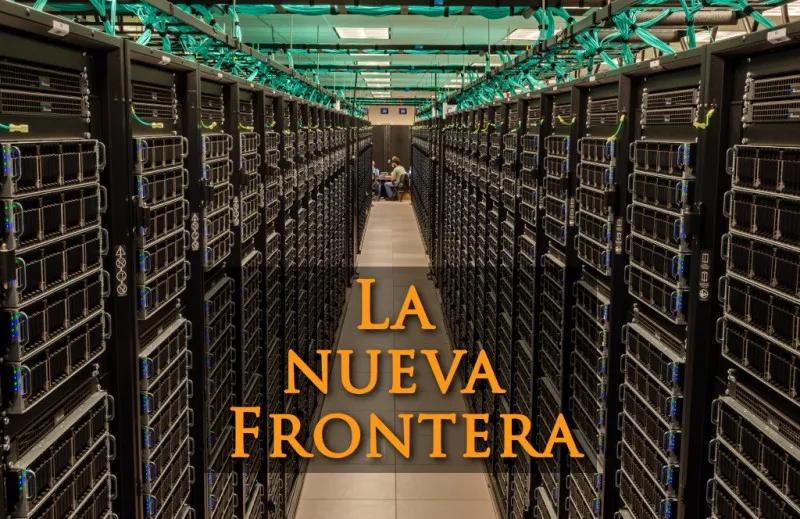
In 2017, the National Science Foundation in the U.S. offered a USD 60 million prize to the university that proposed the best high-performance system specifically for academic research. In 2018, the Texas Advanced Computing Center (TACC), which belongs to the University of Texas at Austin, won that competition. The result is the supercomputer called Frontera.
It began operations in the Northern Hemisphere spring and is already the fifth fastest supercomputer in the world, on the Top500 list. With that power, scientists hope to be able to discover new materials for hypersonic flight, better forecasts of climate events, and explore the mysteries surrounding the origins of the universe. "Computing is possibly the most important tool we possess to reach more deeply into the endless frontier of science", said Dan Stanzione, principal investigator at Frontera.
With this tool, different topics will be able to be investigated, for example, in astronomy, Frontera will help in processing data from the LHC, the Large Hadron Collider, in Switzerland.
What are supercomputers like?
The initial image is of Frontera, at TACC, where they also have other earlier ones, one of which is known as "Stampede". Here, a video showing what it's like.
Number 5
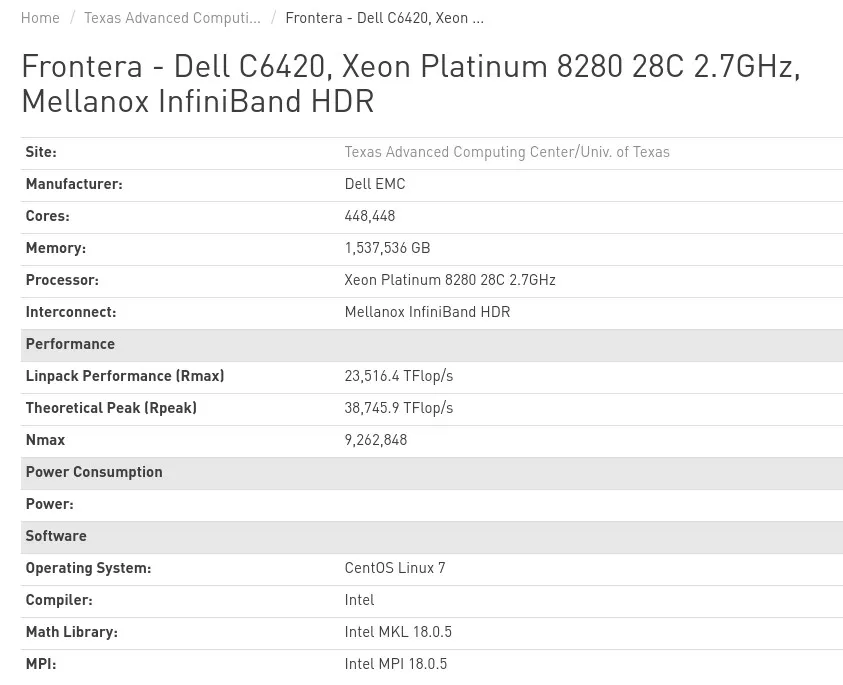
Frontera was, as of June this year, the fifth fastest supercomputer, according to the Top500 ranking based on the LINPACK performance benchmark, which measures computing power through the ability to handle floating-point operations.
Frontera achieved 23.5 PetaFLOPS. To understand this computing power, one could say that what Frontera achieves in one second, a human could achieve if they did one calculation per second for a billion years. However, the system has a theoretical peak of 38.7 PetaFLOPS.
The computer needs 5.5 megawatts of energy to operate, which is equivalent to what can be used to power 3,500 homes.
The system combines Dell EMC PowerEdge servers, with second-generation Intel Xeon processors, Mellanox InfiniBand interconnects, DataDirect Networks storage, and a cooling system from CoolIT, Cooltera, and Green Revolution Cooling.
According to the Top500 list, the system has almost half a million cores.
Beyond the Frontier
At TACC they are already thinking beyond the Frontera, together with Argonne Laboratory, to make Aurora21, the exascale computer, capable of performing 1 exaflop (1018), floating-point operations per second, planned for 2021.
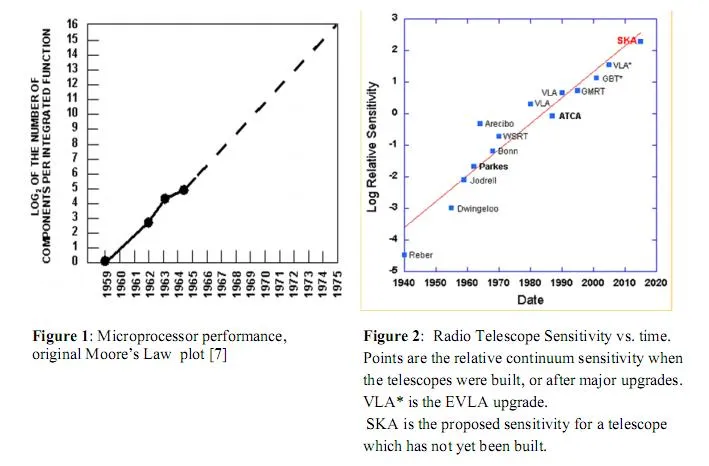
The universe expands. Computing, too.
Sources and related links
- FRONTERA NAMED 5TH FASTEST SUPERCOMPUTER IN THE WORLD
https://www.tacc.utexas.edu/-/frontera-named-5th-fastest-supercomputer-in-the-world - Frontera - Dell C6420, Xeon Platinum 8280 28C 2.7GHz, Mellanox InfiniBand HDR
https://www.top500.org/system/179607 - A NEW NSF-FUNDED PETASCALE COMPUTING SYSTEM
https://www.tacc.utexas.edu/systems/frontera - The newest frontier
https://sciencenode.org/feature/The%20newest%20frontier.php - Aurora21
https://aurora.alcf.anl.gov/ - Intro to Frontera
https://youtu.be/OQ5RMQxjpU0
About the images
Credit: TACC.