Two movie suggestions for staying at home. Also, two albums of excellent music.
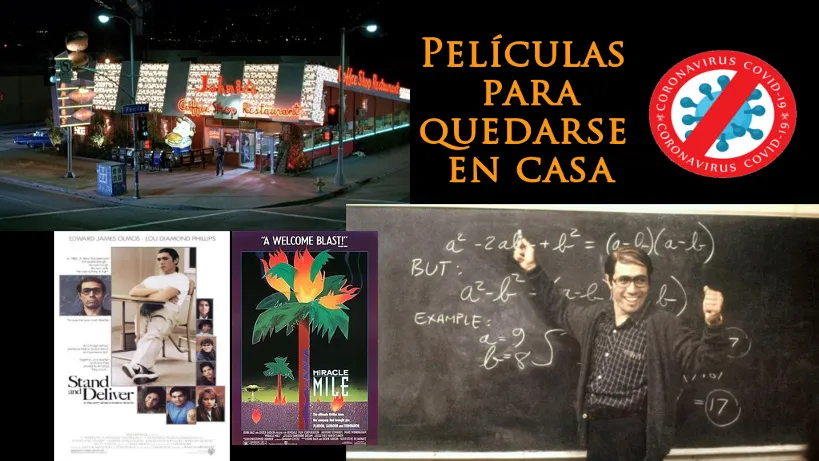
The movie recommendation is subjective, and has an additional complication: it's hard to know for sure how viable it is to watch a movie in different countries.
Since the two movies I'm going to refer to are somewhat old, the possibilities of watching them are not in theaters, but there are other options:
1-Free online streaming services.
2-Paid online services, like Netflix.
3-Torrents.
In the last case, an additional difficulty can be the subtitles, as well as the low download rate if there are few people "seeding" the files. But in both cases I can state that recently I was able to download very good quality video files and the corresponding Spanish subtitles for both movies. The subtitles are available at subdivx.com and it is advisable to first see what subtitles are available and then look for matching torrents.
STAND AND DELIVER, Ramón Menéndez, 1988
Starring Edward James Olmos, the movie revolves around a math teacher trying to teach a difficult group of students.
There is a paradigmatic scene: "Minus times minus is plus," says the teacher. And he asks: "Repeat with me." "Minus times minus is plus," everyone says, several times. "Minus times minus is plus" and so on. After a pause the teacher asks: why?...
It's a good movie for those who like mathematics and for teachers in general, but also for all those who have a formed opinion about what it means to be a teacher. It helps to rethink ideas about how easy or difficult it is to practice that poorly paid profession.
The movie, directed by Ramón Menéndez, was released in 1988. It is based on a true story from Garfield High School in East Los Angeles about math teacher Jaime Escalante, born in Bolivia and deceased in 2010. An asteroid bears his name. In 1982, 18 students successfully took the calculus exam and the educational system found it suspicious. 12 of those students retook the exam and did it correctly. In Spanish the movie is known as "Con ganas de triunfar". IMDB gives it 7.3 points out of 10 with 15273 ratings.
MIRACLE MILE, Steve De Jarnatt, 1988
This is a movie about the possible imminence of a nuclear disaster, but at its core, it's a movie about communication and its effects, in particular, the "Snowball" effect. The crux of the matter can be told like this: a guy who was going to meet a girl -who might be the woman of his life- falls asleep and arrives late at the café. After calling the girl to leave her a message from a phone booth, the phone in the public phone booth rings. It's a person who thinks he's calling his father's house and tells him that he's in a missile silo and a nuclear war is breaking out. The response will arrive in 70 minutes. The guy tells this in the café and everyone runs to the airport to "take advantage" of knowing before the rest. The guy, meanwhile, goes to look for the girl. What starts that way ends with the entire city in a chaotic exodus.
It's worth saying that in the movie there are at least two references to Carl Sagan: at the beginning, when the protagonist visits a museum, the Cosmos series is playing on a television. Later, in the truck they flee in, the woman talks on a cell phone with Carl Sagan.
It's the 1980s, so the cell phone was a brick. And phone booths existed! What would Superman or Agent 86 be without phone booths!
Miracle Mile is an area of Miami, where all the action takes place.
Other curiosities: the café where it all starts has a giant doll at the door with the inscription "Fat Boy", like one of the atomic bombs dropped on Japan by the U.S. The restaurant really exists and is called Johnie’s, although it doesn't have the doll.
On the other hand, the production of the movie had a path similar to the script, since a snowball effect occurred regarding the movie, generating great expectation even before filming began. The original soundtrack for that movie was made by the group Tangerine Dream.
ON IMDB it has a rating of 7/10 with 8713 ratings.
Since something small later becomes something big, the movie reminds one of another, from more or less the same era: After Hours.
MUSIC FOR STAYING IN
I found on the Bandcamp site, an album made by two young people from Mexico under the title Starfighter. The duo calls itself NightRunner.
The music on the album contains some excerpts of dialogue from the movie Miracle Mile, in particular the phone dialogue that starts everything and then something the protagonist says in the café (tracks 1 and 8). The first track is called "After hours".
The music, instrumental and electronic, is highly recommended, beyond that relationship with both movies. And besides being able to be listened to for free online on BandCamp, it can also be downloaded. The last two tracks are unbeatable, in particular the last one called Murder in Miami.
On the other hand, we are about to receive a visit from Pat Metheny. Unfortunately, Lyle Mays recently passed away, an excellent musician with whom Pat worked for a long time. Among his works is We live here, from 1995. The whole album is great, but I highlight the first track, "Here to stay". Besides being high-level music, its title combines with the idea of staying at home and the album cover includes the list of planets in the Solar System.
Two very different suggestions: a movie with a certain possibility to reflect on teaching; and a somewhat popcorn movie, which also allows one to think about the snowball effect, information and the verisimilitude of discourses.
Two movies from 1988. At 32 years, we've gone from apocalyptic nuclear fear, to the fear of a viral end of the world. It may just be a coincidence in language, but this happens precisely in a society where "viral" videos abound.
Ultimately, it seems that mathematics still generates as much fear as 30 years ago, and the transformation of matter into energy (E=mc2) is as dangerous as... snot!
Sources and related links
- IMDB Con ganas de triunfar (Stand and deliver)
https://www.imdb.com/title/tt0094027/ - IMDB Miracle Mile (1988)
https://www.imdb.com/title/tt0097889/ - Stand and Deliver (1988) scene
https://www.youtube.com/watch?v=Q3a-bXXN9Xc - Miracle Mile The Call 1988
https://www.youtube.com/watch?v=ir9Q7gzOoz8&t=60s - Night Runner - Starfighter [Full Album]
https://www.youtube.com/watch?v=c5LCmQC_KeU - After Hours (1985)
https://www.imdb.com/title/tt0088680/ - Starfighter by Night Runner
https://nightrunnermusic.bandcamp.com/album/starfighter - TANGERINE DREAM - MIRACLE MILE (Original Motion Picture Soundtrack)
https://www.youtube.com/watch?v=NrL3OAFLDuU - A Diner With a Past and an Uncertain Future
https://mediadecoder.blogs.nytimes.com/2011/10/16/a-diner-with-a-past-and-an-uncertain-future/
About the images
Photos from IMDB. Virus image from https://publicdomainvectors.org/id/bebas-vektor/Rambu-coronavirus/85203.html