Mathematical requiem of the life factor as an excuse for a memory.
A few days ago, journalist Marcelo Zlotowiazda passed away. Upon arriving at the office, a colleague mentioned it and I, still a bit sleepy, replied curtly: "It's not news that we're all going to die". Despite that cold response, Zloto's disappearance pained me.
Does it make sense to live forever?
We could approach the issue by proposing that, in the future, we will be able to cure all deadly diseases and, thus, never die. (Which is different from being a zombie).
However, if only that changes (ceteris paribus), it would imply that we will have to work 50% of our lives, as now.
If today a person starts working at 20 and retires at 70 and extends their life to 100, they will have worked 50 out of 100 years.
In the case of living to 1000 years, we should work five centuries, but it's certain that in such a scenario, one would work much more, since today people retire because the ailments of age make it difficult to keep working. In which case, in such a future, we would live 1000 years, and work 980.
But being immortal implies not living a long time, but infinite time, in which case we would work infinite time. It's not advisable.
So we will think about living forever, but not that much. That is, a large amount of time... finite.
What reasons could we find to achieve that, if it's even possible?
A nerdy mathematical reason
Mathematician Matt Parker, from the Youtube channel Numberphile, published a video in 2015 in which he tells a mathematical oddity for those born in 1980: in 2025 they will turn 45. And 2025 is 45².
This does not happen with any other human being born in other years. Although, those who will be born in 2184 will also have nerdy reasons to celebrate (see the video indicated below).
What does happen with everyone else is something similar, but it deserves a development.
THE LIFE FACTOR
Let's say I divide the current year by my age, what I get is a number I will call "Life factor". What does such a number mean? Mathematically it is the number of times I can divide the year number into as many equal parts as my age.
For example:
2019 / 46= 43.89.
This implies that this year, when I am 46 years old, my life factor is 43. Let's see what happened before and after:
2017/44= 45,84
2018/45= 44,84
2019/46= 43,89
2020/47= 42,97
As can be seen, each year I got closer to the possibility of my age coinciding with the life factor. The closest approximation was in 2018 (with a difference of 0.16) and since then these two numbers have started to move apart.
Now, if we take the difference between year and age we will get a constant, equal to our year of birth. In my case, 1973.
Questions
1-Why, if the difference between both numbers remains, does the division generate an ever smaller number?
2-If the difference ALWAYS becomes smaller, will it be possible to reach a factor of 1?
Answers:
1-For the same reason that if we take a fraction, say 10/2 and then add 1 to the numerator and denominator, the quotient will be smaller. Let's see:
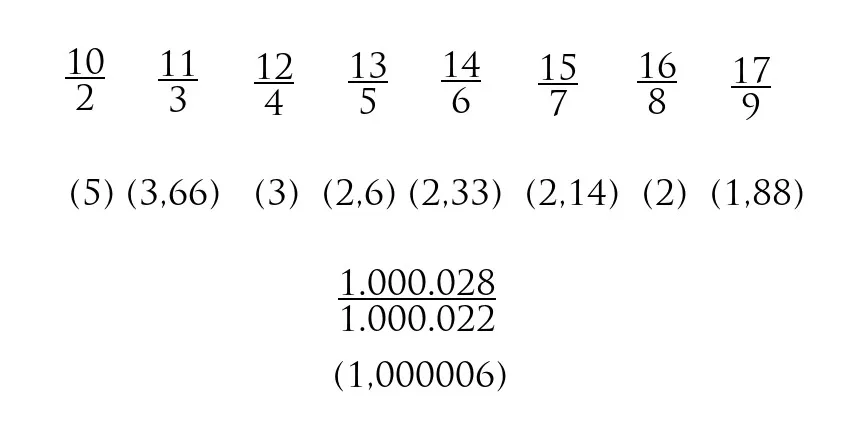
As we see in the first row we have a series of fractions whose difference between numerator and denominator is always 8, but the quotient, the result of the division, is always smaller. If we extend this series enough, the result will get closer and closer to 1, without ever reaching it.
So I also answer the second question this way, but...
2-It will never be possible to reach a factor of 1, except that someone was born in the year zero, since to obtain 1, the current year and our age would have to coincide. But with very large numbers, that difference between our age and the year dilutes. Therefore, we can reach 1 if we settle for a certain level of precision, say 4 decimal places. That is, it is possible that, at some point, our life factor is something like 1.00002.
Since the calculation is simple, as it's just a division, we can use a spreadsheet.
If I extend the cells until the column of my age is 40,000, that would be the year 41,973, logically, my life factor then would be barely 1.05.
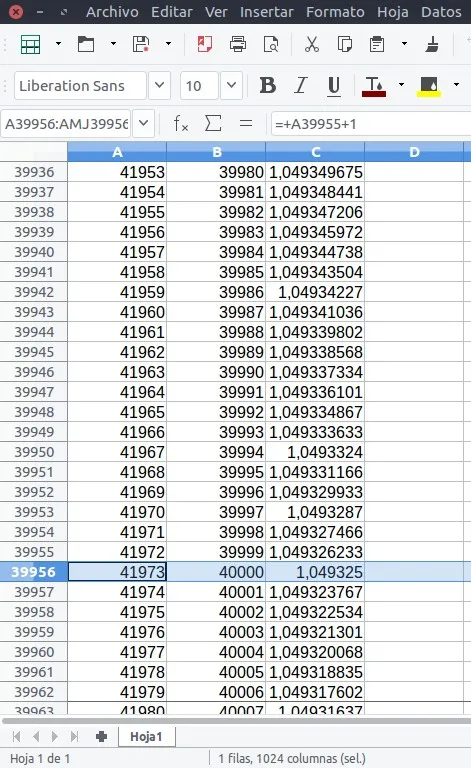
That means that to reach a factor of 1 with four decimal places (1.0000) would take a very, very long time.
For that reason alone, it would be justified to live forever.
Stars are hard to forget because they last a long time.
When my turn comes, I will be an easy person to forget. But I would like to be remembered at least in silence listening for 22 minutes to this song: https://youtu.be/O1cAZbw_gbY.
My mom left on November 6 last year. Her birthday was October 19. Today she would have turned 74. She left when she had just turned 73. At that time, her life factor was 27.6. I don't know if I will reach a factor of 41...
Anyway. All this was a nerdy excuse to say that I miss her very much without it being so obvious.

Sources and related links
Why 1980 was a great year to be born... but 2184 will be better https://www.youtube.com/watch?v=99stb2mzspI
About the images
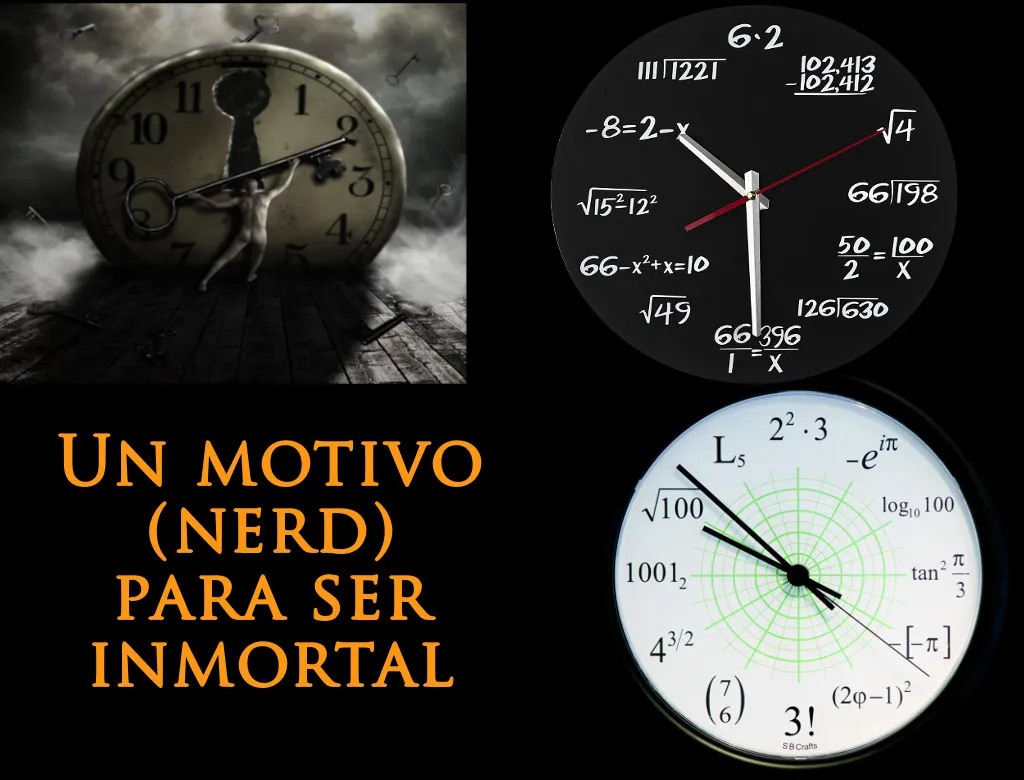
Initial image combined with:
https://shop.hiphopbeats.es/product/inmortal/
COLLECTION OF MATHEMATICAL CLOCKS https://www.gaussianos.com/curiosos-relojes-matematicos/
Math Clocks http://www.sbcrafts.net/clocks/
Decodyne Math Wall Clock https://www.amazon.com/Decodyne-Math-Wall-Clock-Equation/dp/B01IABQ4FU