We are about to reach rotation 366 of the year. How many sidereal rotations have you had in your life?

Readers will have already noticed that I like nerdy excuses to say something simple, but that sounds intelligent.
If the Earth rotates 360º in 24 hours, that implies it spins on its own axis at a rate of 1º every 15 minutes. This speed is important for visual observation, and in astrophotography. As any amateur will notice, if you point a telescope at an object in space, after a few minutes, the same object will no longer be in the center of the eyepiece lens. So to keep seeing the object, you have to correct the telescope (or buy a motorized mount and do a proper polar alignment).
Another speed to consider is given by the phenomenon that stars "rise" 4 minutes earlier each day, relative to the previous one. This difference is not produced by rotation, but by revolution. Let's do the math:
If each day there is a difference of (almost) 4 minutes, in 360 days it will be 360*4=1440 minutes, which equals 24 hours, that is, an extra day!
This also means that if the Earth revolves 360º around the Sun (approximately, since the orbit is elliptical) and takes (almost) 360 days, it is about 1º per day.
Therefore, the planet rotates 1º every 15 minutes and revolves 1º every 24 hours. But this happens simultaneously.
Which leads us to the difference between the mean solar day and the sidereal day, which is about 4 minutes.
As a consequence, the Earth performs 365 rotations per year with respect to the Sun, but 366 with respect to the other, more distant stars.
GRAPHICAL EXPLANATION
I'm going to help myself with a couple of graphics and an analogy. Let's think we are in front of a low column, a column that is only 1 meter high. Behind it, a few meters away, there is a wall with a lit streetlight or lamp.
It would be as if we were the Earth; the column, the Sun; and the lamp, a background star.
We are aligned, in such a way that if I look straight ahead I see the column and the lamp behind it.
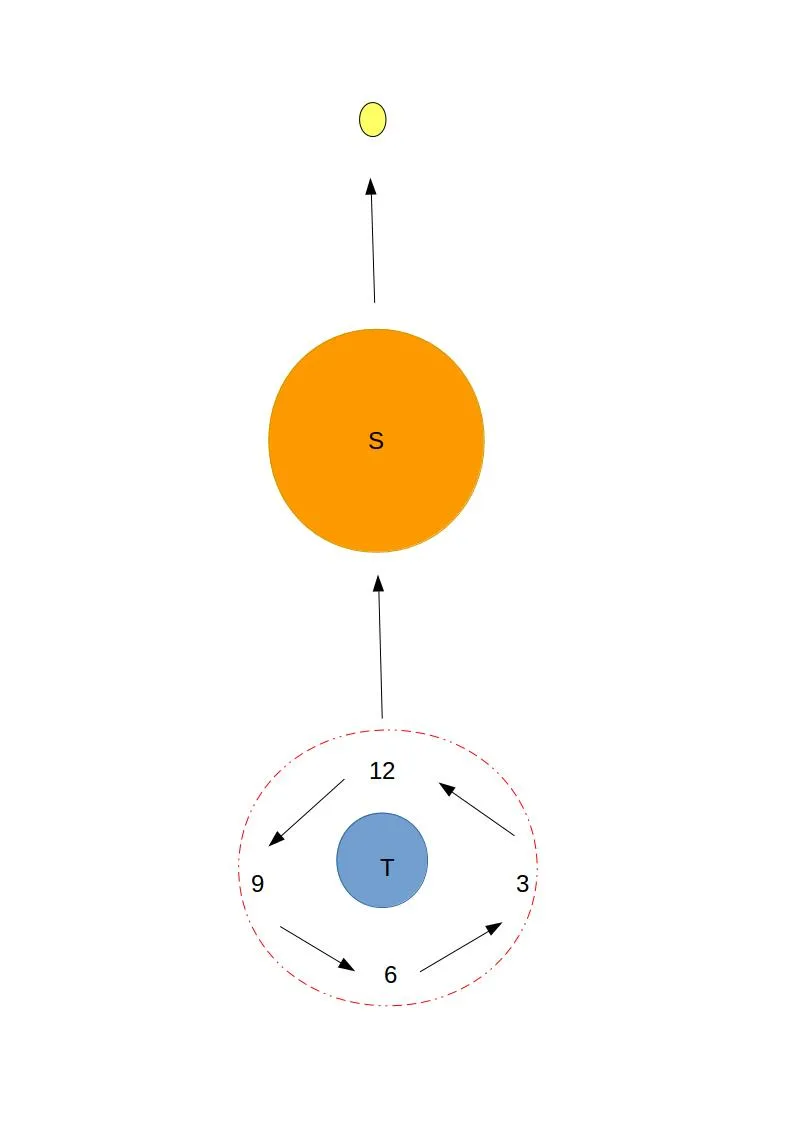
Standing like this in front of the column I am going to rotate on my own axis. To rotate, it's useful to think that around me there is a circle, as if it were a clock that has the numbers 12, 9, 6, 3 and which I am going to see in that order because I am going to rotate counterclockwise, opposite to the direction of a clock's hands.
So I see the 12 on the imaginary clock, the column and the lamp. Then I rotate counterclockwise and see the number 9. I rotate another quarter (90º) and see the 6; I rotate another quarter and see the 3; and finally I rotate 90º again and see the 12, the column (Sun) and the lamp (Star) again.
I will say I saw the Sun and the lamp again when I completed one rotation. Easy, but incomplete.
We know the Earth also revolves. I will add the revolution, which is simultaneous, but to make it easier I'll do it in two steps:
First I will do the same as before for three quarters of the rotation and in the last quarter, before completing the turn, I am going to revolve one quarter around the column and only then will I finish the rotation. Let's see what happens:
After revolving, as I finish the last quarter of rotation, I perceive the lamp before the column. The lamp "gets ahead" of the column only because I changed position. Before I was aligned and now I'm not. It's the same thing that happens with the stars. They "get ahead" because our position around the Sun is different.
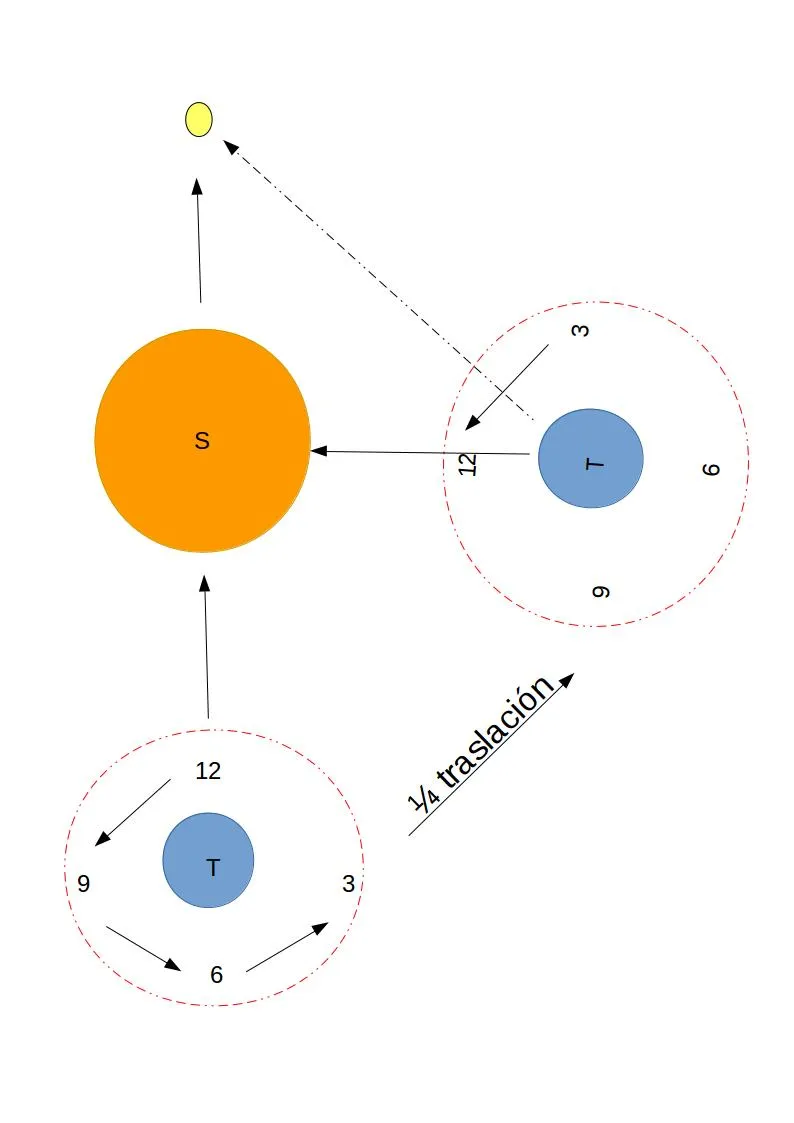
This effect is cumulative. If on day 1 I see a star at 22:00 in one part of the sky (let's say X), the next day, I will see the star in X four minutes earlier. On the third day I will see the star in the same place, 4 minutes earlier than the previous day, but 8 minutes earlier than day 1. On the next one, I will see the star 4 minutes earlier, in the same place as the day before, but 12 minutes earlier than day 1. This "getting ahead" implies an accumulation of 4 minutes per day. We already did that calculation at the beginning. As a consequence, with respect to the stars, we have one more rotation than with respect to the Sun.
Video of the art installation based on astronomy called "Carrousel del cielo". You can select "Auto-translate" to show subtitles in Spanish.
https://www.youtube.com/watch?v=4Wh4zuGayog&vl=de
THE TURNS OF LIFE
How many rotations have you had in your life? In my cosmic carousel, I am about to reach 16790 solar rotations (16836 sidereal ones), in mid-January. This means that if you know math, with a little arithmetic you can figure out my next birthday number. Did I already grab my ring?
At least in Argentina, when I was a kid, when getting on and spinning on a carousel (merry-go-round), we could try to grab a ring.
The ring is a metal hoop that has two ends that are inserted into a wooden piece shaped like a pumpkin. It is shaken by the carousel operator, who stands below the carousel in a fixed spot; while the children try to grab it, since whoever manages to do so, obtains the right to take an additional turn on the carousel for free.

What could replace the ring in the "game of the turns of life"?
If grabbing the ring is as difficult as winning the lottery, then we could think of a kind of cosmic lottery, of guessing a number. This idea occurs to me:
When I have my birthday I will have accumulated 16836 sidereal rotations, how many divisors does the number 16836 have?
If the number of divisors of that number coincided with the years I am turning, Cosmic Bingo!
THE CALCULATION OF DIVISORS
To put such bingo into play, we must then calculate the number of rotations. This is easy: our age times 365 for solar rotations or times 366 for sidereal rotations.
Then, the more difficult part, calculating the number of divisors of that number.
A method for calculating divisors consists of doing two things:
1-Find the prime factors (whenever it is a composite number) (See aside)
2-Use Ramanujan's formula to calculate the total number of divisors.
For the first, although there are websites that have algorithms for that purpose, we can do it manually, like this:
16836/2
8418/2
4209/3
1403/23
61/61
1
That is, we divide the number of rotations by the smallest possible prime number (so that we get an integer remainder) and do the same with the remainders we get, until we reach 1.
We then have the prime factors, which can be expressed like this:
2^2, 3, 23, 61. If these numbers are multiplied together, we get the original number. And since these numbers are all prime, they are the prime factors of the number of rotations.
And then we use Ramanujan's function (the divisor function) like this:
To each exponent of each prime factor (if it's not explicitly stated, it's 1) we add 1 and multiply them together.
In the given case, the exponents are 2,1,1,1. Applying the function we get:
Divisors= (2+1)(1+1)(1+1)(1+1)= 3*2*2*2=24. [The asterisk indicates multiplication].
Another method is to use a website and move on.
Isn't the main use of the internet to stop using the part of the brain that thinks hard and instead use the part of the brain that thinks easy? Below I indicate a website for that purpose.
For the given example, with my number of rotations, there's no Bingo! since I'm not about to turn 24, but almost double that...
And then the prickly question arises:
Will there be a time when the number of rotations (solar or sidereal) of our life is a number that has a quantity of divisors equal to our age?
A first inspection is striking:
The number 5040 (7!) has 60 divisors, a barbaridá (It's written and pronounced just like that, so it sounds more barbaric, you see?).
But 5040 rotations implies an age of 5040/365=13.8 years. Too many divisors for such a short life, ameo...
Let's use courage (valor) and try other values (corajes):
366*24 years is 8784 sidereal rotations. 8784 has 30 divisors. We're getting closer.
366*30 years is 10980 rotations. 10980 has 36 divisors. Again a difference of 6.
366*40=14640, which has 40 divisors. Voilà!
If you're close to turning 40, tell your friends about this incredible coincidence. They'll probably all applaud you...or discreetly walk away...
Anyway, let's not beat around the bush. What I have to say is simple:
Greetings to all@x! Have a good year 2020! And may our carousels take us closer to the Sun than to the black hole.
Aside: Arithmetic Theorem and the number of rotations
I indicated earlier that the cited method is valid if the number of rotations of our life is a composite number. Could it not be?
Clues:
1-The number of rotations will come from multiplying 365 or 366 by the number of years of life, which will be an integer.
2-A composite number is not prime. And it's not prime if it's even (except for 2).
3-Every even number multiplied by another integer (even or odd) will result in an even number.
4-Numbers with more than one digit that end in 5 are also not prime.
5-If you didn't notice, in no case am I taking the leap year into account. Does it matter? In a leap year are there 367 rotations? Answer: if you think yes, it's because you didn't quite understand the matter.
Video by Fito Páez and Ariel Rot of "Giros".
https://youtu.be/jDqK83Sa8Zk
Sources and related links
- Wikipedia Earth's Rotation
https://es.wikipedia.org/wiki/Rotaci%C3%B3n_de_la_Tierra - Wikipedia Divisor function
https://es.wikipedia.org/wiki/Funci%C3%B3n_divisor - Random number: indicates several characteristics of a number given by the user, among them, the number of divisors.
https://numero-aleatorio.com/ - ESA HEAVEN'S CAROUSEL
https://sci.esa.int/web/hubble/-/53856-heavens-carousel
https://www.spacetelescope.org/images/heic1407b/ - HEAVEN'S CAROUSEL Tim Otto Roth
http://www.imachination.net/carousel/ - Hubblecast 74: Hubble and Heaven's Carousel
https://www.youtube.com/watch?v=4Wh4zuGayog&vl=de - @x [arrobaEquis]
https://www.noticiasdelcosmos.com/p/arroba-equis.html
About the images
Initial image: Heaven's Carousel. Credit: NASA, ESA, and Pam Jeffries (STScI).
Ring image: Rosa, so wonderful: https://redaccionrosario.com/2019/10/18/rosa-tan-maravillosa/