A playful and didactic way to approach astronomy
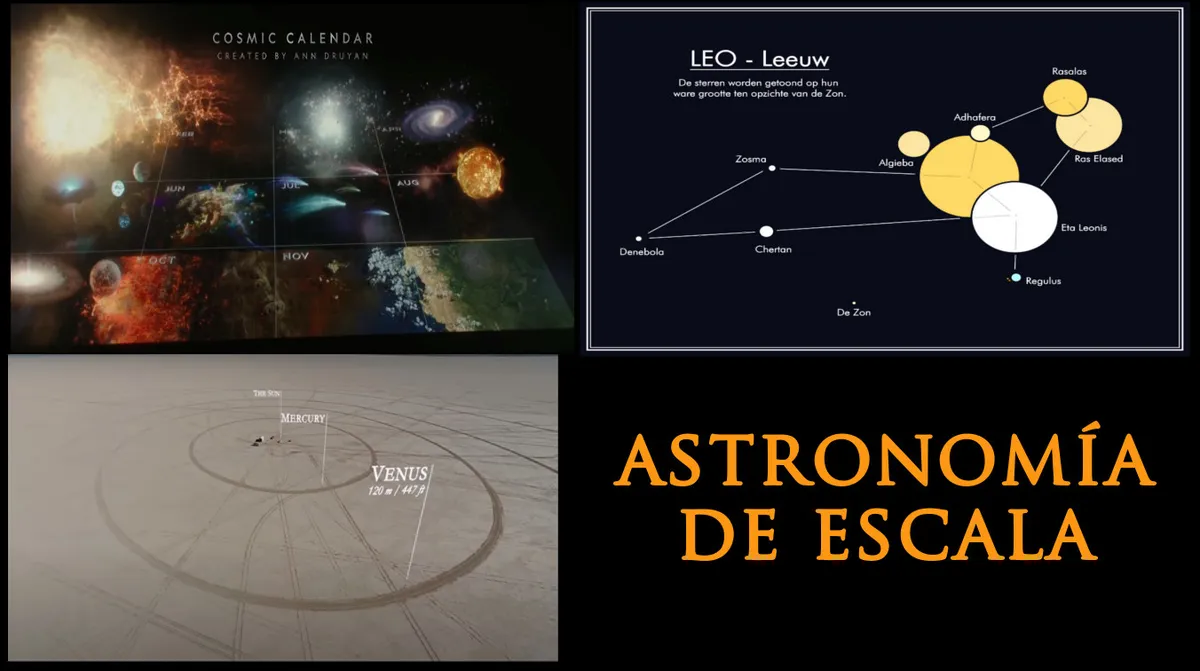
A recurring interest in astronomy lies in proportions. Something "astronomical" is something big. Astronomical objects are certainly large in size or are at enormous distances, compared to life on Earth. However, it is difficult to get an idea of such sizes. Scale representation is ideal for that.
A first task, carried out in many schools, is the creation of a scale Solar System. But there are other ways to do scale astronomy.
THE COSMIC CALENDAR
Another way to do scale astronomy is the idea of a "cosmic calendar" used by Carl Sagan in the original Cosmos series and now also in the new version of the series, hosted by Neil deGrasse Tyson on NatGeo. I must say that the Cosmos series is in its third season (if we count Sagan's as the first). It is called "Cosmos: Possible Worlds". On another occasion I will make some specific comments about this new season. I have seen some errors or omissions in episode 4, for example, that may be worth a post in the future.
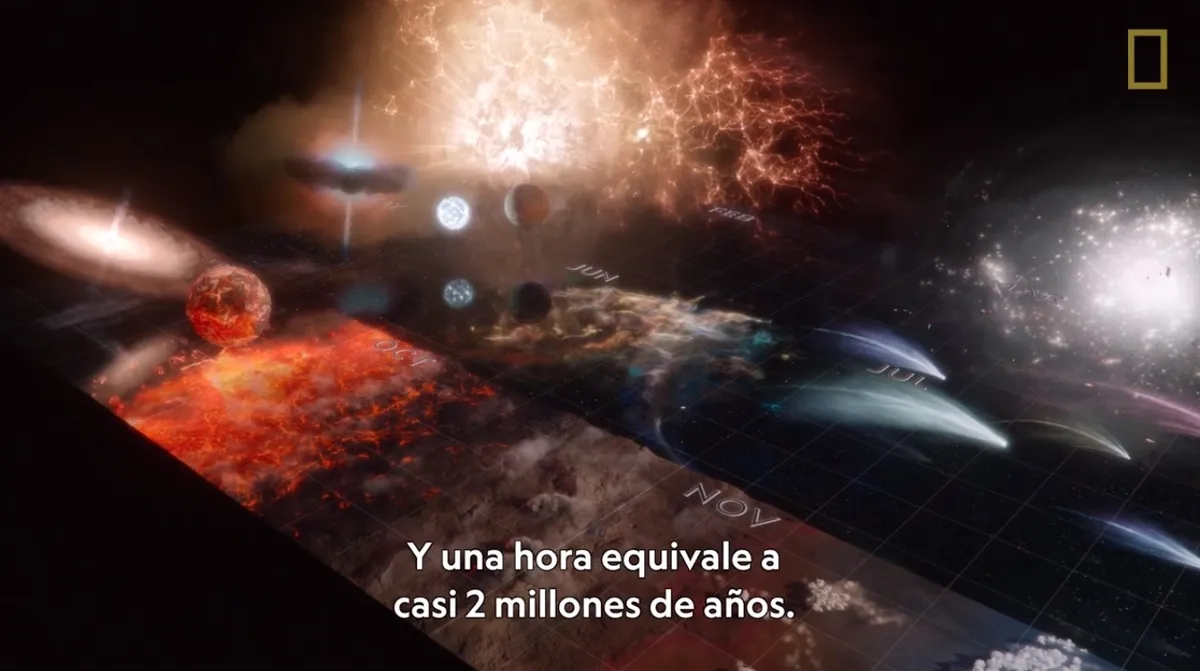
In the series, the concept of the Cosmic Calendar is used. The idea is to scale the age of the universe to fit it into a calendar year.
Let's think about how to do it:
If the age of the Universe is approximately 13.7 billion years, then each of the 12 months would have a duration of 1,141 million years. However, months have different durations, between 28 and 31 days. So it is convenient to divide the initial amount by 365, to know how long a day would last: 37.5 million years.
If a day lasts that amount in the Cosmic Calendar, then the months of 31 days, like January, last: 1,163 million years.
With these simple calculations, we can say that any event or process that occurred in the last 38 million years, in the Cosmic Calendar, would appear on the last day of the calendar, December 31.
To know when an event that occurred 650 million years ago would appear in the Cosmic Calendar, we can calculate backwards: 650/38=17, that is, 17 days before the last one.
Out of simple curiosity we can continue using the scale:
If a day lasts 37.5 million years (38 million to round), then, one hour lasts 1.5 million years.
If one hour lasts 1.5 M years, then, 1 minute lasts 26 thousand years and 1 second lasts 434 years.
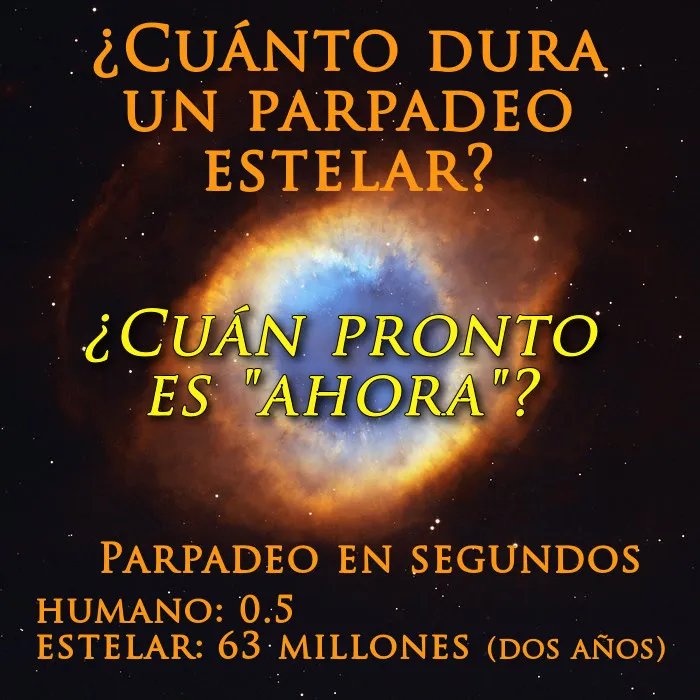
If a person's blink lasts 0.5 seconds, then, at "cosmic scale", a "cosmic blink" lasts 217 years.
This calculation of "cosmic blink" is valid for the duration of the Universe. If we compare it with the duration of an average star, the result is much smaller: 2 years. (See link below)
CONSTELLATIONS TO SCALE (MAGNITUDE)
The stars in constellations are not connected, except by our imagination. They have different brightnesses, sizes, temperatures and distances.
The magnitude of stars is twofold: apparent and absolute.
Apparent magnitude is given by comparison, without taking distance into account. However, a star that appears faint to our eyes may be much more luminous than another that seems very bright to us. Absolute magnitude is obtained by knowing the distance to the stars and comparing the brightness with a calculation by which it is considered that the stars are at the same distance of 10 parsecs, considering that if the star is actually farther away, when "bringing it closer" its brightness should increase, and if it is closer, when moving it away it should decrease.
The formula M= (m+5)-(5 log d) is usually used, where log is base 10 logarithm; m is the apparent magnitude and d is the distance in parsecs.
Thus, if the Sun has an apparent magnitude of -26.75, what will its absolute magnitude be?
The first problem is that the above formula requires using parsecs as the unit of measurement. The Sun is at 1 AU, 150 M km. How many parsecs is that? 1 parsec is equal to 3.26 light-years.
We can search the web for a unit conversion site or we can entertain ourselves doing it ourselves:
1 light-year is the distance light travels in one year. And light travels in a vacuum at almost 300,000 km/s (299,792.458).
So we use that speed for one year, with the calculation:
300,000 * 60 * 60 * 24 * 365 and to the result (1 light-year in kilometers) we multiply it by 3.26 to get one parsec in km.
The result is the whopping 3.08 * 10^13. (The asterisk indicates multiplication)
To know the proportion of parsecs to the Sun, we divide the distance in km (150 M) by that amount:
4.86 * 10^-6, which is the same as 0.00000486 parsecs.
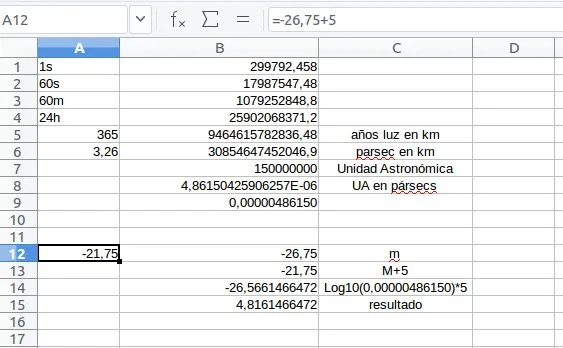
Then we use the previous formula with this data:
m, apparent magnitude= -26.75 d, distance in parsecs= 0.00000486
M=(-26.75+5)- 5 * log(0.00000486)
M=-21.75 - 5 * -5.31
M=-21.75- (-26.56)
M=-21.75+26.56
M=4.81
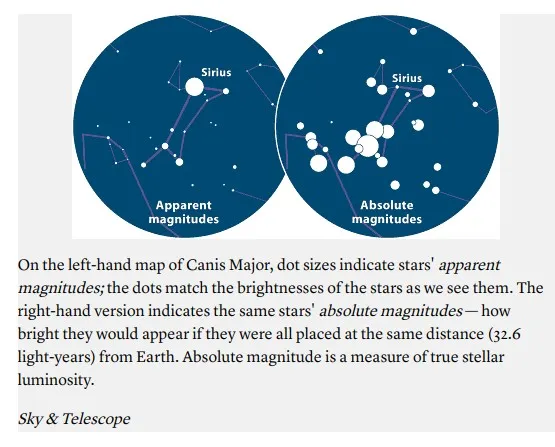
If we do this for the main stars of each constellation, we could draw them with a size proportional to the magnitude, whether apparent or absolute. An example is shown by Sky & Telescope magazine with Canis Major:
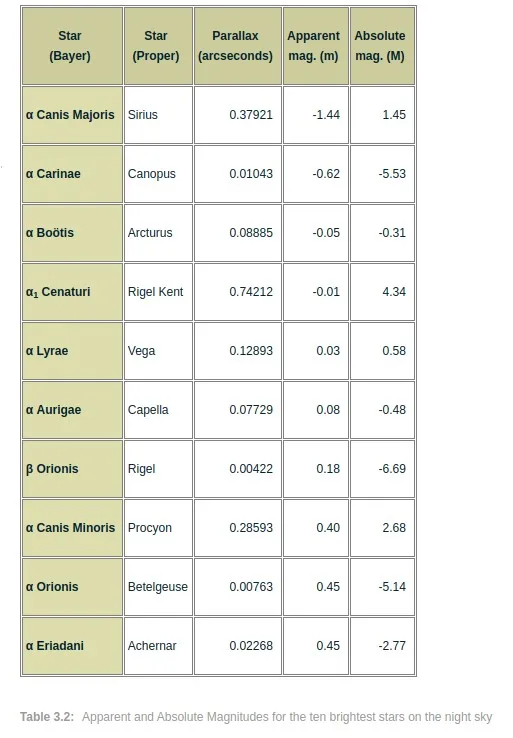
Below is an ESA table with the apparent and absolute magnitudes of some stars. It must be remembered that the lower the magnitude number, the brighter the star:
CONSTELLATIONS TO SCALE (SIZE)
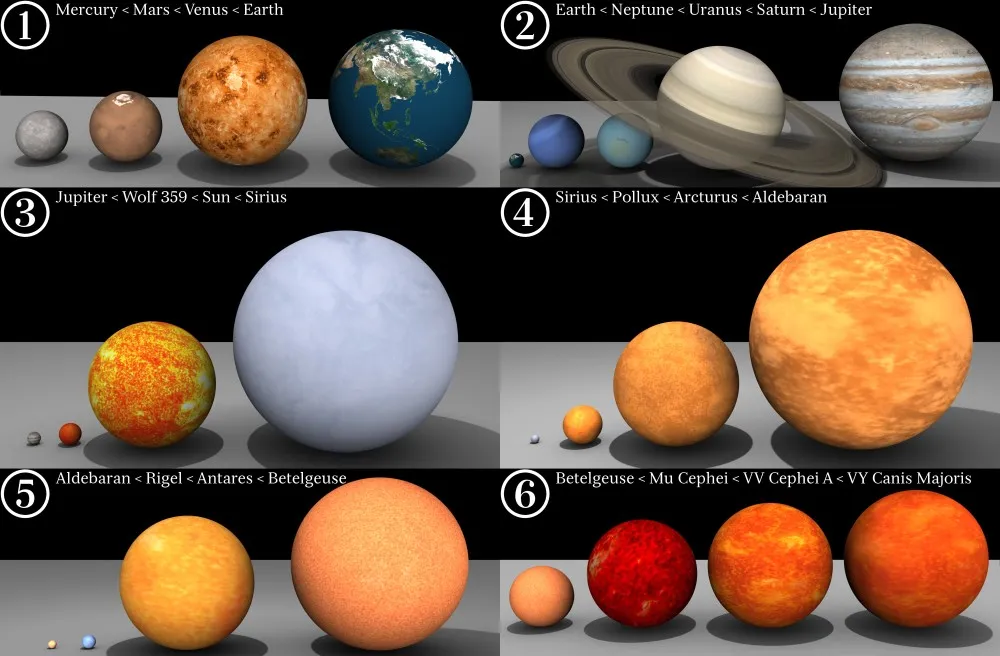
In the same way it can be done with their size. The public already knows scale illustrations of different stars, like these we see here from Wikipedia:
A Dutch astronomer, Nick Oberg, shares on his website images of some constellations with this concept of real size, to scale. As a result, Orion looks like this:
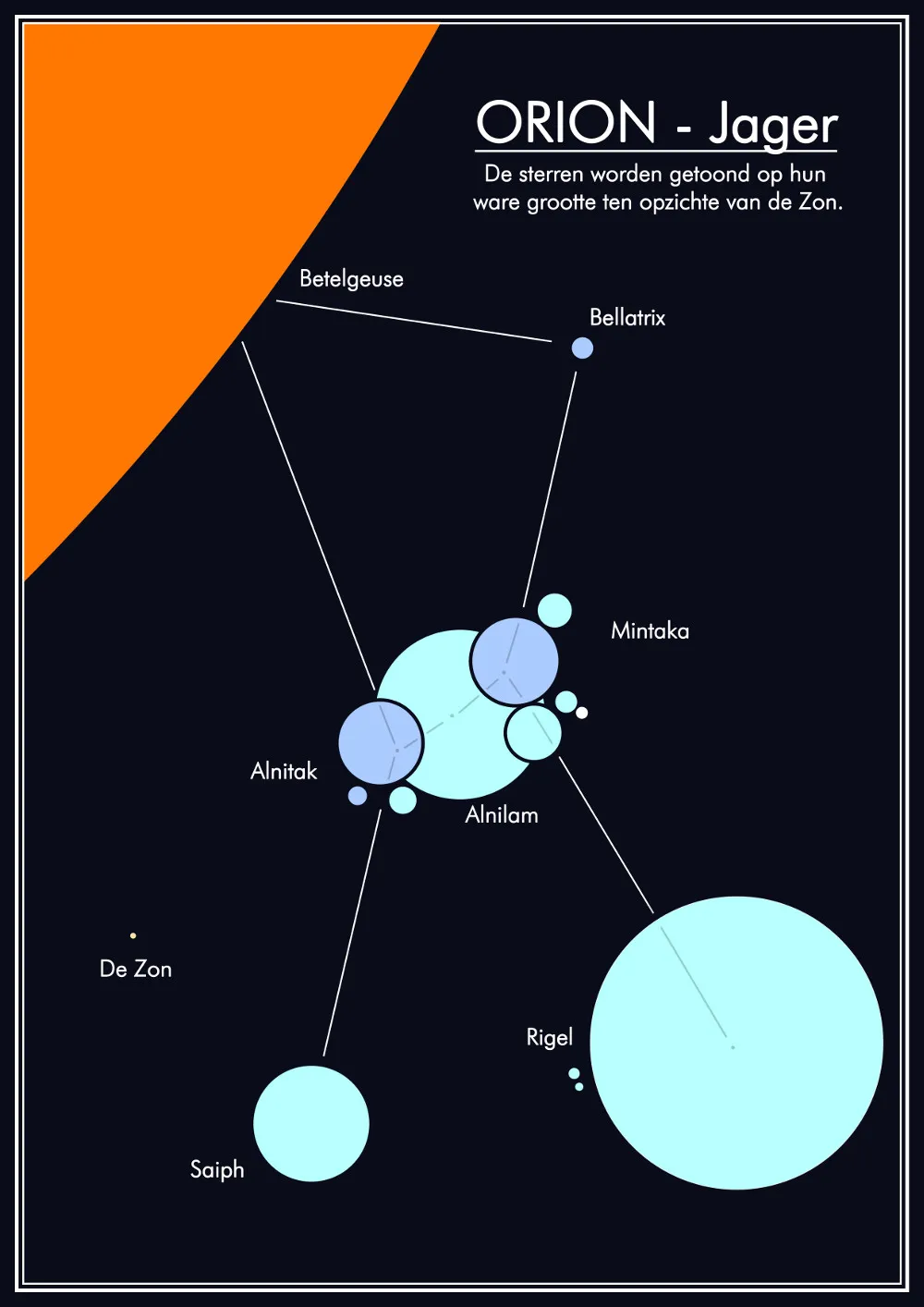
The words "De Zon" mean "The Sun". It is striking in this illustration, the difference between our Sun and Betelgeuse.
In the case of the constellation Cygnus, the Swan, we see the Sun and around it the orbit of Mercury, to facilitate comparison with the giant Deneb.
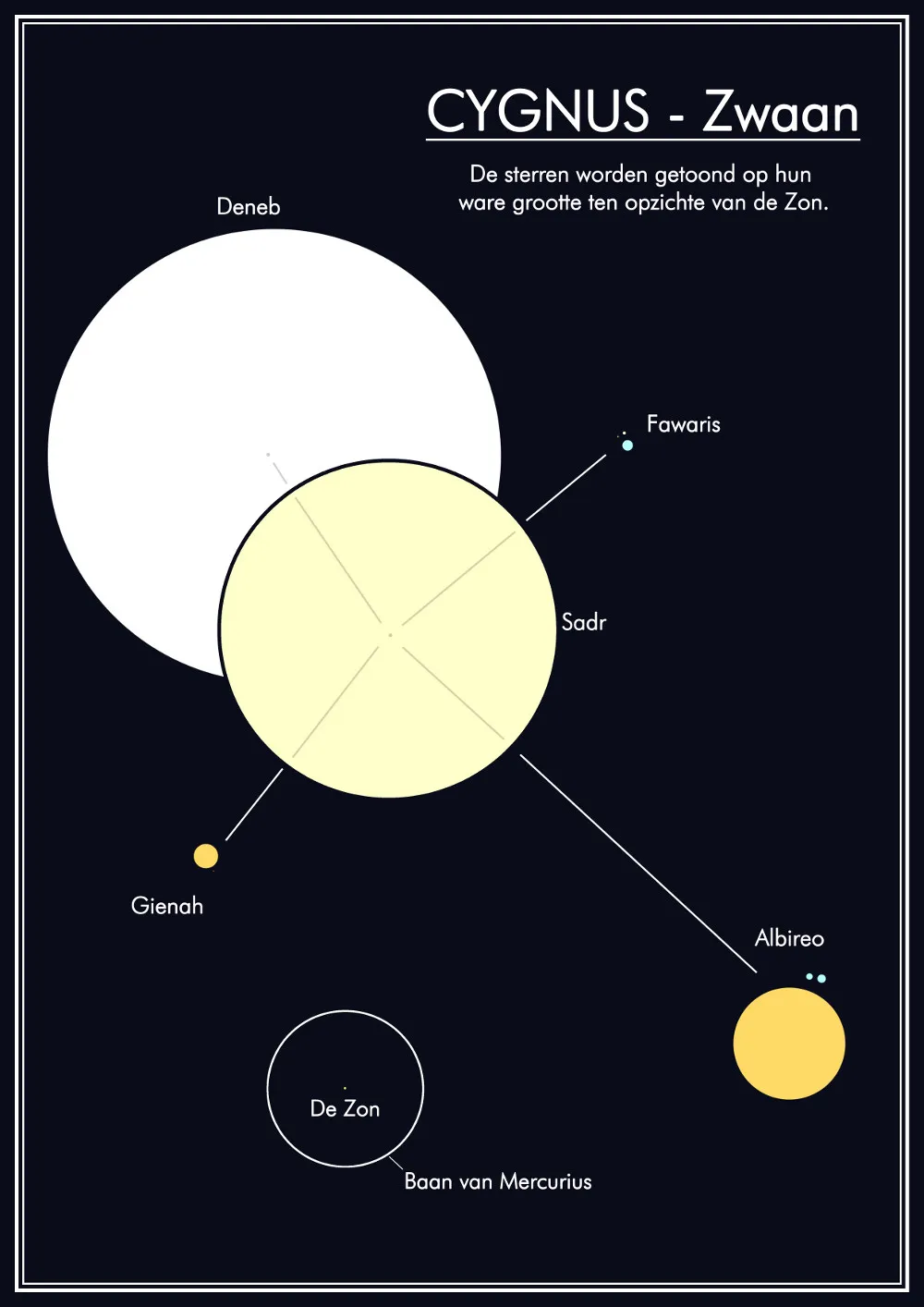
On his website there are some other illustrations, all larger than those shown here. It is worth consulting that site.
PLANETARY QUARANTINE SCALE
Someone once said that the speed of time is 1 second per second. Although time is measured the same everywhere (despite the fact that we now know that actually depends on speed), the way of dividing time creates differences. Human beings have established that a year is the time it takes the Earth to orbit the Sun. Because the Earth moves. And we established that a day is the time it takes the planet to rotate on its own axis.
If we apply these two concepts to other planets, inside or outside the solar system, we would have different time scales.
On Mars, for example, the day lasts almost the same as here. But the year lasts 687 days.
On Jupiter, the day lasts 10 hours, but the year lasts almost 12 Earth years.
We don't know how long the COVID-19 quarantine will last. But if we wait for a vaccine to be tested, produced, and administered, then the quarantine could last a year. Some have argued that, without quarantines, the disease could be dealt with in a short time, thanks to immunization. It implies that almost all people get sick, but since for the majority it would be mild, they would gain immunity (which is not clear that it happens) through the generation of antibodies. The small (scale) problem is that if only 5% is fatal, even though the percentage is low, 5% of 7,500 million people is an enormous number. The results are evident in countries like England.
Therefore, it's best to stay home, as much as possible. Governments don't need to impose repression for us to know that's the best thing.
If we lived on other worlds in the Solar System and the quarantine lasted 1 orbit (1 year), in terms of Earth years, those planetary quarantines would last according to this scheme:
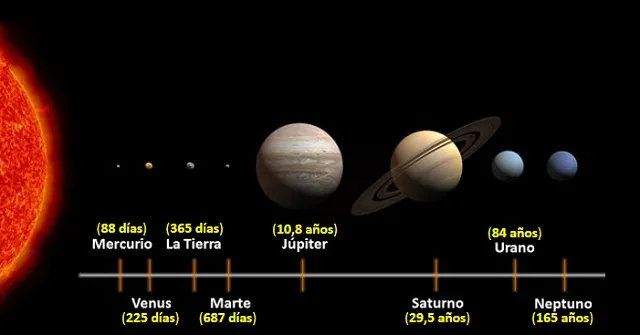
I don't know about you, but I'm starting to like Mercury more and more. However, on the fastest planet, a day lasts 59 days. At home, the day/year ratio is 1/365=0.002. On Mercury, the ratio is 59/88=0.67. How long would the quarantine last on Mercury, if such a process had a duration equal to 360 rotations?
However, there is no life on Mercury. The side facing the Sun is an oven and the other is a freezer. Earth is, therefore, beautiful, full of life. Too bad about viruses, those weird bugs that are neither alive nor dead, like hurricanes.
I hope that soon new winds will blow and we can go back to scaling life. Let's take care of ourselves with kindness and scale up our tolerance.
Sources and related links
- Absolute Magnitude on Wikipedia
https://es.wikipedia.org/wiki/Magnitud_absoluta - Nick Oberg
https://www.astro.rug.nl/~oberg/posters.html - Cosmic Calendar
https://es.wikipedia.org/wiki/Calendario_c%C3%B3smico#/media/Archivo:Cosmic_Calendar.png - The Cosmic Calendar | Cosmos: Possible Worlds
https://www.nationalgeographicla.com/ciencia/el-calendario-cosmico-cosmos - Watch This Guy Build a Massive Solar System in the Desert | Short Film Showcase
https://www.youtube.com/watch?v=Kj4524AAZdE - Star Sizes Wikipedia
https://en.wikipedia.org/wiki/File:Star-sizes.jpg - ESA STELLAR DISTANCES
https://sci.esa.int/web/education/-/35616-stellar-distances?section=apparent-and-absolute-magnitude - THE STELLAR MAGNITUDE SYSTEM
https://skyandtelescope.org/astronomy-resources/the-stellar-magnitude-system/ - How long are the years on each planet?
https://www.saberespractico.com/curiosidades/duracion-anos-en-cada-planeta/ - Is the coronavirus a living being?
https://www.agenciasinc.es/Reportajes/El-coronavirus-es-un-ser-vivo - The twinkling of a star
https://www.noticiasdelcosmos.com/2020/02/el-parpadeo-de-una-estrella.html
About the images
Initial image: Screenshots from Youtube, NatGeo, Nick Oberg.
Figure 1: Sky & Telescope
Figure 2: ESA
Figure 3: Wikipedia
Figures 4-5: Nick Oberg
Figure 6: https://www.saberespractico.com/
Cosmic Calendar image: NatGeo