Will we see the giant star explode as a supernova this year?
Information and reflection on astronomical predictions.
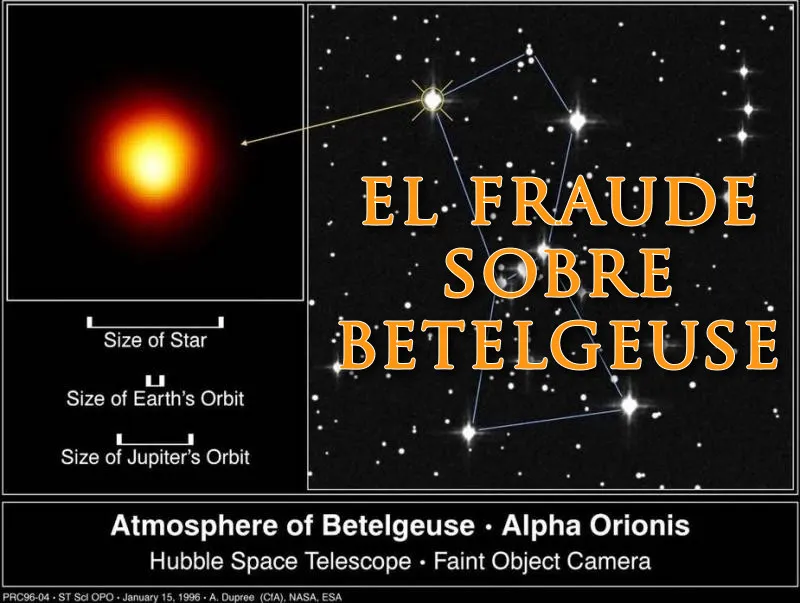
It is taught that scientific theories must be predictable and reproducible. Perhaps because of that, there are those who consider that scientists must spend their time making predictions. Maybe also because of that, there are those who think that astronomers must reproduce the nonsense on the web. In particular, that the star Betelgeuse, in the shoulder of Orion, is about to explode as a supernova and that it will do so this year 2020. That is what is being said on the web. Orion is the hunter. And this tale is a scam.
Shall we take a few minutes to think?
Let's say that science were "the art of making predictions," which it is not. Let's assume it. Let's say.
Then, instead of investigating, the astronomer should make forecasts. It would be something like this:
Year 2010: The astronomer says: "Betelgeuse is about to explode as a supernova". Then, the supernova did not come.
Year 2012: The astronomer says: "Betelgeuse is about to explode as a supernova". Then, the supernova did not come.
Year 2015: The astronomer says: "Betelgeuse is about to explode as a supernova". Then, the supernova did not come.
Year 2017: The astronomer says: "Betelgeuse is about to explode as a supernova". Then, the supernova did not come.
Year 2019: And so...the fable of the lying little astronomer.
Of course, at some point, the astronomer will be right. But between that and astrology, black magic, or a quiz show on TV, there is no difference.
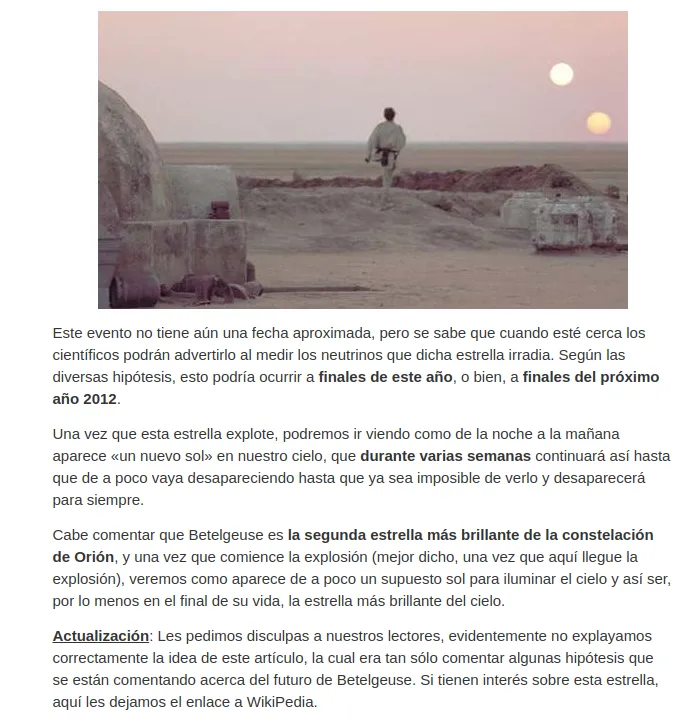
Ahh...but the astronomer "explains": "The brightness of this star has decreased, that's why we think it's about to explode."
But, man, isn't it a variable star? Hasn't its brightness decreased before and it didn't explode?
On the other hand, what the heck does "about to" explode mean? A year, ten years, 100 years? On the astronomical timescale, all those values are a blink. All the values are "valid" for "about to" explode, but they are VERY different human-scale values.
A few years ago the topic of Betelgeuse came up and it became recurrent at the inverse rate of the stellar brightness change, gaining strength when the star loses it. Below I put a link to the same news about Betelgeuse from 2011.
In 2018 I wrote the post "Cosmic Pinocchio: Fake astronomy news". There I gave as an example of fake news, the explosion of the giant star.
The reason for this is that, although it is partly true, it is impossible to make a precise prediction about when it might occur. There is no way. I remember that a few years ago, the web echoed a comparative study done by an astronomy professor and a student. What they did was compare the brightness change of this star with the changes recorded in another that later did explode. And they concluded that the pattern was similar and that, therefore, Alpha Orionis was about to become a supernova...in the following years.
But, wait, let me tell you a story:
A long time ago, we know, Fulanito vomited. Before doing so, he coughed three times.
Now we find Zutanito, who coughed three times. Is he about to vomit?
Is there any reason to suppose a causal relationship between people who cough and people who vomit?
This does not imply that that work was wrong. It suggests that one must be careful with the conclusions.
An inductive argument aims to establish a general truth from several particular cases. The conclusion is always probable and not necessary, but it is valid as long as the cases are "sufficient".
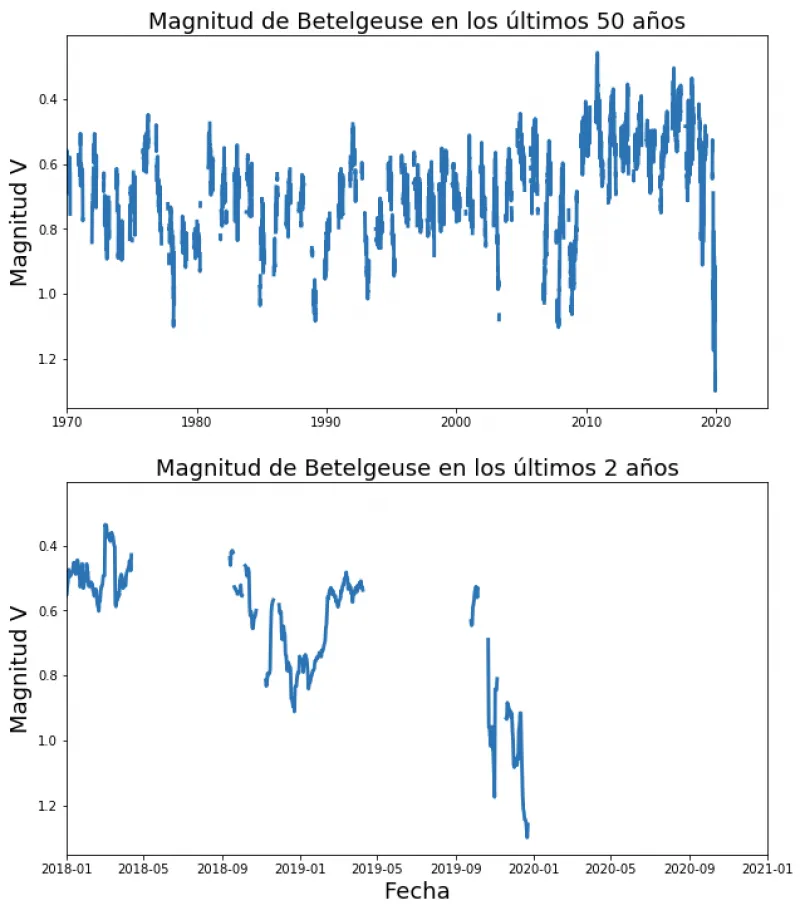
Look: brightness variability of Betelgeuse since 1970, taken from the blog of Mula Francis (Francisco Villatoro). Something similar is said by Phil Plait, in case someone needs the "badge" of the Principle of Authority.
In economics, one speaks of a "bubble". Wikipedia helps me:
An economic bubble (also called a speculative bubble, market bubble or financial bubble) is a phenomenon that occurs in markets, largely due to speculation (...)
What there is about Betelgeuse is a speculation based on some scientific data extrapolated to reach a conclusion that includes an imminent expiration date. The "prophecy" of the date is unscientific, there is not enough data to establish a date. Moreover, the composition, distance and mass of the star are not well known.
The worst lies are half-truths. Even more so if an astronomer says it, as Tiempo Argentino quotes.
The worst part is...they could be right. But if they were, it would be as "meritorious" as the lying little astronomer who, from telling so many lies, got one right. It has nothing scientific about it. It's what Horangel does.
It goes without saying that, since the star is about 600 light-years away (approx), then, if the explosion is detected now, it's because it happened before, since the light takes time to reach us. So instead of talking about when it explodes, we talk about when the phenomenon is detected.
Conclusion
It is impossible to know if the second brightest star in Orion will be seen as a supernova tomorrow, next year, or in a century. I understand the desire, but you mustn't put the cart before the horse. I would love to see a supernova with the naked eye. Who wouldn't? But wanting it doesn't justify talking nonsense. The mere expression of a wish does not become reality. If it did, life would be very easy.
As if that weren't enough, the panic created by irresponsible people who add that, if it were to happen, it would be the end of the world. Nothing will happen. It's too far away to fear. More frightening are the liars we have close by...
Sources and related links
- Cosmic Pinocchio: Fake astronomy news
https://www.noticiasdelcosmos.com/2018/04/pinocho-cosmico-noticias-falsas-de.html - Economic Bubble on Wikipedia
https://es.wikipedia.org/wiki/Burbuja_econ%C3%B3mica - The Boy Who Cried Wolf
https://arbolabc.com/fabulas-para-ni%C3%B1os/el-pastorcito-mentiroso - DON’T PANIC! BETELGEUSE IS (ALMOST CERTAINLY) NOT ABOUT TO EXPLODE
https://www.syfy.com/syfywire/dont-panic-betelgeuse-is-almost-certainly-not-about-to-explode - Science for All T02E16: The star Betelgeuse will explode as a supernova
https://francis.naukas.com/2020/01/02/ciencia-para-todos-t02e16-la-estrella-betelgeuse-explotara-como-supernova/ - ¿La Tierra podría tener un segundo sol?, from 2011
https://elgeek.com/13768/la-tierra-podria-tener-un-segundo-sol
Time: The year 2020: another leap year with a solar eclipse and a "possible supernova"
https://www.tiempoar.com.ar/nota/el-2020-otro-ano-bisiesto-en-el-comienzo-de-una-nueva-decada
About the images
Initial image: Andrea Dupree (Harvard-Smithsonian CfA), Ronald Gilliland (STScI), NASA and ESA.
Graphic: Francisco Villatoro's Blog.
Screenshot from Elgeek.