About numbers, dates, formats, clocks, flip-flops and...flip-flops. Very Nerdy.
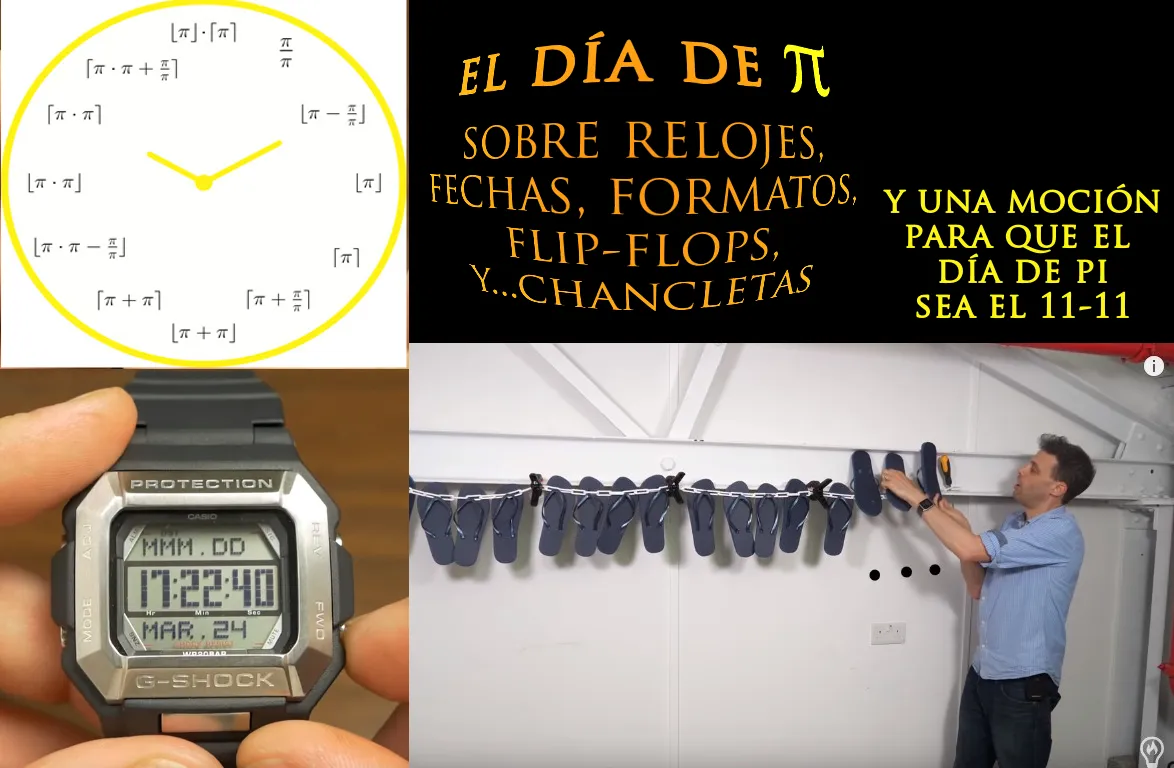
1-Pi Day
Pi Day is celebrated internationally on March 14, since the irrational number linked to the circle begins with the digits 3.14 and that date, written in the American format, which indicates the month first and then the day (mm-dd), is 3/14 or 3-14.
It's a problem that, in much of the Rest of the World, that date format is not used, but another, inverted one, with the day first and the month after (dd-mm).
But there is this cultural inertia by which the trend is set by the United States, thanks to the rest imitating its customs, perhaps because English has become an international language in commerce and the sciences. Perhaps the clocks are to blame.
This March 14, when Pi Day is celebrated, look at the date on your wristwatch. Most likely, especially if it's a quartz watch, the date will appear as 3-14.
2-Clocks
It would be ridiculous for me to say here what a clock should have. Each person looks for something different in clocks, whether quartz (analog or digital) or mechanical (hand-wound or automatic).
There is an enormous variety of clocks for all tastes, from those that privilege practical functions to those that make aesthetic design prevail.
My personal criterion is this:
A clock is, above all, for me, a machine that marks the passage of time and that includes the date, which can be displayed in several formats, among them dd-mm or mm-dd, although there are other variants. However, the vast majority of clocks (both wristwatches and wall or alarm clocks) only show the date in a single format, the American format.
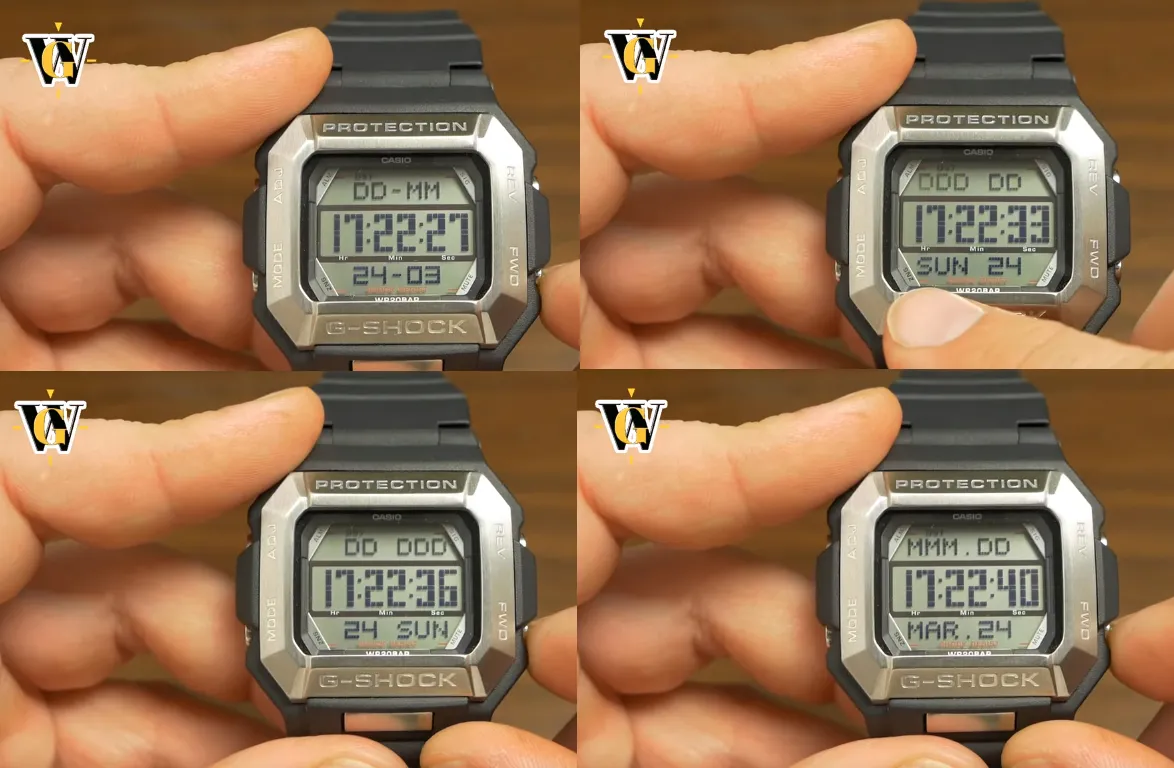
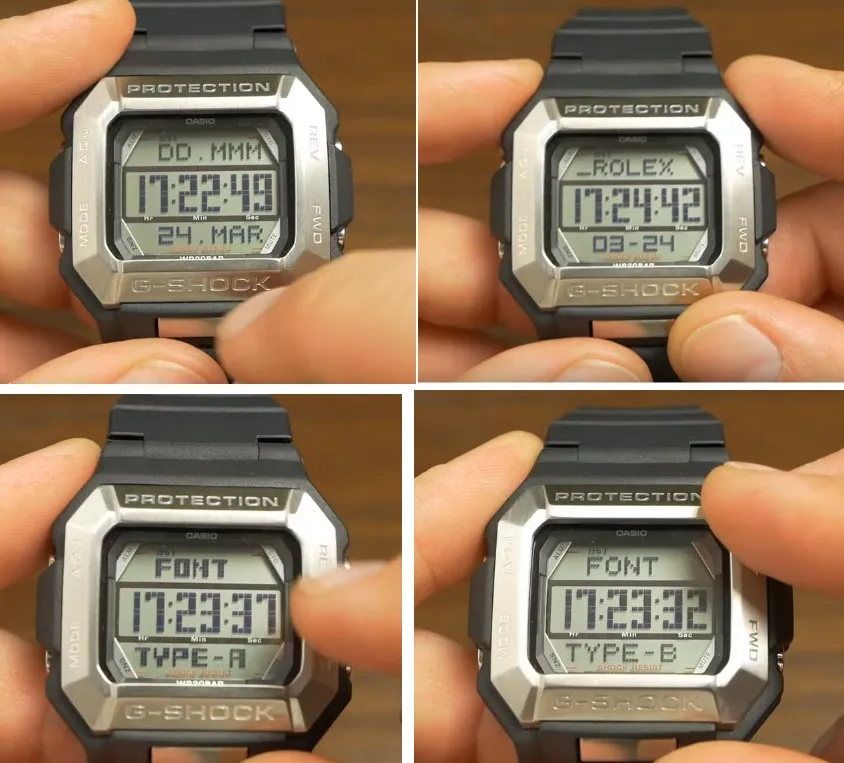
Some watches, including some G-Shocks, allow changing the date format from mm-dd to dd-mm, but they are few. However, Casio had a "perfect" watch in this sense, although -paradoxically- I think it was also the ugliest watch in the world. I'm referring to the G-7800 model, which was discontinued.
Here I leave some images that show the different possible date formats, as well as the (unique) possibility of changing the typographic font (!!!) and adding a word or short phrase on the first line of the LCD screen. It also had other very useful functions.
Quartz watches are small computers. They measure time by passing electricity through a quartz crystal, which is piezoelectric and the electronic circuit uses those oscillations (32768 per second) to divide time. However, the crystal oscillating that many times is neither natural nor by chance. The crystal is calibrated (by putting gold on it) to vibrate that many times. Why? For two reasons: it is a number greater than what is audible by humans. The crystal has the shape of a tuning fork. Also, that value corresponds to the first power of two greater than the audible number of oscillations. 32768=2^15. And the reason it is a power of 2 is that a bistable or "flip-flop" is used in the electronic circuit, for which it is convenient. The idea is to convert that amount per second so that it is 1 time per second. How is it done?
From a mathematical point of view, powers of 2 are always half of the next one: 2^1=2; 2^2=4; 2^3=8; 2^4=16...
A flip-flop or bistable is a chain that works as a filter. At each step, the signal can be divided in half. If I start with 2^15 and divide that signal in half, the output will be 2^14, since we said that each power of 2 is half of the next one. And if I divide that last one in half, the output will be 2^13 and so on. Below I indicate two videos from YouTubers who explain flip-flops. In one case, "El traductor de Ingeniería" (Damián Pedraza) explains it in a logical-mathematical way, while Steve Mould does it with...flip-flops. (In the United States, they call flip-flops to sandals).
Therefore, a quartz watch is a small computer. How difficult could it be to include in its programming and memory the possibility of changing the date format and language? Very little. It is proven that Casio can, when it wants to.
3-Pi Day and the date format
If we wanted to celebrate Pi Day using the Rest of the World date (dd-mm), we would have the problem that month 14 does not exist. That's why it has been suggested to do it on July 22, since the fraction 22/7 is a good rational approximation to Pi. And in that case, the backslash of the date would be compatible with the division symbol.
Will there be some Solomonic way to reconcile both dates with their different formats?
One possibility is to celebrate Tau Day on June 28 (6-28 in the American format), and Pi Day on July 22. Tau is 2π.
Another option could be November 11, which has the convenience of being a palindrome date if written only with numbers and is written the same in both date formats. November 10, in a non-leap year, is the 314th day of the year. It is so because counting begins at 1. But if we said that January 1st is day 0, then, the 314th day of the year would be 11-11.
I think I deserve the Nobel Peace Prize for pacifying international mathematics. I also think I deserve a Casio manager to run to the factory, start producing the G-7800 again and send me one as a gift for this covert advertising. Thus, on Pi Day, whether March 14 or July 22, I will be able to read the date on my wristwatch appropriately.
3-14 The Pi Clock
If we talk about PI, about clocks and date formats, and about the Pi Day date, we are left to think of a clock that shows the time using only the transcendental constant. Is it possible?
Yes, as seen below. But...what does it mean?
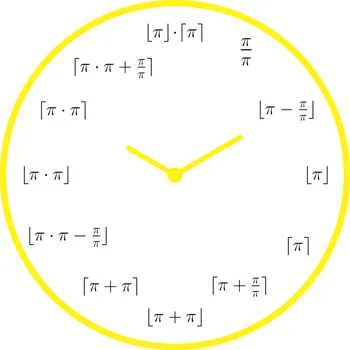
In this clock drawing, rounding functions, called floor function and ceiling function, are used.
The symbols used for these functions are similar to brackets, but instead of having two "little legs", they have only one.
The ceiling symbol means that the number or operation must be rounded to the first integer upward. If the little leg is the bottom one, it is rounded to the previous integer.
These functions can be applied to the numbers and not to the operations, as in the case of position 12. Or they can be applied not to the values, but to the result of the operation, as occurs in position 7 or 10.
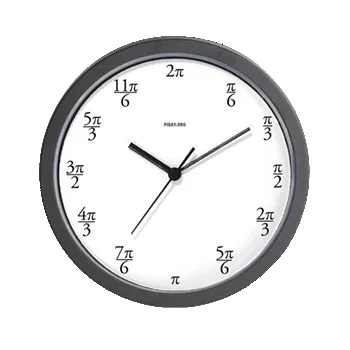
Another possibility is the one seen below, in which the clock gives the time in radians:
What are radians?
Suppose that instead of a clock, the circle were a cake or a pizza. Now we are going to cut it to get slices, like this:
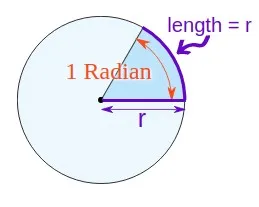
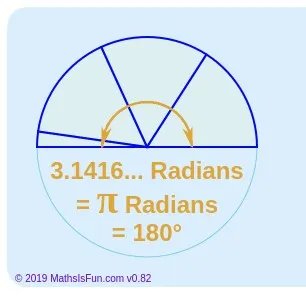
Each slice of cake or pizza is similar to a triangle, but it has two straight sides and one side with a slight curvature, right? We will cut the pizza in such a way that the sides have the length of the radius of the pizza or cake circle. The curved side must also measure one radius. The interior angle of the slice is one radian.
If we cut the cake or pizza like this, we will see that half of the cake is occupied by 3 of these slices and a little bit more. Exactly, 3.14 slices. Which is equivalent to saying that half a circle (180º) is π radians.
This allows us to deduce that, therefore, each radian is equivalent to 180/π = 57.29 degrees.
Thus, to convert from radians to degrees we multiply by 180 and divide by π.
To convert from degrees to radians, we multiply by π and divide by 180.
As a consequence:
30º= π/6= 0.52 radians; 60º= π/3; 90º= π/2; 180º=π, etc.
If the circle of a clock has 360º and 12 numbers, it means that each number will be at 30º. If we start with the place occupied by the 12 as degree 0, at 30º we place the 1 (π/6), at 60º we put the 2 (π/3) and so on.
If we look at the previous graphic again, we can think of the circle as the orbit of the Earth (which is not circular, but it's similar). In which case, the Earth would reach π radians of its orbit after 180º, that is, halfway, therefore, halfway through the year. If the civil year has 365 days, the halfway point would be day 182, July 1. Ultimately, any date is good. It's enough to celebrate Pi time, at 3:14 on any day.
However, 3.14 is not the number Pi. It cannot be written. So Pi is not anywhere nor can it be applied, but it is always used and an approximation is found.
It's paradoxical: it's a very useful number, but it's never used. Like date formats on clocks. It was time to say it, roundly.
Sources and related links
- G-7800 the COOLEST square G-Shock EVER MADE
https://www.youtube.com/watch?v=lqH01gkG0n8 - G-7800 - module 3163 - tutorial on how to setup and use ALL the functions
https://www.youtube.com/watch?v=Ahslsv_TOlw - How a quartz watch works - its heart beats 32,768 times a second
https://www.youtube.com/watch?v=_2By2ane2I4 - FLIP-FLOPS Sincrónicos | El Traductor
https://www.youtube.com/watch?v=Sxzzh-OUZjg - Maths around the clock
https://plus.maths.org/content/maths-around-clock - Funciones de parte entera
https://es.wikipedia.org/wiki/Funciones_de_parte_entera - Radián
https://es.wikipedia.org/wiki/Radi%C3%A1n - Radians
https://www.mathsisfun.com/geometry/radians.html - Reloj Pi radianes
https://www.cafepress.com/piday.226442162
About the images
Images from Mathisfun.com; Cafepress.com; Plus.Maths.org; Youtube screenshots.