100 years after "The Great Debate" that laid the foundations of modern cosmology. From the Unitary Universe to the Island Universe.
A century ago, counting galaxies was simple: it was enough to know how to count to 1.
If today there is a branch of astrophysics called cosmology, it is because, at some point, astronomers realized they could scientifically investigate the previous stages of the universe and its evolution, which implies studying galaxies. In the plural.
But it was not always known that there was more than one galaxy. On the contrary, those who postulated such a "multiple universe" were considered almost scientific heretics.
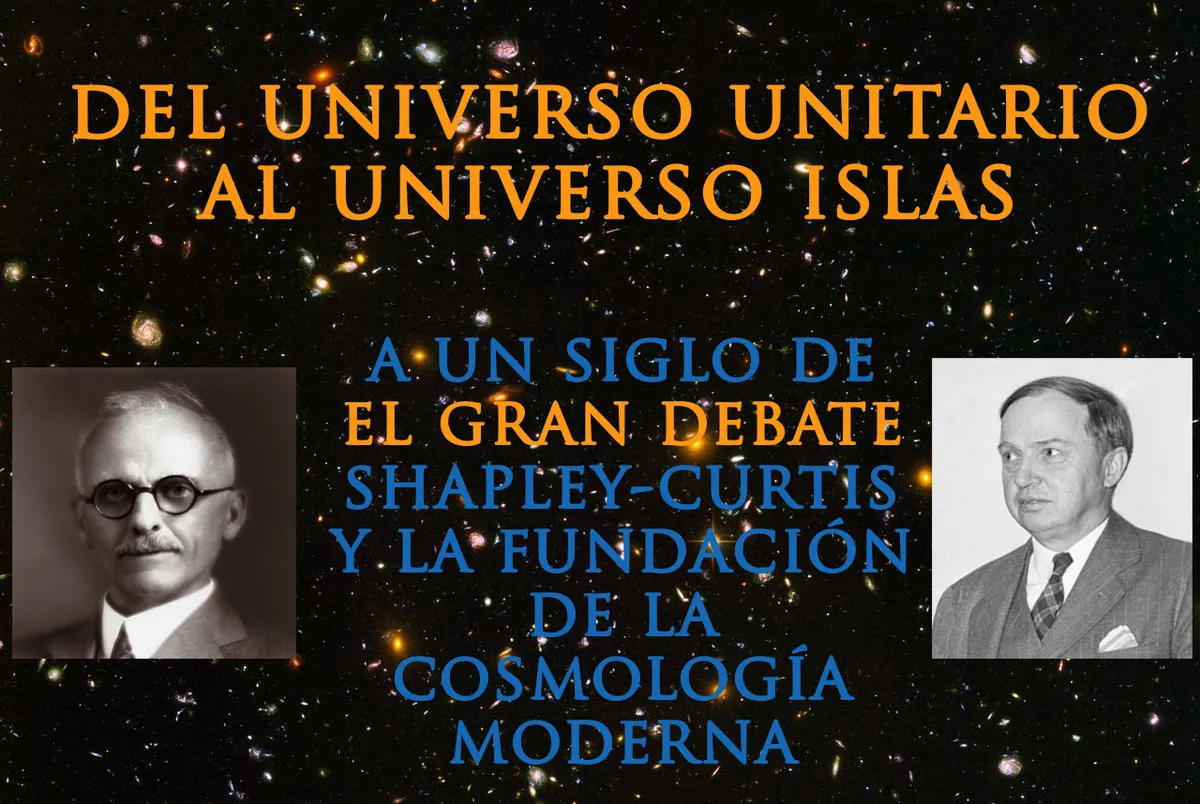
The tension between a thesis and its antithesis would finally be overcome with a synthesis. That tension gave rise to "The Great Debate", a key piece in the founding of modern cosmology, on April 26, 1920.
On that date, astronomers Harlow Shapley and Heber Curtis presented their antagonistic visions of the cosmos. Who won the Great Debate? Spoiler alert: both won and both lost, in a sense.
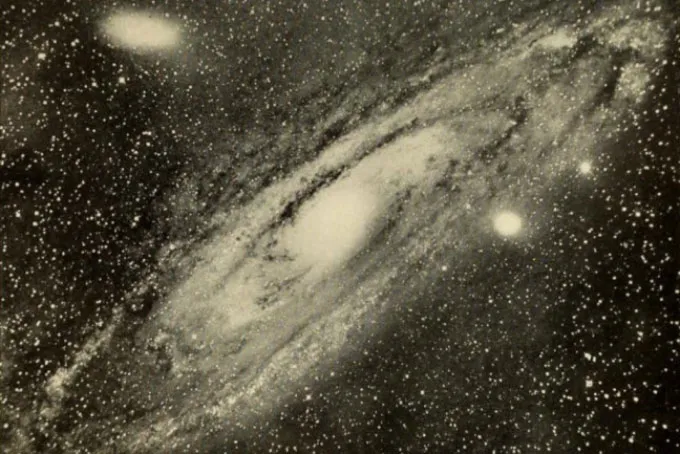
On one hand, astronomers thought that the entire universe was composed of a single galaxy, the Milky Way. However, what were then called "nebulae" could be observed, faint structures that, from the unitary view, were considered parts of the only existing galaxy.
On the other hand, there were those who based themselves on the concept of "island universe", a concept coined by astronomer Ormsby MacNight Mitchel in the late 19th century (see sidebar). This opposing view argued that those nebulae contained so many stars that they were comparable to the Milky Way and were far enough away to be considered independent objects, that is, other galaxies. So distance was a crucial issue.
Curtis was affiliated with the minority sector of the multiple universe, that is, the existence of other galaxies.
In contrast, Shapley insisted that the nebulae were included within the single galaxy. To support his position, he cited measurements by Adriaan van Maanen of the spiral motion of those nebulae, which would be undetectable if such nebulae were very distant galaxies.
In 1919, the U.S. National Academy of Sciences decided that both would present their visions of the cosmos at its April meeting.
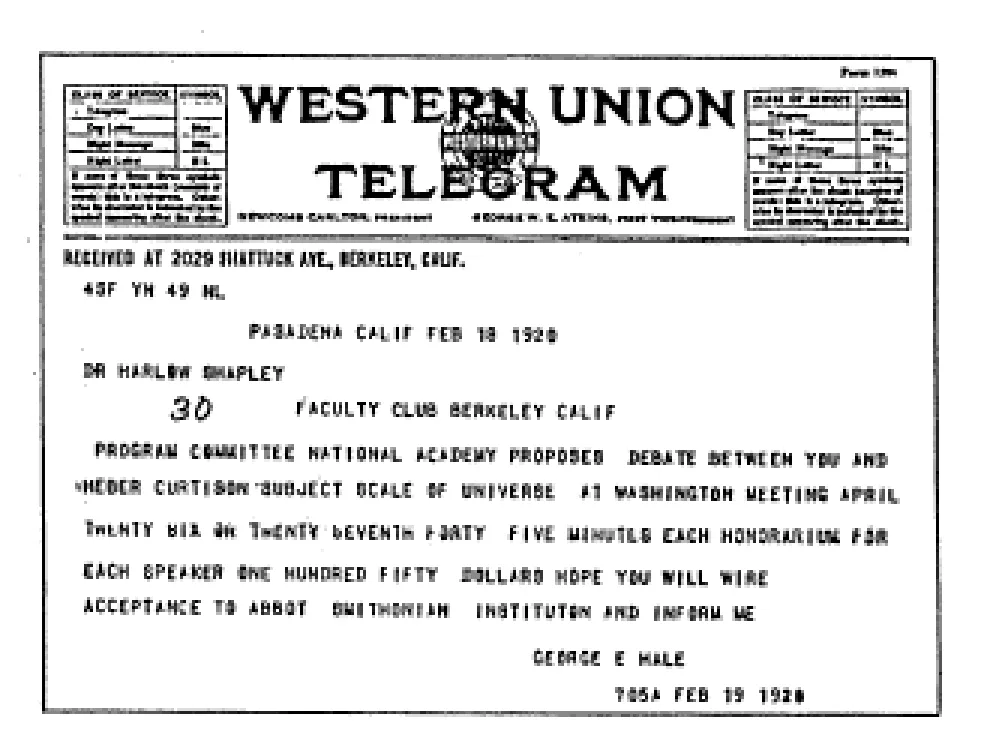
The debate was about "the distance scale of the Universe". Curtis, in that sense, was the more conservative, holding a more traditional view that the Milky Way extended only 30,000 light-years.
Shapley thought the single galaxy had a diameter ten times larger, 300,000 light-years.
"If, as Shapley proposed, the Galaxy was larger than thought, it would be harder for Curtis to maintain the claim that spiral nebulae were independent island universes," as historian Michael Hoskin analyzed in a 1976 work.
That Great Debate would not live up to a true debate, if we understand by that term the possibility for both participants to ask questions and refute each other in an exchange of opinions. Far from that, it was merely each one's presentation, without exchanges, and the subsequent written publication in a science Bulletin.
The presentations lasted 40 minutes. First was Shapley, who read a text, while Curtis, the better speaker, used slides to strengthen his point of view.
Shapley listed a number of astronomical observations of the time, barely mentioning the island-universe theory, which he considered almost a pseudo-science, for abandoning "the foundations of modern astrophysics". It is clear that the accusation of being pseudoscientific is a taunt used repeatedly among cosmologists, even today. However, Shapley acknowledged that if the Milky Way were as small as Curtis maintained, then the idea of an island universe could be correct.
"If the galactic system is as large as I maintain, the spiral nebulae can hardly be comparable galactic systems. If it were one-tenth as large, then perhaps it is a good opportunity for the hypothesis that our galactic system is a spiral nebula, comparable in size with other spiral nebulae, all of which would be island universes of stars", explained Shapley. At the end, the astronomer opened the possibility that Curtis's view might be correct if more data were collected in the future.
Curtis presented data to support his antithesis, citing various estimates of the Milky Way's diameter. He pointed out that analyses of the light from spiral nebulae indicated they were clusters of stars (with spectral characteristics similar to our galaxy).
Later their presentations would be published in writing, but they were not transcripts of the public oral presentations; they were new texts published under the title "The Scale of the Universe" in the Bulletin of the National Research Council.
That is, on one hand, an oral, public debate took place at the Washington headquarters of the National Academy of Sciences in April 1920; and later there was another written "debate" in May 1921. Whether or not a mere presentation without exchanges should be considered a debate has also been the subject of another small debate which, in my view, is not interesting.
The synthesis would come a few years later, partly as a consequence of that Great Debate, which involved observations and calculations about the composition and distance of spiral nebulae. That synthesis would arrive as a result of Edwin Hubble's observations, which demonstrated that the Andromeda nebula was an island universe, very distant and full of stars. The contribution of other scientists, including Henrietta Leavitt, must be highlighted so that Hubble could finally reach his conclusions.
SHAPLEY AND THE TRIUMPHANT DEFEAT
It may seem that Shapley lost that debate, in light of current knowledge. But the small dimension that Curtis assigned to our galaxy had the consequence that the Sun was left near the center, as was conceded at that time. At the turn of the century, astronomer Simon Newcomb cast doubt on that idea, pointing out that in the past there was consensus that the Earth was the center of the universe and they already knew it was not. Shapley considered that Newcomb was right to be skeptical about it and that the Sun was not near the center of the galaxy. In this, Shapley was right.
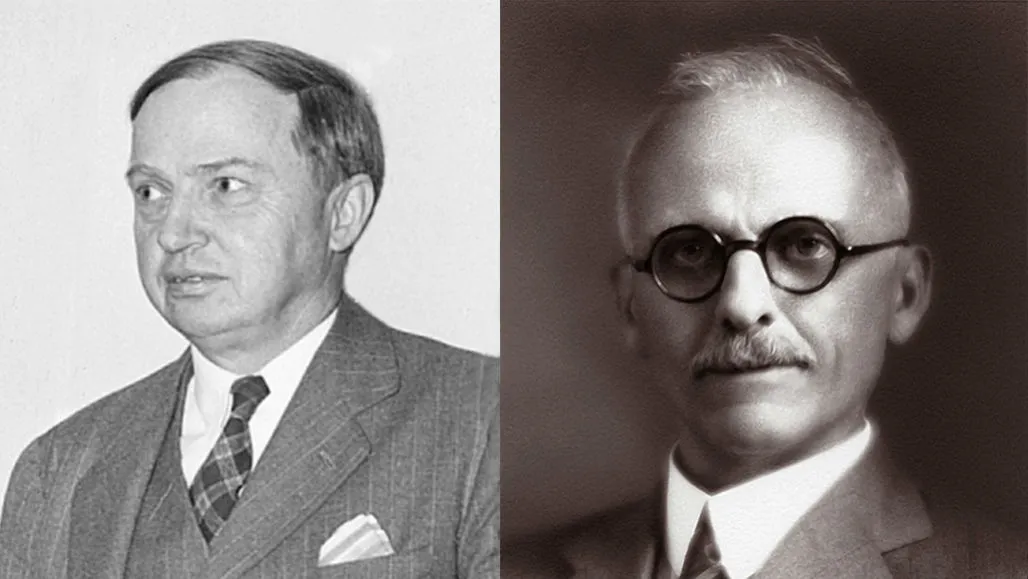
Harlow Shapley, born November 2, 1885, died October 20, 1972. An asteroid, a lunar crater, and a supercluster are named after him.
Heber Doust Curtis, born June 27, 1872, died January 9, 1942. He discovered asteroid 23400 (A913 CF) and a lunar crater is named after him.
THE BEGINNING OF MODERN COSMOLOGY AND THE CURRENT DEBATE
We could start another discussion about what was the cornerstone of modern cosmology. Edwin Hubble's observations are the best candidates, since they allowed us to know not only that other galaxies existed, but also their morphology and, later, the expansion of the universe was determined.
However, attributing it to Hubble would be to ignore the reasons and resources that allowed the astronomer to make his discoveries. The Great Debate and the scale of the Universe were the topic of the moment. Even with scarce resources (compared to today) astronomers of the early 20th century were already seeking to answer big questions and break down taboos. The Great Debate was a great engine of research. Today, something not very different happens.
There are at least two types of great debates. There are discrepancies about the expansion rate, the Hubble constant. Another debate, considered somewhat minor (still) is about the mass and density of the cosmos, where there is also a discrepancy between different methods used.
If a debate implies at least two interpretations of reality and if we consider such interpretations opinions, then science IS opinion and cannot be otherwise. They are, however, scientific opinions, not vulgar ones, based on data related in a logical way.
Current debates may converge in the future into a consensus, but new data will always have to be taken and confronted with theories. And if they do not match, the process continues.
We live in a universe full of isolated galaxies. Quarantine is cosmic.
On the origin of "island universes"
The concept seems to have been used, in a similar way, by Alexander von Humboldt in his book Kosmos from 1845. The original title was Kosmos – Entwurf einer physischen Weltbeschreibung. There the German word Weltinseln was used to refer to the Milky Way, not to the distant nebulae. The English translator turned it into "world island", "world island".
In 1846 the astronomer Ormsby MacKnight Mitchel published the magazine Sidereal Messenger in which he included an article by astronomer Johan Heinrich von Mädler that refers to "our island universe". The article was a translation, undoubtedly done by Mitchel, of a previous publication from the same year in Astronomische Nachrichten. In the original German, Mädler used the term Weltinsel.
Probably Mädler borrowed the term from von Humboldt and Mitchel was the one who translated the term into English.
Source: The Number of the Heavens: A History of the Multiverse and the Quest to Understand the Cosmos, By Tom Siegfried, Harvard University Press, 2019, page 162.
Sources and related links
- A century ago, astronomy’s Great Debate foreshadowed today’s view of the universe
https://www.sciencenews.org/article/astronomy-great-debate-island-universe-milky-way - The Scale of the Universe
https://apod.nasa.gov/diamond_jubilee/debate20.html - 23400 (A913 CF)
https://ssd.jpl.nasa.gov/sbdb.cgi?sstr=23400
About the images
Andromeda photo from ScienceNews, from the book ASTRONOMY OF TO-DAY, 1909.
Shapley-Curtis photos
ScienceNews. SMITHSONIAN INSTITUTION ARCHIVES, ACCESSION 90-105, SCIENCE SERVICE RECORDS, IMAGE NO. SIA2008-5931; ROCKEFELLER UNIVERSITY
Initial image with background from NASA, ESA, and S. Beckwith (STScI) and the HUDF Team.
Telegram from "The 1920 Shapley-Curtis Discussion: Background, Issues, And Outcome".
http://adsbit.harvard.edu/cgi-bin/nph-iarticle_query?1995PASP%2E%2E107%2E1133T