Volker Springel and Lars Hernquist received the prestigious 2020 Gruber Prize in Cosmology.
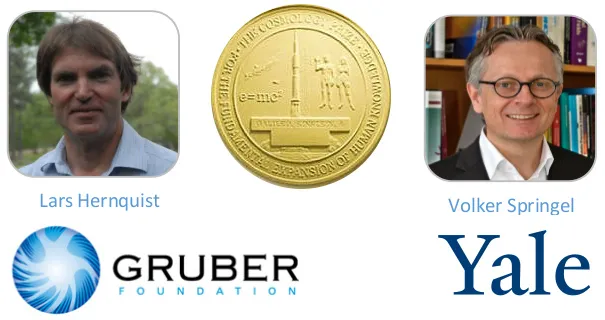
This year's prize from the Gruber Foundation was announced on May 6. The award went to Volker Springel of the Max Planck Institute for Astrophysics and Lars Hernquist of the Harvard Center for Astrophysics, in recognition of their work in cosmological simulations, a method that tests theories and inspires new research on structure formation on various scales, from stars to galaxies and clusters. Furthermore, the numerical algorithms and codes they developed have been used by many other researchers to advance their field. The scientists will share the cash prize of USD 500,000 and each will also receive a gold pin at a ceremony to be held soon.
Hernquist was a pioneer in cosmological simulations when he joined the field in the late 1980s and has been an influential figure ever since. Springel, who entered this research field in 1998 and worked with Hernquist in the 2000s, has written and applied many of the most used codes in cosmological research. As one of them commented, they have been "one of the most productive collaborations in cosmology."
Cosmological simulations start with the traditional source of astronomical data: observations. Then, through a combination of theory and known physics, the simulations recreate the processes that could lead to the current structures. By comparing the properties of the simulated universe with observations, the cosmological model used can be validated. This tool has allowed Hernquist and Springel, individually and in collaboration, to show that information from the CMB (Cosmic Microwave Background Radiation) and quasar spectra are reliable predictors of current structures. They have also used simulations to test theories about cold dark matter and dark energy and how -together with baryonic matter- they give rise to the known galaxies.
In addition to their own discoveries, both researchers have provided the means for other scientists to transform cosmology. For example, Hernquist, Springel, and their collaborators have emphasized the need to incorporate feedback (material feedback) into simulations. In 2005, together with Tiziana Di Matteo, they demonstrated that feedback from black holes determines the growth relationship between supermassive black holes and their host galaxies.
Both wrote several widely used codes today. Hernquist together with Neal Katz created TreeSPH. Springel wrote two codes: in 2001 with Naoki Yoshida and Simon White they introduced GADGET, used in the Millennium Simulation. He also led the creation of AREPO, later used for the creation of Illustris, a simulation of galaxy distribution, in 2014.
The Gruber Foundation partnered with the IAU in 2000 so that the International Astronomical Union would nominate and select candidates for the prize. That year, the prize winners were Allan Sandage and James Peebles. Later, other prominent astrophysicists received the prize, including Martin Rees, Vera Rubin, Alan Guth, John Mather, Saul Perlmutter, Carlos Frenk, R. Brent Tully, and Sandra Faber.
Additionally, the Gruber Foundation, founded by Peter and Patricia Gruber, awards scientific advancement in genetics and neuroscience, as well as recognition for young scientists, and has a program for women's rights.
THE MEDAL
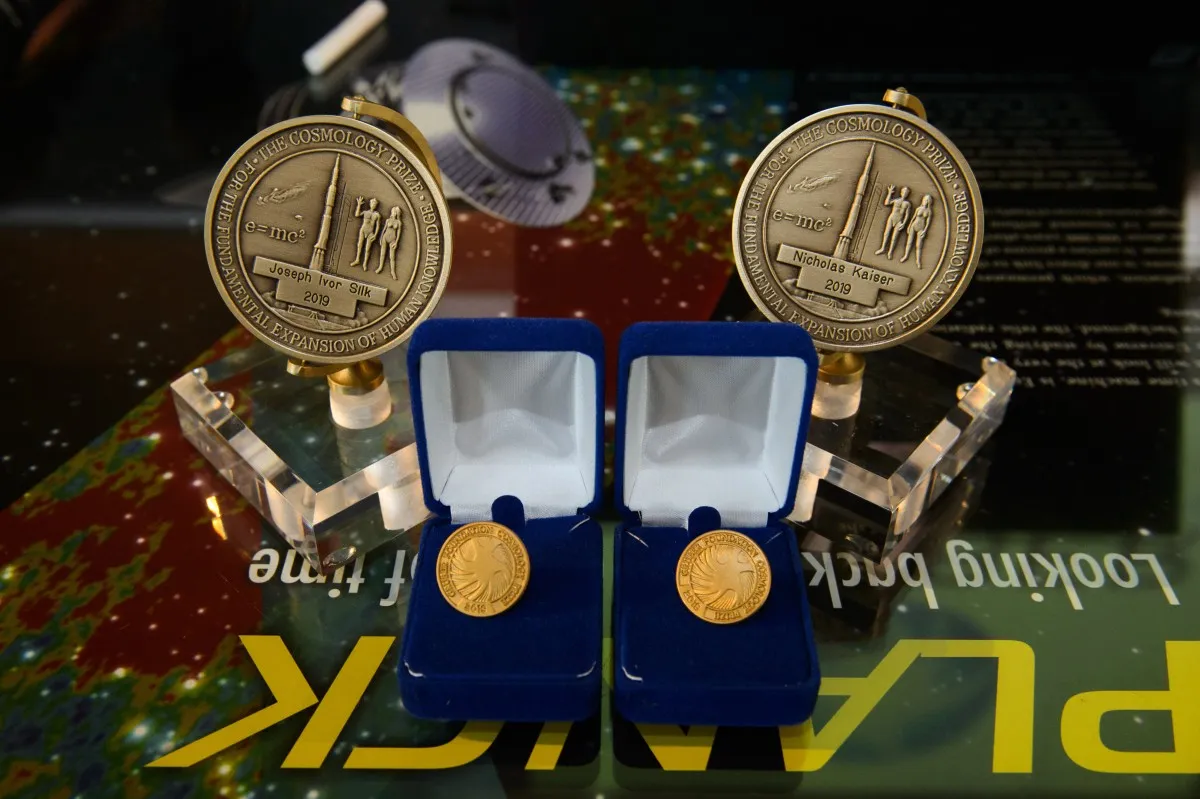
The medal's design attempts to symbolize what it aims to award: paradigm-shifting discoveries (E=mc2); space exploration (rocket); the fruits of exploration (Andromeda Galaxy, the first galaxy identified and photographed) and the images of a couple included on the Pioneer 10 spacecraft, as a symbol of peace.
The following photo shows in detail the medal and the pin for last year's winners.
It is worth reflecting that the prize implies that computing is to astronomy what analog photography once was and much more. Today's astronomers must know not only physics and mathematics, but also English (to read and write scientific papers) and computing, to use others' codes, modify them, or create their own. Simulations are one more tool in the computational arsenal, very powerful for modeling the universe on a large scale, allowing one to "experiment and manipulate" what would otherwise be impossible.
I bet Newton, Leibniz, and Descartes would be fascinated with the computational application of calculus and analytic geometry in cosmological simulations. The Frenchman would say: "I did not dream it."
Sources and related links
- Gruber Foundation at Yale
https://gruber.yale.edu/cosmology - Recipients of 2020 Gruber Cosmology Prize Announced
https://www.iau.org/news/pressreleases/detail/iau2003/?lang
About the images
Images IAU-Gruber Foundation.
Lars Hernquist Photo Credit: Dr. Anna N. Zytkow