The big problem of planets like Earth.
The importance of the search for life and its current technological limitations.
I invite readers to use our imagination to go back to the past, to the period before the detection of exoplanets. When was that?
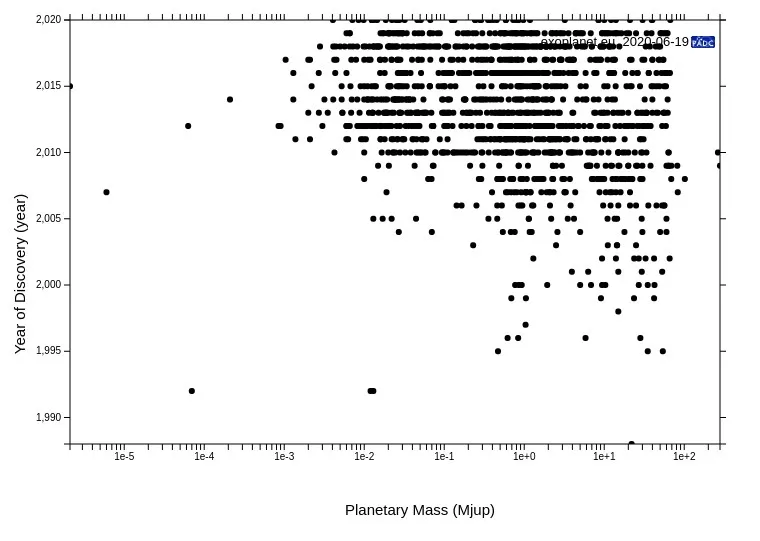
The first planets outside the Solar System were discovered during the 1990s. In the following graph from Exoplanets.eu we see on the vertical axis the year of discovery and on the horizontal axis the mass of the exoplanets found as a function of Jupiter's mass. As can be clearly seen, the first exoplanets were discovered in the 1990s and were massive. As we advance in this story, the frequency of findings will increase and the mass of the revealed objects will decrease. Note: a couple of exoplanets were detected in the 1980s, but they were not considered as such at the time. This is the case of HD 114762 b, which was considered a brown dwarf.
I think it is important to think about this story as if it had not happened. We are professional astronomers, we live in the 1980s and we wonder if it is possible that life exists outside Earth. We tell ourselves yes, it is highly probable. But since we are scientists, not philosophers, we then decide to search for that potential. But where? The universe is enormous. We cannot search everywhere. And it would not be logical to search anywhere. We must establish a strategy, a roadmap, a series of steps, an algorithm, to search for life in the most likely places. That is what we will do here. It is what I propose. Will you join me?
FIRST ROADMAP
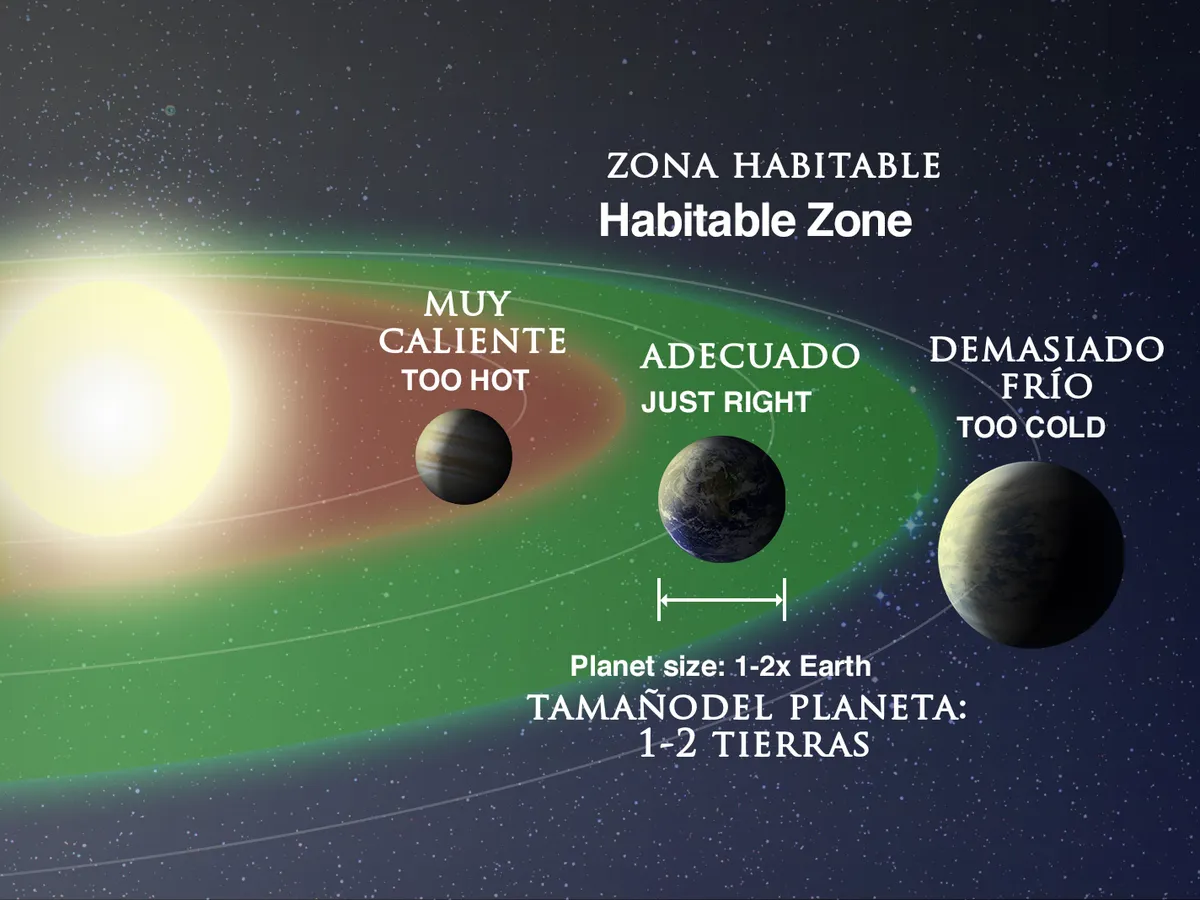
-We do not know what the recipe for life is. Perhaps there is not one, but many. But we do know that there is life on Earth. And that here life arose because our planet has liquid water. It is not well known how the water arrived, perhaps through asteroids. But we do know that the water remained because the planet is neither too close nor too far from the Sun. It is called the "habitable zone".
-We also know that Earth is a rocky planet, like Mercury, Venus, Mars...Pluto. In contrast, Jupiter, Saturn, Uranus, Neptune, are gaseous. At least in our case, a surface is needed for life to arise. So we should pay more attention to rocky planets. And, in the Solar System, composition is related to size/mass. Too big is gaseous.
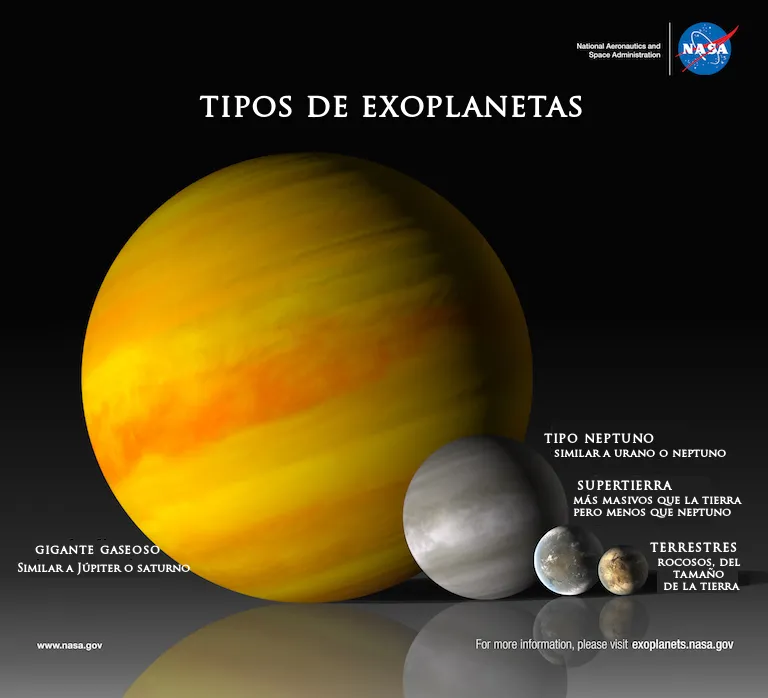
Rocky planets can have much less mass than Earth, or be several times larger. That is, to be rocky there is a range of size and mass. In the literature we will see that extrasolar planets are categorized as Terrestrial, Super-Earths, Neptune-type, and Gas Giants.
We could say that this categorization is based on the mass of the objects. But it also says something about distances, since in general, the gaseous ones are farther from their stars. However, hot Jupiters, gas giants close to their stars, were also discovered.
-Based on the above, we should search for life on planets that possess some characteristics like Earth: in size-mass and in distance to the Sun. Another important fact is gravitational stability. Life takes time to arise and evolve. For life to have time, it is necessary for the planet to remain, instead of being destroyed by high tidal forces, typical of multiple systems.
-It remains to be said that, if we search for life, it would be convenient to start with the Solar System. Mercury and Venus are very close to the Sun. From Jupiter onward, they are very far. Mars is the great candidate. Furthermore, it has polar ice caps. However, we should also consider the moons. In the Solar System there are more than 200 natural satellites. But it makes no sense to search in all of them. Some moons are very far, others are too small. After this sieve, 3 or 4 potential ones remain, around Jupiter and Saturn.
ROADMAP 2: COARSE TUNING SOLAR SYSTEM
To develop the above, let's start at home. To find life on the moons of the Solar System, we could send spacecraft that fly by and allow us to have more data. In fact, that is what allowed us to do that filter and know that there are a few candidate moons. This has been done since the 1970s with the Voyager, Pioneer and later Cassini probes.
We would have to send rovers, as was done on Mars. But first we would have to map those moons better to choose the best places to land.
Just as on the moons, this would also have to be done on Mars. It is evident that since 1980 it was the point of the roadmap most developed. Next month, NASA will launch the Perseverance probe to the red planet. It will be its ninth rover. It will have very special characteristics that deserve their own post. But we can here focus on the fact that it will do something that should be on our improved roadmap: bring samples of Martian soil to Earth. Until now, the rovers took images and sent them as data to Earth for analysis. NASA's Perseverance will take samples that will later be collected by another spacecraft and brought to the planet in a series of steps that would culminate in 2031.
ROADMAP 3: COARSE TUNING OTHER STELLAR SYSTEMS
Outside the Solar System, the distances are very large.
-We must search for all types of exoplanets.
-We must pay attention to those that are rocky (and therefore, smaller).
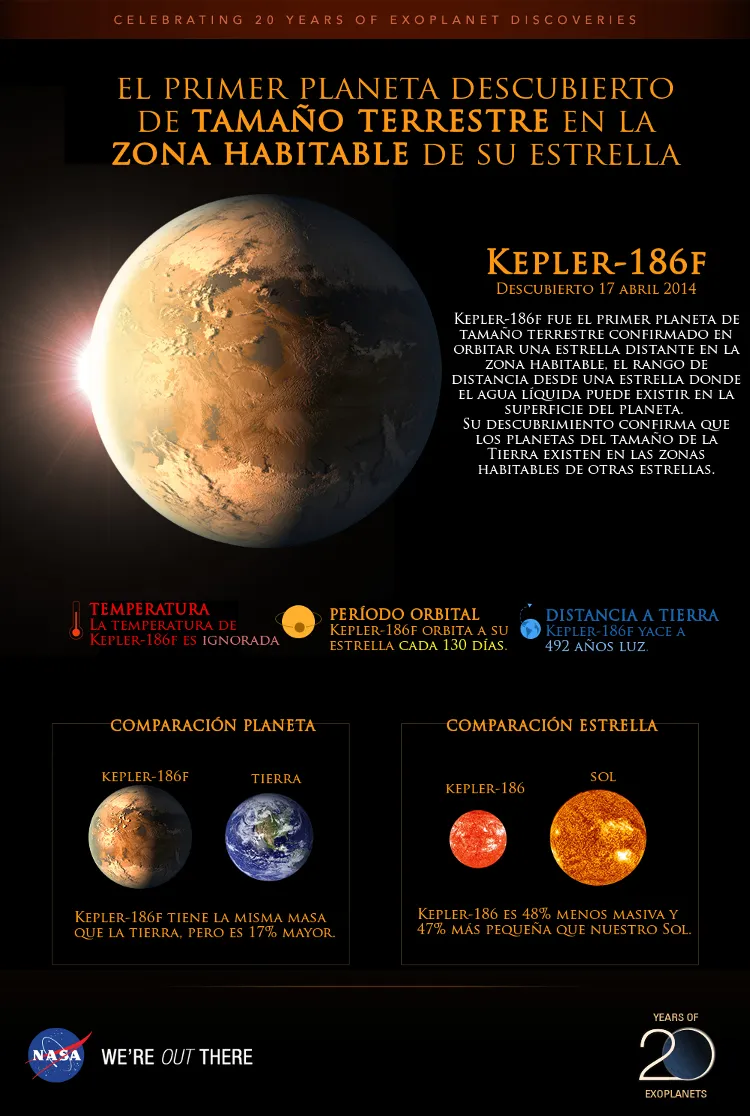
-We must pay attention to those that are in the habitable zones (not too far from the star).
This has great challenges. It is difficult to see the planets of the solar system, visible to the naked eye, when they are on the horizon along with the Sun. The light from the star prevents seeing anything else.
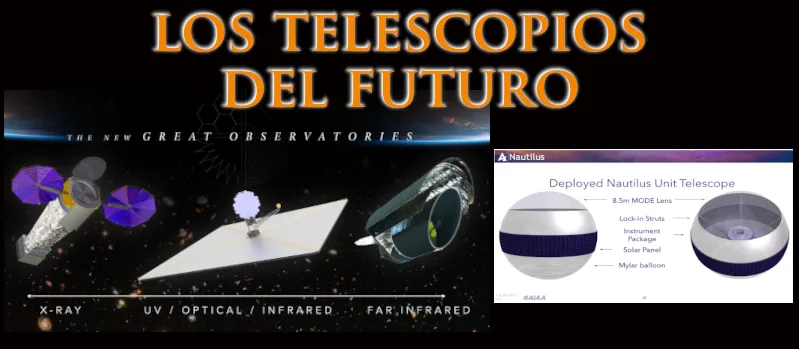
NASA proposes creating a space telescope that deploys a "starshade" or "star shield", shaped like a flower, that would be placed in front of the telescope and block the starlight, to be able to observe potential planets around it.
https://www.youtube.com/watch?v=XYNUpQrZISc
Another proposal is that of coronagraphs, used to block the light of a star like our Sun to be able to study its corona.
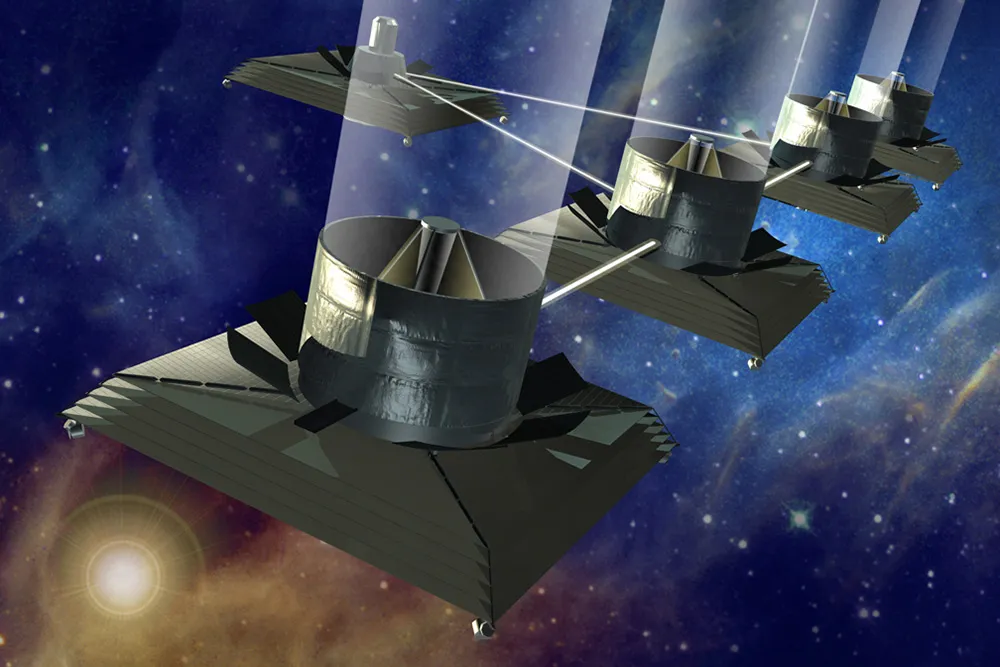
A bolder idea is nulling interferometry. It consists of launching several space telescopes that work in synchrony and the signals from each one cancel the starlight.
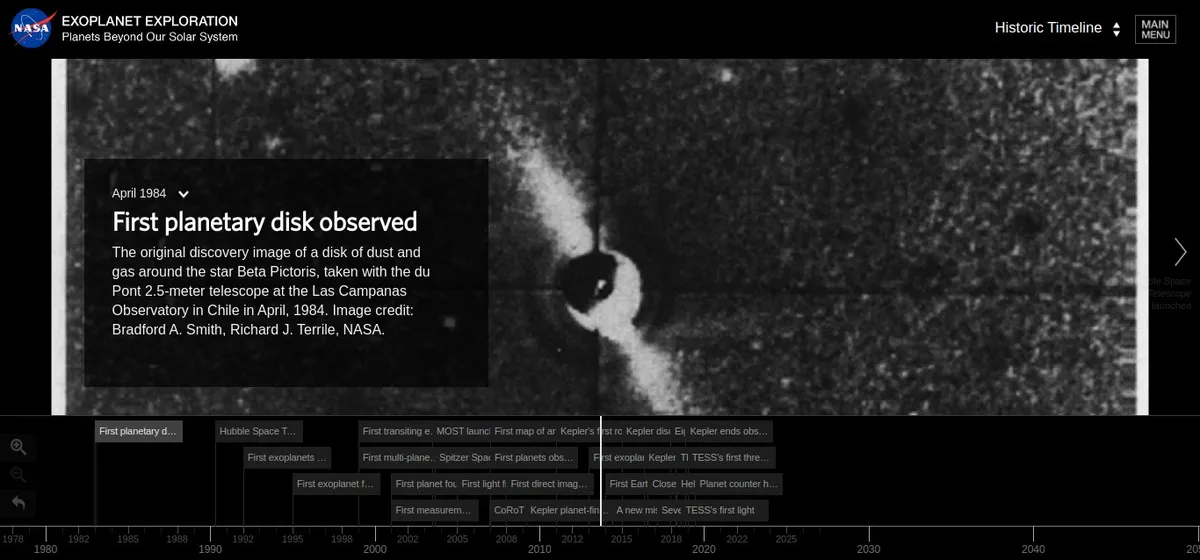
To detect planets we must develop methods. One possible way is to do "the great Le Verrier". Planets have mass and are affected by gravity. But they also affect other massive bodies, like stars. If a star has a planet, the star's motion is different than if it didn't. Also, at some point, the planet aligns between the star and Earth, blocking a little bit of the starlight. With technical development and theoretical skill it was possible to develop these techniques and others to the maximum, as seen in the first graph.
Without a doubt, we could create a telescope especially dedicated to searching for planets. The Kepler mission is responsible for the greatest number of discoveries to date. According to NASA's catalog, there are 4,164 confirmed exoplanets and 5,294 candidates.
But also TESS was launched in 2018. The first graph will become too small.
It is evident that if this roadmap had been made, we would have reached this point.
FINE-TUNING: THE FUTURE
We would need to know if on those rocky planets, of Earth size, in the habitable zone, there is effectively liquid water. Can that be known remotely?
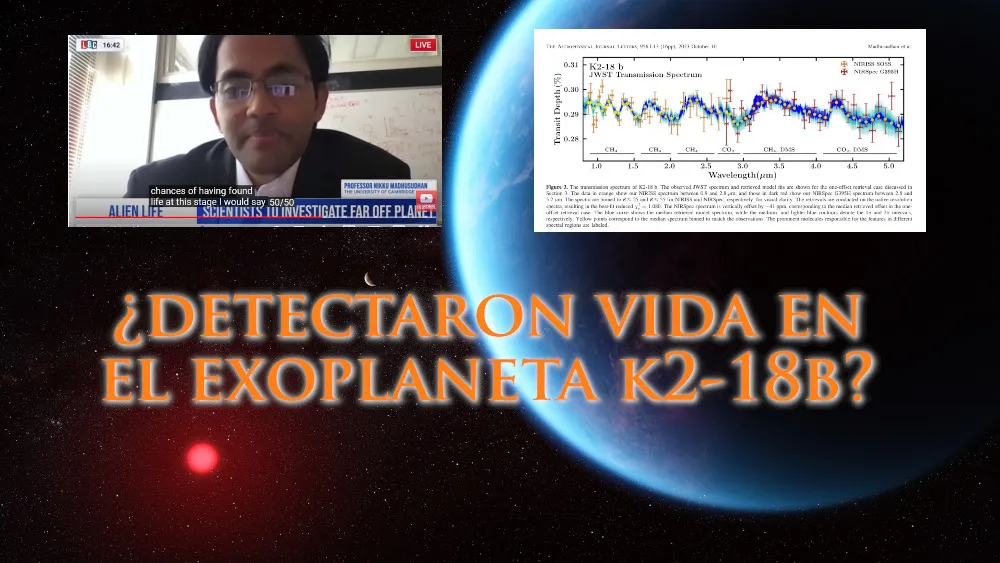
Ahhhhh, spectra. What would astronomy be without telescopes? Almost nothing. What would astronomy be without spectra? Very little. To analyze the atmospheres of planets, astronomers have proposed something very ingenious. The star is observed when the planet is aligned with Earth. A part of the starlight passes through the exoplanet's atmosphere and is received on Earth. This way it is possible to know, partially, what chemical elements are in the planetary atmosphere.
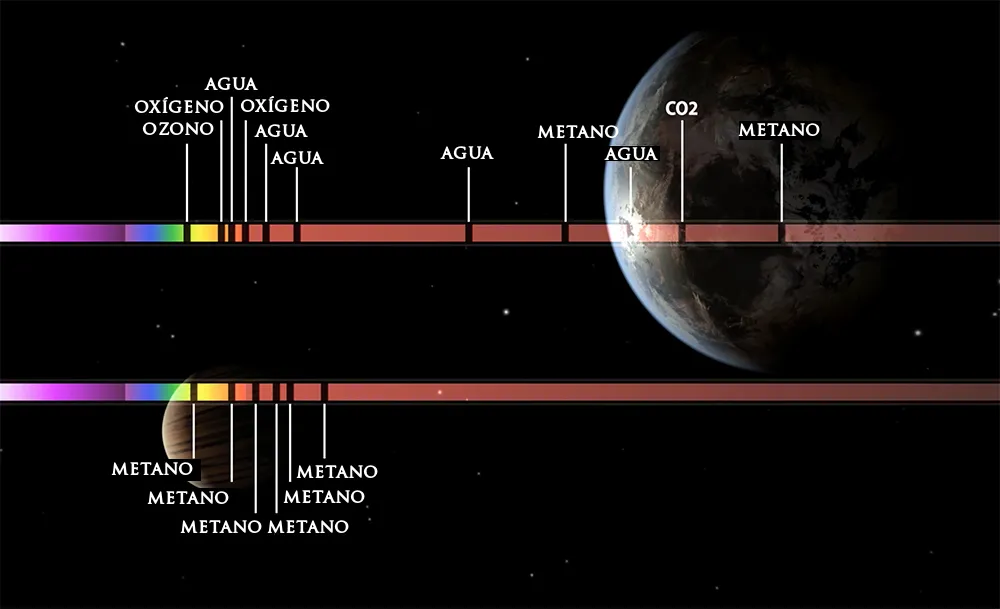
But even if on rocky planets, in the habitable zone, signs of liquid water (water vapor in the atmosphere) are found, does that guarantee there are life forms?
No, there are no guarantees. But those would be the best candidates. How will it be known, finally, if on such candidate planets there really is some form of life?
THE BIG PROBLEM
Well, it's about the big problem of "Planets like Earth". On one hand, they are the best candidates. They are hard to detect, small, close to stars, distant. Despite all those problems, a few have been detected and more are to come. But the future is intriguing. There is no current way to know if on such candidates there is effectively life.
Life can be microbial, bacteria, algae, trees, rodents, or large mammals, let's think of cetaceans or elephants. At most they measure 30 meters. It is impossible to detect objects of such size, even in the solar system, using telescopes. We will have to go, send surface probes. Orbiting an exoplanet could be significant to know more, but life could hardly be detected from 200 thousand kilometers above the surface.
Creating larger telescopes also does not seem a good path for this objective. And getting close is a serious problem because even at close distances, it would take a long time (thousands of years).
The Breakthrough Starshot project proposed the StarChip initiative which consists of a fleet of micronaves propelled by a laser that could reach the nearest star system (which has two planets) in 40 years of travel.
This proposal is still in its infancy. If achieved, it would be a very notable milestone in space exploration, but even in that case, could ships with miniature instruments, at 150 million km from the exoplanet, detect bacteria or elephants? No, by no means.
CONCLUSION
From the 1980s until now, a roadmap for the great search for life outside Earth has been developed. Are we alone? It would be formidable to answer the question, even if only by finding fossils or simple life forms.
Astronomers and technicians have been very ingenious and creative in walking this path plagued with problems. In retrospect, what has been done is formidable, marvelous. Having the ability to detect exoplanets thousands of light-years away was unthinkable a few decades ago. Bringing material from the Martian soil to Earth was only in the plans of science fiction authors. But now it is about to become reality with the launch of Perseverance.
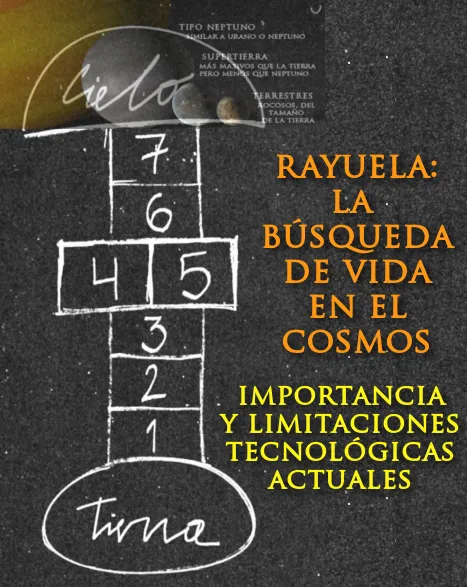
In this great search, humanity has come quite close to the answer. As in hopscotch, we are close to "Heaven". But the last step is, currently, impossible. Life outside the Solar System will not be discovered before a century. Unless some technological revolution occurs.
Meanwhile, the moons of Jupiter and Saturn, as well as Mars, are our best alternative. They are closer and we can indeed send spacecraft.
We will have to Persevere. Perhaps astronomers need to read Rayuela, the novel by Cortázar. And remember that the roadmap can be another. We will have to kick the board...
Hopscotch is played with a little stone that must be pushed with the tip of the shoe. Ingredients: a sidewalk, a little stone, a shoe, and a beautiful drawing with chalk, preferably colored. At the top is Heaven, below is Earth, it is very difficult to get the little stone to Heaven, you almost always miscalculate and the stone goes out of the drawing. Little by little, however, you acquire the necessary skill to clear the different squares (snail hopscotch, rectangular hopscotch, fantasy hopscotch, rarely used) and one day you learn to leave Earth and lift the little stone up to Heaven, until entering Heaven, (Et tous nos amours, sobbed Emmanuèle face down), the bad thing is that precisely at that point, when almost no one has learned to lift the little stone up to Heaven, childhood ends abruptly and you fall into novels, into the anguish of the divine rocket, into the speculation of another Heaven that you also have to learn to reach. And because you have left childhood (Je n’oublierai pas le temps des cérises, Emmanuèle kicked on the ground) you forget that to reach Heaven you need, as ingredients, a little stone and the tip of a shoe.
Hopscotch, Julio Cortázar, Chapter 36.
Sources and related links
- NASA EXOPLANETS
https://exoplanets.nasa.gov/exoplanet-catalog/ - Breakthrough Starshot Initiative
https://breakthroughinitiatives.org/initiative/3
About the images
Hopscotch: https://vientosenmimente.wordpress.com/2013/05/03/la-rayuela-se-juega-con-una-piedrita-que/
Graphics: NASA-JPL