Two experiments from an Argentine secondary school will fly on balloons to the stratosphere, as part of Cubes in Space, an international competition.
Pablo González is a teacher, a friend of this blog, and has published here once before. He told me about a new experience and I thought the best thing was for him to tell it. At the end, a few brief words from me.
CUBES IN SPACE RB6 2020: THE ARGENTINE EXPERIENCE
My name is Pablo González, I am a mechanical engineer and I work in secondary and university teaching. I want to tell you how a group of teachers and secondary school students designed and built two experiments that will travel to space. At the Instituto San Felipe Neri we have been experimenting in space sciences within the CANSAT program for 15 years. For the year 2020 we decided to change the project.
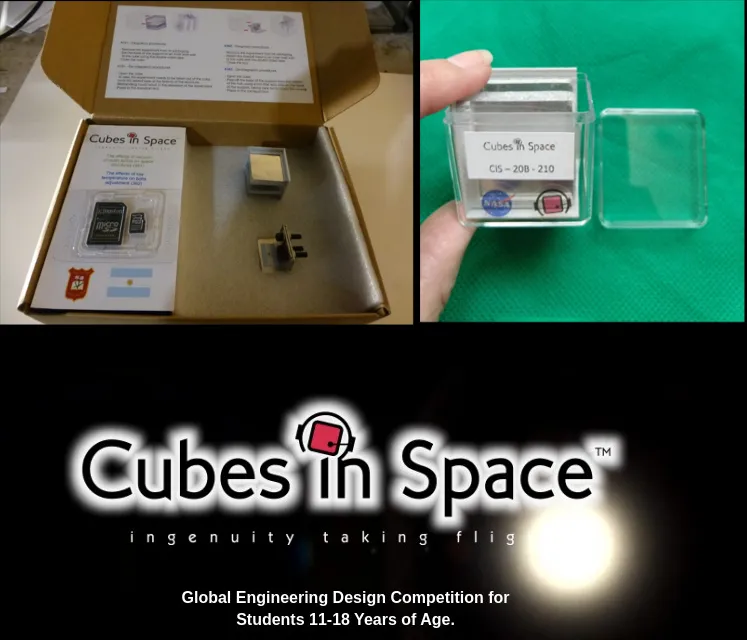
We learned that there was an international competition to send small experiments to space using NASA sounding rockets and scientific balloons. This program is called CUBES IN SPACE. It is a worldwide competition by Idooldedu INC. that offers at no cost to students up to 18 years of age the possibility to design, build and fly those experiments to space together with NASA's Goddard and Langley centers.
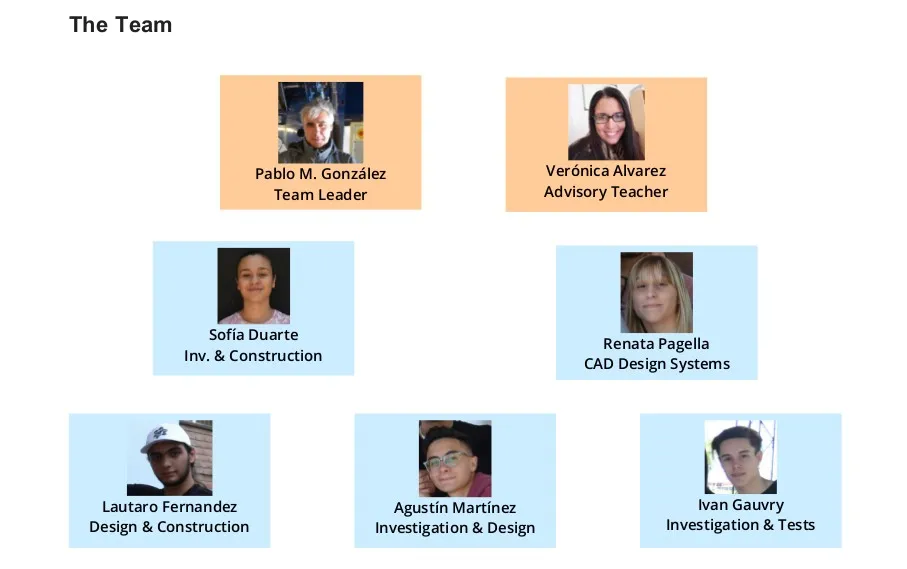
What could we put in a 4x4x4 cm cube? To experiment with the high accelerations of sounding rockets and their vibrations, we devised metal structures joined with bolts, to verify how they were altered during the flight. These ideas were approved and we were invited to put them into practice. We held the first meeting at the school until the lockdown was decreed. This new environment conditioned our project, in addition to the news that NASA sounding rocket launches were canceled for the entire year. So we thought of designing new experiments to apply them in a stratospheric flight of a research balloon. With the materials we had in our homes and meeting by teleconference, we formed a work team and devised two new experiments. Sofía, Agustín, Renata, Iván and Lautaro, together with teachers Verónica and Pablo, finished forming the team.
The first of the experiments wanted to answer the question: how would a sandwich-type structure behave in the vacuum of space? We thought of making two sandwich-type panels, widely used in the aerospace field, one with polyurethane and another made of PLA (a thermoplastic) manufactured on a 3D printer, a honeycomb-type panel.
The second experiment would consist of how the degree of tightness of screws varies at extremely low temperatures, on the order of 50 degrees below zero.
One of the ways to communicate, in addition to the phone and video conferences, was the creation of a blog to keep us updated and meet the deadlines and dates set by the program. Here we had the invaluable collaboration of teacher Verónica Álvarez, who advised us on the correct use of English to communicate with the organizers. It was necessary to document the design process and justify the experiments. After a long back-and-forth with those in charge, we earned the right to fly our ideas.
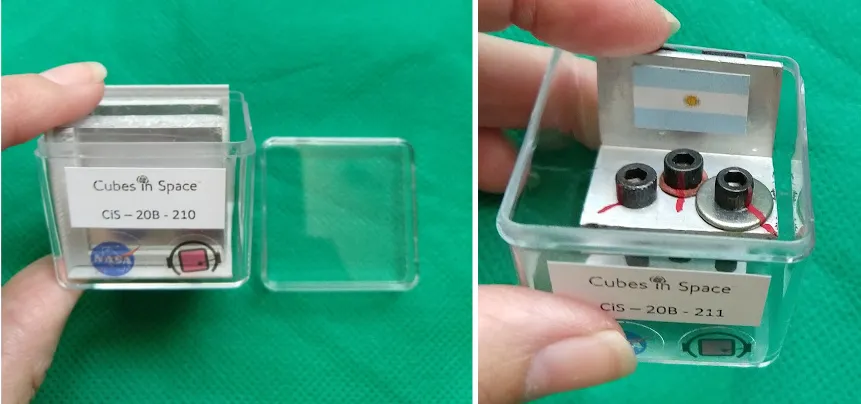
Now the fun begins. Renata designed the structures that had to be printed in a program, sent them to me and we printed them at my house. With that material and gathering other things, the four kits were sent with a courier service to Lautaro, Iván, Sofía and Agustín so they could build and test the experiments. They provided the remaining materials and each built the experiments at their home, with the tools they had at hand. It was necessary to do some preliminary tests to validate the hypotheses. They were very simple, and consisted of putting some structures at minus 13 degrees (the temperature inside a freezer) or subjecting a structure to the vacuum that can be obtained inside a jar. Programs were also used to digitally test the behavior of these structures.
Again we gathered what the kids did and proceeded with a rigorous disinfection of the experiments, even using a type C ultraviolet light lamp. Everything was packed and dispatched to the United States via courier two weeks before the established deadline, which was in early July 2020.
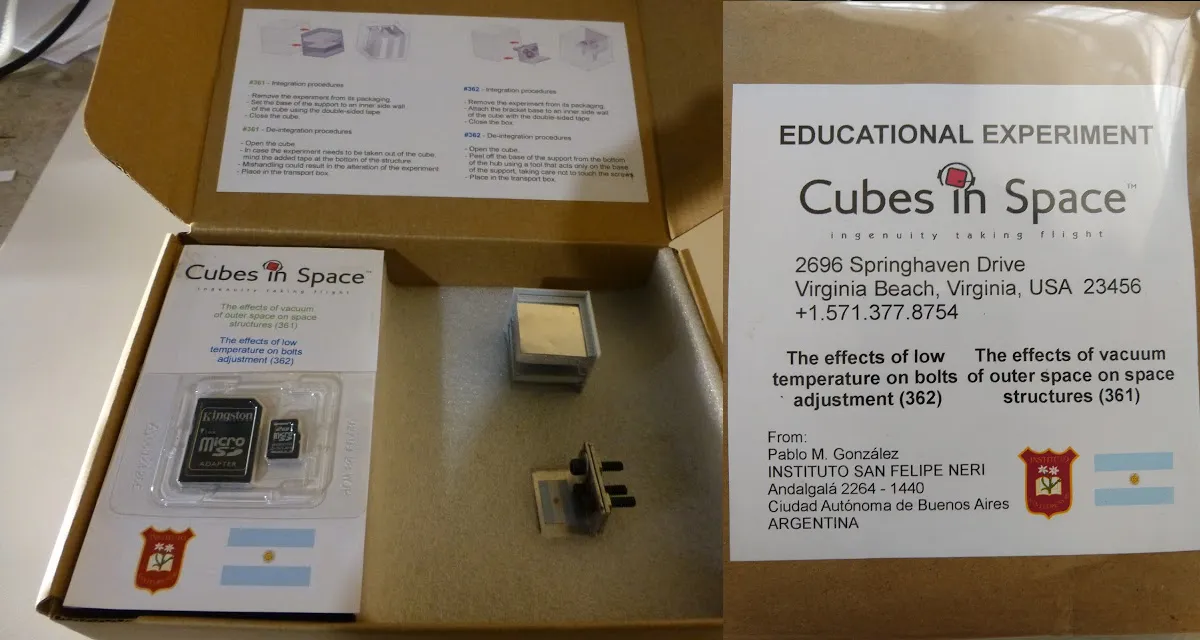
The final integration was in the United States, which consisted of fixing the experiments to the cubes. The work done by the kids was recognized as a model of organization and documentation for future experiences of other schools, naming it as the "gold standard."
Now we are waiting for the moment of the flight, which according to the plan would be taking place in late August or in September. After the flight, they will send us the experiments so we can evaluate how they behaved in space.

A "GOLDEN" EXPERIENCE
Beyond the "gold standard" qualification received from the organization, it is an experience to replicate. With some resources, a lot of ingenuity, effort and dedication, it is possible to excel. It is common to see teenagers as "lazy" and secondary school teachers as "unconcerned." But not everything is the same. Even with the limitations of the quarantine, they have managed to interact fruitfully, each contributing what they could.
It's not just about "launching objects into space" to investigate their behavior in a vacuum and at low temperatures. It's about promoting education. Perhaps the balloons will ascend to 50 km. But the height of the experience is not measured on that scale. Hopefully it will motivate other students and teachers in the country.
We Argentines do not have different genes from Americans or Japanese. But the collective results are different. It is evident that the difference is cultural. The good thing is that this can be changed, since it depends on us. This experience certifies it.
Congratulations to the entire team!
Note: in the cited blog are the documents with the hypotheses of the experiments and their justification. A great job.
Sources and related links
School website: https://www.institutosanfelipeneri.edu.ar/
WHAT (video 1’): https://youtu.be/dySwsTBc8eY
HOW (video 8’): https://youtu.be/5D1ebuEpOLA
PHOTOS: https://photos.app.goo.gl/EQHtJiANA7Vg1FX9A
Blog: https://cis2020.blogspot.com/
CUBES IN SPACE: https://www.cubesinspace.com/index.html
About the images
Credit: Pablo González and CIS.