They reanalyzed the original data and found that the statistical method had errors.
Last month, a team of scientists reported the finding of phosphine (PH3) in the upper atmosphere of Venus. It was world news, since phosphine is considered a biomarker, a possible sign of life. It must be said, however, that just as phosphine exists on Earth, of biotic origin, it also exists on Jupiter, of abiotic origin. A few years ago, Spanish researchers found phosphine beyond the solar system: in the star CW Leonis.
Since the original announcement, other articles on the matter have been published to answer various questions, such as how much life would be necessary to produce the detected phosphine?, while others indicated that the presence of life was not necessary to produce the molecule, since it could also be produced by volcanic activity (Ngoc Truong, 2020).
The new work was led by Professor Ignas Snellen of Leiden University and has not been published under peer review so far (submitted to A&A), but is available on the Arxiv repository.
The goal of the work is to re-analyze the original data from the radio observations of Venus at 267 GHz in the same way as in the original, with the original scripts to reproduce the spectral analysis and then evaluate it statistically.
The original work was done by Greaves et al. 2020; which in this new paper they call "GRB20", for short, based on the initial of the surnames of the first three authors (Greaves, Richards, Bains).
A quick clarification appears in the work: Since the publication of GRB20, the original authors alerted about an update in the ALMA data processing script. In parallel, the data available in the ALMA archive were reprocessed to include that correction.
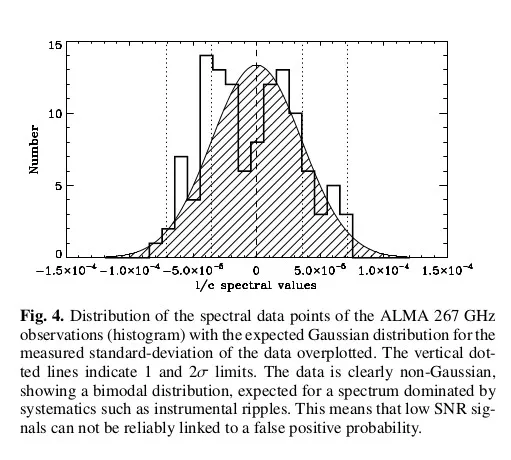
In the conclusions they indicate that the original work used a curve fitting that removes noise and instrumental effects, but that can generate over-estimations and artificial results.
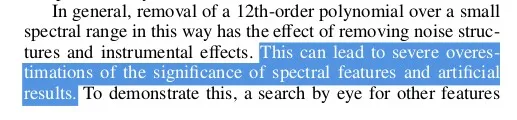
"We find that the 267 GHz ALMA observations presented by GRB20 do not provide statistical evidence for phosphine in the atmosphere of Venus", they point out. And they clarify that "the reported detection of PH3 is caused by a high-degree polynomial curve fitting". Finally they declare that "Our analysis shows that at least a handful of spurious features can be obtained with their method and thus conclude that the presented analysis does not provide a solid basis to infer the presence of PH3 in the atmosphere of Venus".
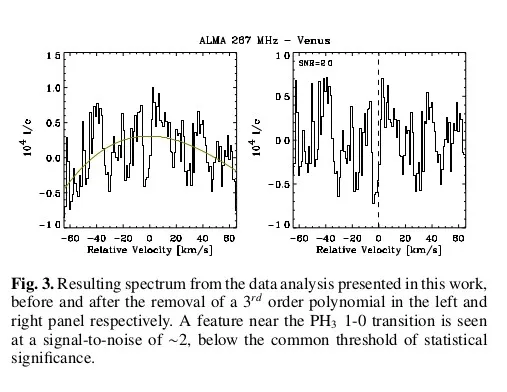
Is everything said? Not at all. It is interesting to make clear the high mathematical and computational component in astronomy. Raw data must be processed and then analyzed, for which software resources and statistical analysis are used intensively. When the detected signals are weak and the noise level is high, the results are often controversial. But with more data acquisition, with different instruments by independent teams, it is possible to reach firmer conclusions.
Perhaps, finding phosphine on Venus is as difficult as finding Three Little Ducks☉ in its atmosphere.
Sources and related links
Astronomers Challenge Recent Findings About Venus. “No Statistically Significant Detection of Phosphine”
Re-analysis of the 267-GHz ALMA observations of Venus: No statistically significant detection of phosphine
I.A.G. Snellen, L. Guzman-Ramirez, M.R. Hogerheijde, A.P.S. Hygate, F.F.S. van der Tak arXiv:2010.09761 [astro-ph.EP]
https://arxiv.org/abs/2010.09761
Presence of phosphine confirmed around the star CW Leonis https://www.agenciasinc.es/Noticias/Confirmada-la-presencia-de-fosfina-en-torno-a-la-estrella-CW-Leonis
Hypothesis Perspectives: Might active volcanisms today contribute to the presence of phosphine in Venus's atmosphere?
Ngoc Truong, Jonathan I. Lunine arXiv:2009.11904 [astro-ph.EP]
https://arxiv.org/abs/2009.11904
Greaves, J.S., Richards, A.M.S., Bains, W. et al. Phosphine gas in the cloud decks of Venus. Nat Astron (2020). DOI: https://doi.org/10.1038/s41550-020-1174-4
About the images
Venus: NASA.
Graphics: Snellen et al (2020).