A recent study on the brightness decrease of the star in Orion.
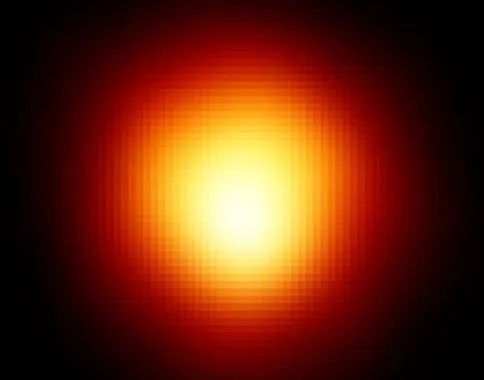
Research conducted by astronomer Emily M. Levesque (University of Washington) and Philip Massey (Lowell Observatory) presents optical spectrophotometry of the red supergiant (RSG). By comparing the spectrum with stellar atmosphere models for stars of the same type, they conclude that Alpha Orionis has a current effective temperature of 3600 (+/-25) K. While this is a bit less than measurements prior to the recent evolution of the light curve, this drop in effective temperature is insufficient to explain the brightness decrease. And they propose that episodic mass loss and an increase in circumstellar dust along our line of sight is the most likely explanation.
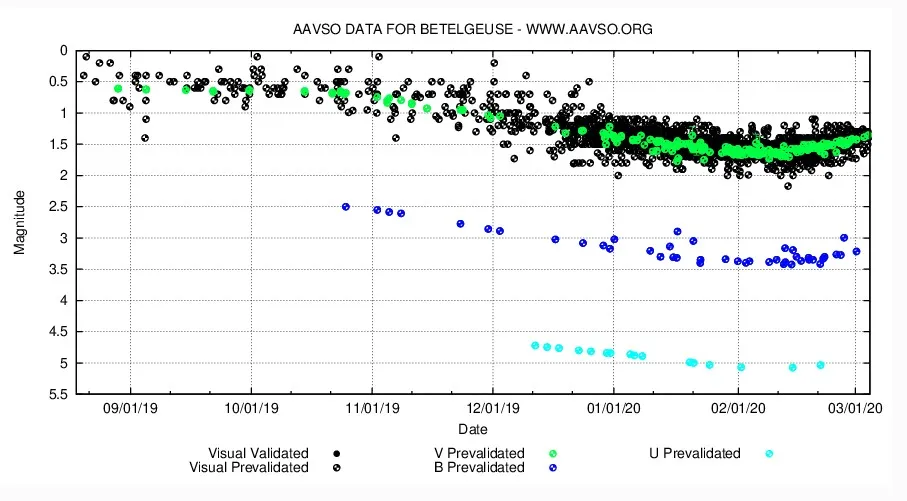
On December 7, 2017, astronomers reported a V magnitude for the star of 1.12, the faintest observed in 50 years, considerably less than its peak brightness of V ∼ 0.2. The brightness decline (and magnitude increase) peaked on January 30, at 1.61. The light curve shows a well-defined period of ∼425 days attributed to pulsations, as well as a longer period of 6 years. Predictions suggested that if the brightness decrease was due to the confluence of those two known periods, the star would reach its minimum in the second half of February.
Beyond certain repercussions in the mass (and irresponsible) press linked to an imminent supernova process, the serious possibilities are others. One possible explanation is that variations in the convective cells on the surface could lead to a decrease in the apparent effective temperature, by pushing part of the blackbody emission outside the visual range.
Another possibility is that it had a recent mass loss, generating dust around it that dims it.
The observations made in this study are from February 15, with an optical spectrograph on the Lowell Discovery Telescope.
On the other hand, in a previous study, the effective temperatures (Teff) of 74 RSGs, including Betelgeuse, had been measured by investigating the absorption lines of titanium oxide (TiO) with stellar atmosphere models.
By comparing the 2020 spectrum with observations from March 7-8, 2004, when it had a V ∼0.5, a difference of mag ∼1.1 and a Teff of 3650 K (+/- 25) is noted. As seen in Figure 1, the flux is much greater in 2004, although the shape of the two SEDs (spectral energy distribution) is very similar, with a small excess in the blue evident in 2020.
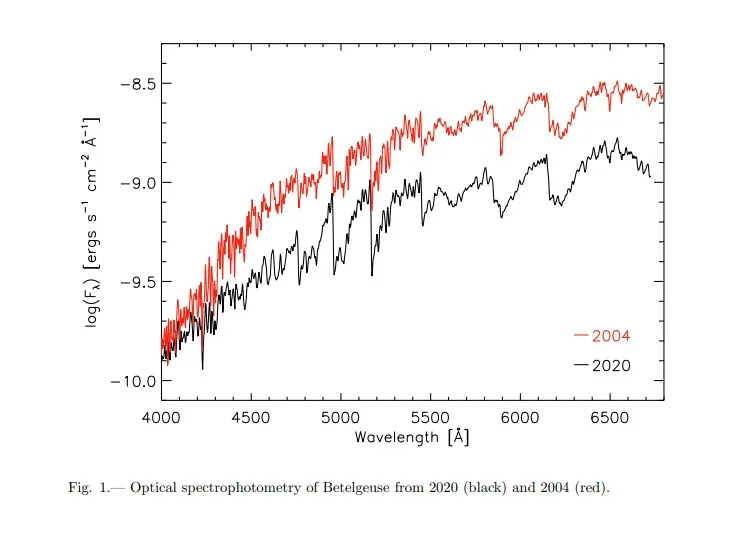
Figure 2 compares the depth of the TiO absorption bands in the normalized 2004 and 2020 spectra. The latter has stronger bands, and a lower Teff.
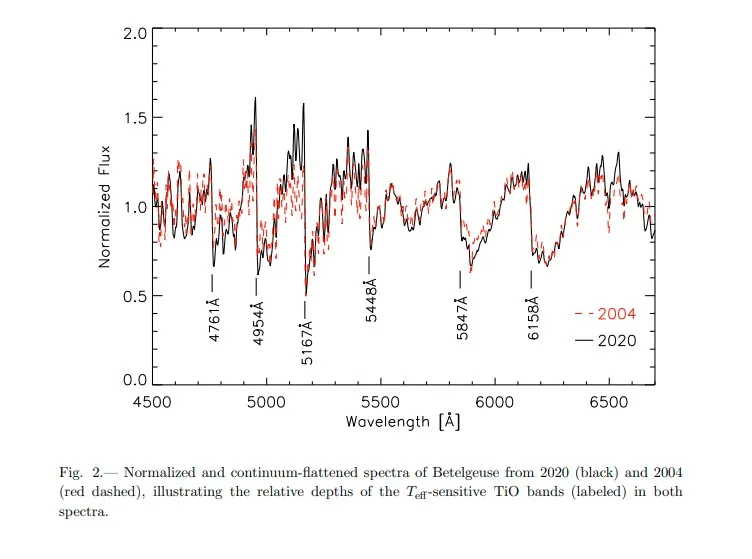
In short, the Teff fell only 50K when comparing the 2004 spectrum (when V ∼ 0.5) with the 2020 one (V ∼ 1.6). Considering the precision (+/- 25 K), the effective temperature during its current brightness decrease only fell at most 100 K.
This suggests that this "cooler" period is probably not the main cause of the brightness loss. On the other hand, the reddening of the star does not seem to be different from 2004, according to the Cardelli Law, but they consider that such a model might not apply due to the grain size of the mass loss in RSGs.
Instead of making unsupported predictions, more research is needed.
On February 22 it was reported that the star began to increase its brightness again. Will we see it as a supernova? The probability of seeing a supernova with the naked eye is lower than winning the lottery. Hope is the last thing you lose. Before that, you lose everything else, including patience and eyesight...
A cool star?
The scientific article, as well as the post on the Astrobites blog (written by a doctoral student), which describe the aforementioned research, use the word "cool". In the first case it's logical, since that word means "cold" in English. And although cold is a sensation (which stars don't have), it is used to account for a temperature drop.
But in the second case, the word is also used in another sense. What does it mean to be cool?
Although there are many definitions, we could say that if something seems "cool" to us, it seems nice or interesting to us. And, obviously, we will say that about things or people we know.
For example, it is expected that many people consider the number π as "cool", since it is a well-known number, with many applications and linked to the circle. But due to the Interesting Number Paradox, any other number can be "cool". Despite which, since the latter is not known by many people, surely in a survey a number like Pi would win. Perhaps some mathematicians would mention other numbers like Tau, or the Munchausen Number 3435.
The interesting number paradox is like this: suppose there are interesting numbers and uninteresting numbers. Let's call the second set U. Let's also say that alpha ∈ U, meaning that the number alpha is an uninteresting number. And let's also say that alpha is the smallest of all numbers in U. Well, by being the smallest of all, it becomes interesting. In which case, it should be removed from U. Upon removing the number alpha from U, another number will be the lowest in that set, let's say beta. So now beta ceases to be uninteresting and would have to be removed. And so on until the set U is empty. Which implies there are no uninteresting numbers.
We could say the same about stars. If we ask people which star seems "cool" to them, they will say stars they know. Surely Betelgeuse will be at the top of preferences, since it is a very bright and well-known star.
If the condition of being interesting were exclusively related to brightness, then the list should include Sirius, Canopus, Rigel, Arcturus, Vega, Procyon, Altair, Antares, Pollux.
Betelgeuse is 60 thousand times more luminous than the Sun, with a bolometric absolute magnitude (MAB) of -7.2 and about 18 Solar masses. In the Milky Way, one that could be considered very "cool" is Eta Carinae.
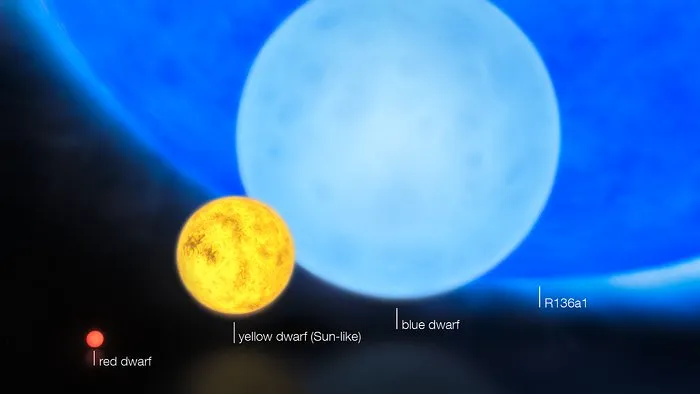
But R136a1 is a star of 265 solar masses, with an MAB of -12.5 and is almost 9 million times more luminous than the Sun. It is part of the Large Magellanic Cloud and there of R136, a cluster in 30 Doradus, the Tarantula Nebula. Of course, since it lies about 170 thousand light-years away, its visual magnitude is 12, so it cannot be seen with the naked eye. It is a Wolf-Rayet star, which I think is very "cool", even though it is a blue hypergiant.
Right next to Betelgeuse, Bellatrix (Gamma Orionis), the hunter's left shoulder, goes unnoticed.
Another "cool" star is Algol, an eclipsing binary, one of the first known variables, whose name in Arabic is Ras al-gul (demon's head). Holy algorithms!
If by the paradox of interesting numbers, the set of uninteresting numbers is empty, it turns out that in astronomy, there are sets of stars, called constellations, although they are not physical sets, but symbolic ones. But there is a set that has only one element and is a nameless set. The most "cool" star is that unique one that is not part of any constellation. That one you can't see at night. That one is cool, especially in winter...
Sources and related links
- Betelgeuse Just Isn't That Cool: Effective Temperature Alone Cannot Explain the Recent Dimming of Betelgeuse
Emily M. Levesque, Philip Massey
arXiv:2002.10463 [astro-ph.SR]
https://arxiv.org/abs/2002.10463 - Astrobites: You were cool, Betelgeuse, by Sunayana Bhargava
https://astrobites.org/2020/02/27/you-were-cool-betelgeuse/ - The Relationship between Infrared, Optical, and Ultraviolet Extinction
Cardelli, Jason A.; Clayton, Geoffrey C.; Mathis, John S.
Astrophysical Journal v.345, p.245 (1989)
DOI: 10.1086/167900 - The Fall and Rise in Brightness of Betelgeuse
ATel #13512; Edward Guinan, Richard Wasatonic (Villanova University),Thomas Calderwood (AAVSO) and Donald Carona (Texas A& M University) on 22 Feb 2020; 12:59 UT
http://www.astronomerstelegram.org/?read=13512 - AAVSO: Light Curve Generator (LCG)
https://www.aavso.org/lcg - Paradox of interesting numbers
https://es.wikipedia.org/wiki/Paradoja_de_los_n%C3%BAmeros_interesantes - Munchausen number
https://es.wikipedia.org/wiki/N%C3%BAmero_de_Munchausen - Giant star of 300 solar masses discovered
https://www.eso.org/public/spain/news/eso1030/
About the images
Initial image; NASA’s Astronomy Picture of the Day (APOD), June 5, 1999: A. Dupree (CfA), R. Gilliland (STScI), NASA.
https://apod.nasa.gov/apod/ap990605.html
Light curve: AAVSO
Figures 1 and 2: Emily M. Levesque, Philip Massey.
R136A1: ESO/M. Kornmesser