On winner predictions and half-hour candies.
This week several media outlets echoed the Citation Laureates list disseminated by the private company Clarivate, which nominates scientists in 4 fields as possible winners of the famous prizes. I propose a double analysis of the topic. On one hand, we will see what correlation there is between that list and the actual winners, that is, we will do statistics. And secondly, we will see why the mass media does not do it.
The Clarivate Citation Laureates have an entry in the English Wikipedia. There are listed the nominees in Physiology-medicine; chemistry, physics, and economics from 2014 to 2020 inclusive, that is, the last 7 years. The nominees in that period were more than 100, but those finally awarded a Nobel prize were only 6. Ergo, the success rate is less than 6%.
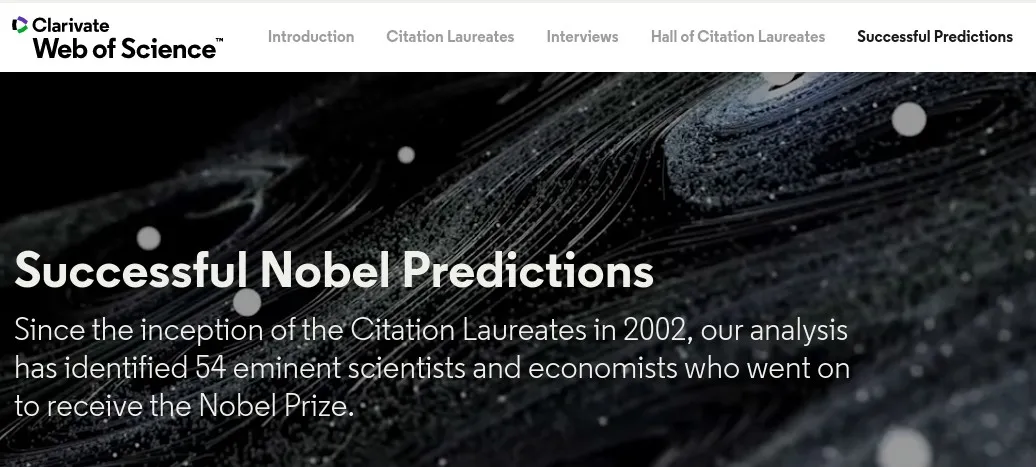
If we go to the Clarivate website, we see they pride themselves on having correctly predicted 54 scientists who obtained the laureate prize, since 2002. Given that for each science they nominate at least 3 scientists, in 4 categories, the minimum list per year is 12. In the 19 years from 2002 to 2020 inclusive that's 12*19= 228. If the correct predictions are 54/228=0.24, that is, 25%. This, provided that the nominees were only 3 per science.
Again, the Wikipedia entry indicates that up to 2017, out of 300 nominees, those who obtained the prize were 43, which would give a success rate of 14%.
IS THE LIST A FRAUD?
Beyond the list being presented as a roster of candidates for the Nobel Prizes, it has the value of enumerating researchers whose work was highly cited by their colleagues. That is, the scientists included are "Nobel class", as indicated on the Clarivate company website.
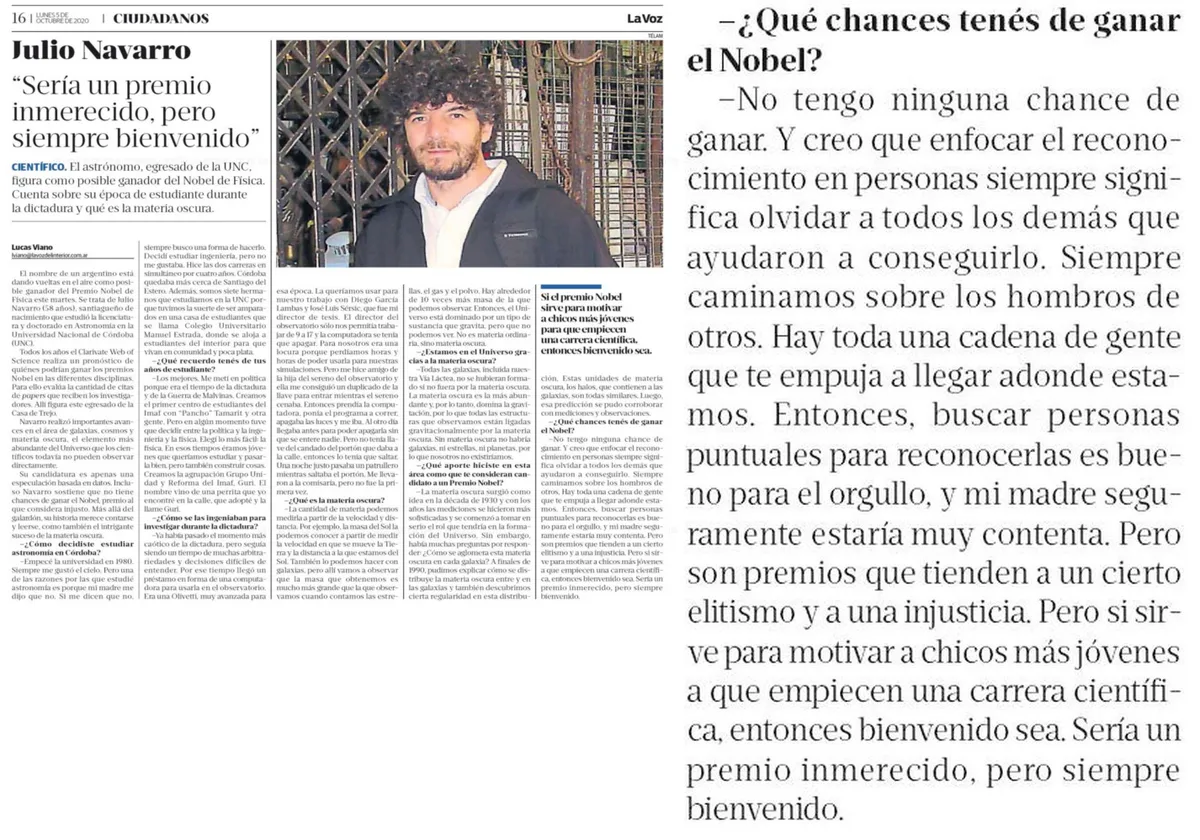
Argentine astronomer Julio Navarro did not lie to anyone. On the contrary, he was explicit in several interviews, but I highlight the one published in La Voz del Interior, from which I extract the last question and answer:
WHAT IS AWARDED AND WHAT IS NOT
It is worth reflecting that not all valuable human activities are awarded. The Nobels are to science what the Oscars are to cinema, the Golden Boot to soccer. But who awards the useful things of everyday life? Who received the prize for inventing toilet paper? If discovering galaxies and black holes is important, but making toilet paper is not; then what would the population do with the thousands of papers published in journals about Sgr A* if there were no bathroom tissue?
Having the privilege of discovering should be enough for anyone's ego. It should matter little whether or not one flaunts a gold medal. It seems, however, that the "stars" of science need applause as much as their colleagues in show business.
I recounted here recently that astronomer Volker Springel received the Gruber Foundation Prize (which also awards a medal, prettier than the Nobel one). Springel created computer codes for cosmological simulations. He probably will not receive a Nobel for creating software, since Nobels award (empirical) discovery. But, does he need it to consider himself "prestigious"?
Juan Martín Maldacena is already highly recognized by his peers, theoretical physicists, but he is very unlikely to receive a Nobel for something that has not yet been discovered, even though the media often nominate him for the famous prize.
Richard Brent Tully together with J. Richard Fisher proposed what is known as the Tully-Fisher Relation. Similarly, Sandra Faber is co-author of the Faber-Jackson relation. Faber received the Gruber Prize in Cosmology in 2017, Tully in 2014.
Simon White and Carlos Frenk (together with Marc Davis and George Efstathiou) received the Gruber Prize in 2011.
Edwin Hubble did not receive the Nobel Prize in Physics. There is a legend that they decided to award him in 1953, but that he died before the announcement and Nobels are not posthumous prizes. An investigation showed a couple of years ago that it is false (see below)
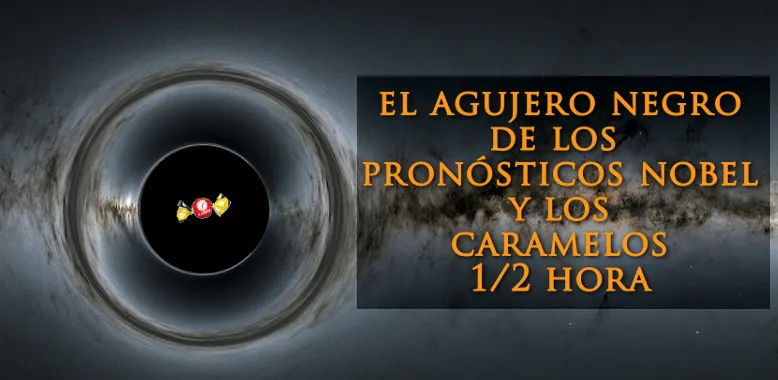
THE HALF-HOUR CANDIES AND THE BLACK HOLES OF THE NEWS
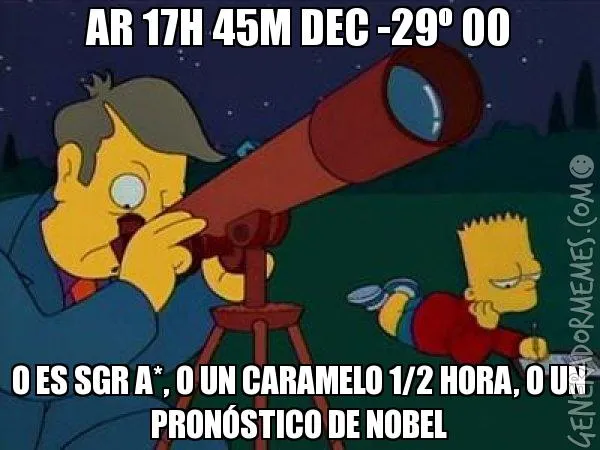
Why do the media present those included in the Citation Laureates list as candidates for the Nobel if the statistics say otherwise? It is clear that those predictions lasted less than a "Media Hora" candy.
Why does this happen? I'm not sure, but an anecdote might help:
When I started working, at 17 years old, in a kiosk, the owner would offer me "Media Hora" candies which I refused because I didn't like them. And he taught me something I never learned: "When someone asks you for these candies, don't tell them they are disgusting, because we have to sell them. Tell them they will gain time".☉
Sources and related links
- What Are Black Holes?
https://www.nasa.gov/vision/universe/starsgalaxies/black_hole_description.html - Verification of the anecdote about Edwin Hubble and the Nobel Prize
Kohji Tsumura
arXiv:1705.10125 [physics.hist-ph]
https://arxiv.org/abs/1705.10125
Interview with Julio Navarro: "It would be an undeserved prize, but always welcome".
https://www.lavoz.com.ar/ciudadanos/un-astronomo-de-unc-con-chances-de-ganar-nobel-de-fisica
About the images
Credit: NASA’s Goddard Space Flight Center; background, ESA/Gaia/DPAC