Limitations of observing the night sky in large cities.
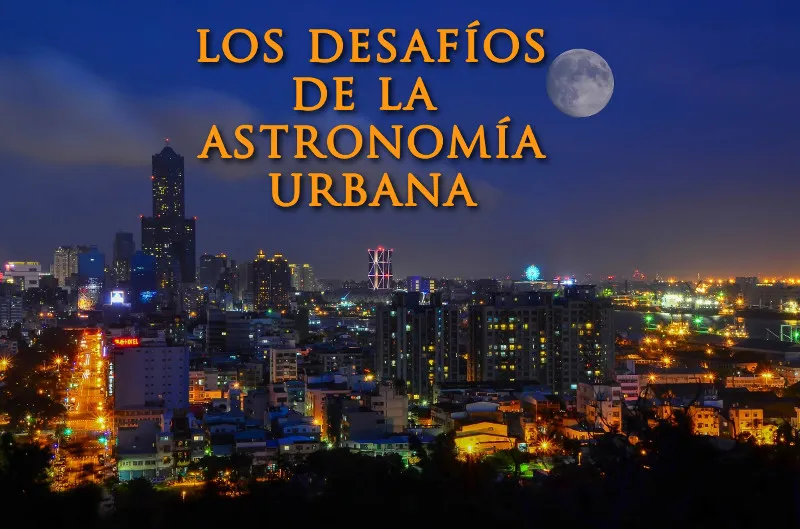
It is estimated that about 4 billion people in the world live in urban areas. But in much of America and Europe, the urban population climbs to 80-90%. There are also large urban areas, due to population density, and others medium or small. It is possible to think that the greater the population density, the greater the real estate development and high-rise construction. At the same time, with greater commercial economic activity, there will be more lighting. As a consequence, there will be less visible sky and it will be brighter, two problems for doing urban astronomy.
It is then worth analyzing what the challenges of amateur observational astronomy are in cities.
1-Light Pollution
One of the restrictions of doing amateur observational astronomy in large urban centers is light pollution. Given the brightness of the sky, a product of the artificial lighting of cities, much of the deep space objects is diluted. Naked-eye observation is limited to the Moon, the visible planets and the brightest stars. With a medium telescope some jewels can be seen, but much less than in rural areas.
A double possibility to expand the limits of urban astronomy are filters. There are some light pollution filters that are moderately affordable, although like almost everything, they are imported. These filters block certain specific wavelengths of radiation. But other, more expensive filters can be used, which filter almost all light, except a band known as the "chemical spectrum," such as H Alpha filters.
Apart from general light pollution, there is also local light intrusion, for example from a neighbor or a business. One possibility is to set up a "false wall" or screen, which can be a metal, plastic or wooden structure covered with a dark cloth. Another simpler option is, as Ford Prefect, the character from The Hitchhiker's Guide to the Galaxy, would say: a towel. Using it to cover your head when observing through the eyepiece helps to block surrounding lights. Some use hooded sweatshirts for the same purpose.
2-Lack of sky and horizon
Due to the lush arrangement of buildings, in large cities, the portion of available sky is small. But the situation changes depending on the chosen observation site. A terrace can be a good place if there are not many taller buildings nearby. It is for this reason that astronomical phenomena that occur up to 20º above the horizon are difficult to observe in cities. In some cases, the limit rises to 30º, but that varies according to the level of construction in each city. In the same city there will be better sites than others, but since it is not so easy to choose the area where to live and circumstances can change, it is advisable to look for alternatives among friends and astronomy clubs.
3-Urban anxiety or lack of "fisherman's" patience
There are some sociological-psychological currents that associate city life with anxiety and a hurried life. However, astronomy requires patience. Observing the sky depends, among other factors, on weather conditions that can be very changeable. A cloudy but windy night can clear up two hours later and have a clean sky.
It is for this reason -added to the previous ones - that observing meteor showers can be disappointing in large cities: it is that the brightness of the night sky, the visualization of only a small portion of sky, the changing weather conditions and anxiety are mixed. It is an explosive cocktail for expectations. As if that were not enough, there are "copious" showers and others not so much, added to the fact that some occur simultaneously with the full moon, which also reduces the possibility of observing.
4-Safety
Although solar astronomy can be done during the day, much of amateur astronomy is nocturnal. And if we move away from local lights, the greater darkness, ideal for this hobby, is bad advice for several safety reasons.
There are "friends of what belongs to others." It would be fantastic to be able to do astronomy in a public park safely, but unless it is done together with several other people, it may not be advisable.
Beyond the possibility of theft, it can be easy to get hurt if the terrain is uneven or it can be risky if there are loose animals. All these issues can be overcome by inspecting the place before the observation.
The animation shows the difference that a street light can make in the visibility of the night sky.
5-The "ideal" telescope
There is a now famous phrase that says the ideal telescope is the one that is used the most. It is advisable to start with binoculars: they are more economically accessible and easier to transport and use, although there are some heavy and large models that require a tripod.
In general, the bigger, the better. The "power" of telescopes is given by the diameter of their primary objective. But if the telescope is very large, it will also be very heavy, difficult to move. On the other hand, they are somewhat fragile instruments.
Having a very large telescope without motorization in an urban center can be a waste if you do not have a place with the possibility of seeing a large portion of sky. That's why, in addition to thinking with your wallet, it is advisable to think about concrete practical use.
Nowadays "hybrid" telescopes, which have mechanisms that mix lenses and mirrors, not very long, but with a greater focal length than a Newtonian telescope, are much more accessible than in the past. I am referring to Schmidt-Cassegrain or Maksutov. Some already come motorized and computerized, are easy to use and very portable. With motorization, equipment computerization can also be accessed, via a laptop or notebook and the appropriate software that allows managing the telescope connected to the computer.
Equatorial mounts are ideal for astrophotography, while altazimuth mounts are easier to handle. Faced with several telescope models, it is always better to decide on those with better optical quality. And, something fundamental, to acquire Plössl eyepieces of different sizes to immediately replace those that come "as a gift" with the telescope which are almost always of poor quality. The difference between bad and good eyepieces is notable. Other accessories, like Barlow, reticles, filters, can be acquired over time.
Given the above, before spending money it's a good idea to think about each person's situation, access to the sky from home, the possibility of transporting with one's own vehicle, and the available budget.
6-Boredom and social pressure
With the same telescope, especially if it's small-medium, the number of observable objects will be limited, partly by the instrument's limitations, partly by the aforementioned restrictions. After several nights of observing such objects, we might start to get bored of always seeing the same thing. The Orion Nebula, the Pleiades, the Jewel Box, the Tarantula, Omega Centauri are some of the favorite objects, easy to locate, but also repeated in almost every observation. Until we get saturated. Don't throw in your towel, champion of the skies! We must stand on the shoulders of giants, those with more experience, who guide us in observing fainter deep-sky objects or binary stars. There are books and websites with good recommendations. It's a good idea to make a list with objects of different classes: a couple of planetary nebulae, open clusters, globular clusters, galaxies, comets, etc. With our equipment, however, we might not be able to observe everything we want, but surely more than we imagine.
Just as the company and advice of others can be beneficial, sometimes we fall victim to a "social pressure" of wanting to achieve or do the same as everyone else, as if we were running a race. Let's not get carried away by others' expectations: each person has their own pace and style. We don't need to photograph everything and show it on social media and have it turn out well and everyone like it. Nor should we fall into the frenzy of wanting a bigger telescope every six months to see more.
There will be phenomena described as "unrepeatable," like an eclipse, a conjunction, a transit, but which we won't be able to observe for various reasons: sometimes conjunctions happen very close to the horizon and the totality of an eclipse is only visible in certain places we might not be able to go to. The important thing: It's not a tragedy. Even "unrepeatable" phenomena happen again, even if only approximately.
CONCLUSION
Astronomical observation in large cities has several limitations. To overcome them, a good option is to go out to more rural areas, with greater darkness and a higher percentage of observable sky. For that, it's ideal to have an easily transportable telescope, not too heavy.
But often we can't travel - even more so in the current pandemic context - and we have to settle for observing from the local area of our home in a city with bright skies surrounded by buildings. In that context, it's vital to know the specific restrictions of the circumstance to try to adapt to the context and have expectations appropriate to reality.
Maps, observing guides (whether books or websites) and friends or astronomy clubs can be very useful for taking the first steps. To a large extent, as with everything, it's a bit of trial and error.
What we must not lose sight of is that astronomical observation should be pleasurable, an occasion for enjoyment and relaxation. And, in any case, don't forget to bring your towel!☉

Sources and related links
- 5 Strategies For Urban Astronomers
https://www.celestron.com/blogs/celestron-in-the-community/5-strategies-for-urban-astronomers - Setup is key when urban stargazing
https://astronomy.com/observing/get-to-know-the-night-sky/2006/12/setup-is-key-when-urban-stargazing - Urbanization
https://ourworldindata.org/urbanization
About the images
https://pxhere.com/es/photo/1218140
Don't Panic and Grab a Towel!
https://katabasisrevista.com/2020/05/24/que-no-cunda-el-panico-y-coge-una-toalla/