Some ideas about the most awaited event.
We live in times when astronomical events are narrated as if missing them were like wasting your life. However, most astronomical events repeat, although each one has its particularity.
In the case of observing a supernova with the naked eye, something different occurs. Supernovae occur with a very high frequency, but since the stars are very far away, the vast enormous majority are unobservable to the naked eye.
On February 24, 1987, the radiation from supernova SN 1987A in the Large Magellanic Cloud began to be observed, with an apparent magnitude of 3. The discovery was made in Chile and New Zealand.
It is established that an object can be observed with the naked eye if its apparent magnitude is up to 6, although with the light pollution of large cities, it may be 5 or 4. This magnitude is proportional to the object's luminosity and the observer's distance. Professional astronomers add extinction, that is, the amount of radiation (light) that is "lost" due to absorption or scattering by dust.
The previous recorded event was SN 1604, Kepler's Supernova, with a visual magnitude of -2.5.
If we took only these two data points, the frequency of observing supernovae with the naked eye is every ~400 years.
In 2013, a group of astronomers did a study on the probability of observing galactic supernovae, but they did not limit it to being seen with the naked eye, but with the use of telescopes. Based on that study, another group, led by C. Tanner Murphey, analyzed -at the end of last year- the frequency of supernovae visible to the naked eye.
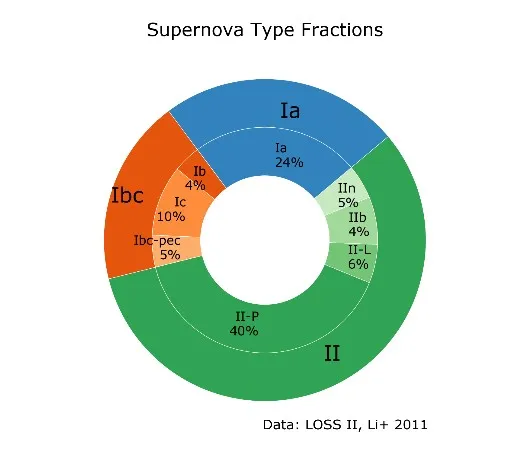
Astronomers divide supernovae by their mechanism, between thermonuclear (Type Ia) and core collapse (CCSN) (Type II). Here the proportion between both groups is shown:
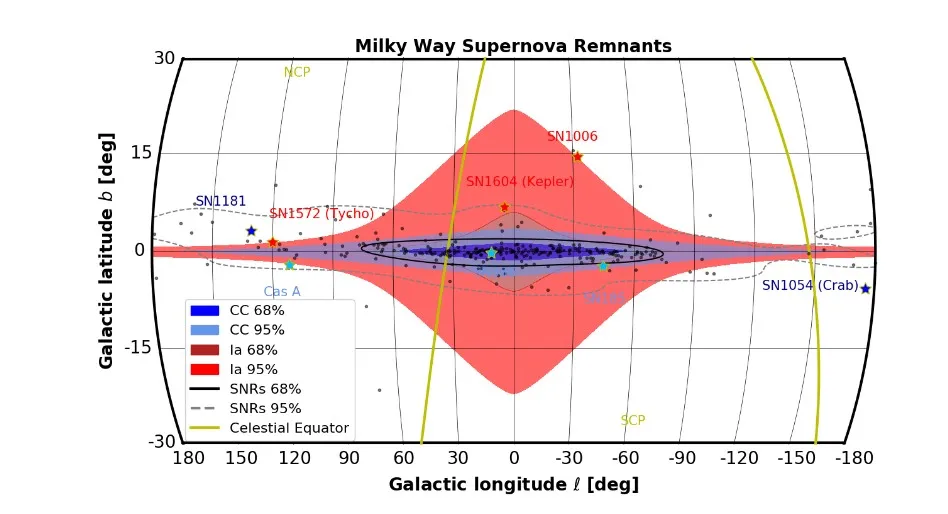
The study shows the following graph which includes 294 remnants from the Green (2019) catalog and predictions of where supernovae, whether CCSN or Type Ia, should be found. What is seen is a great agreement, but the historical supernovae, those seen before the telescope, and therefore with the naked eye, are out of place in relation to the model.
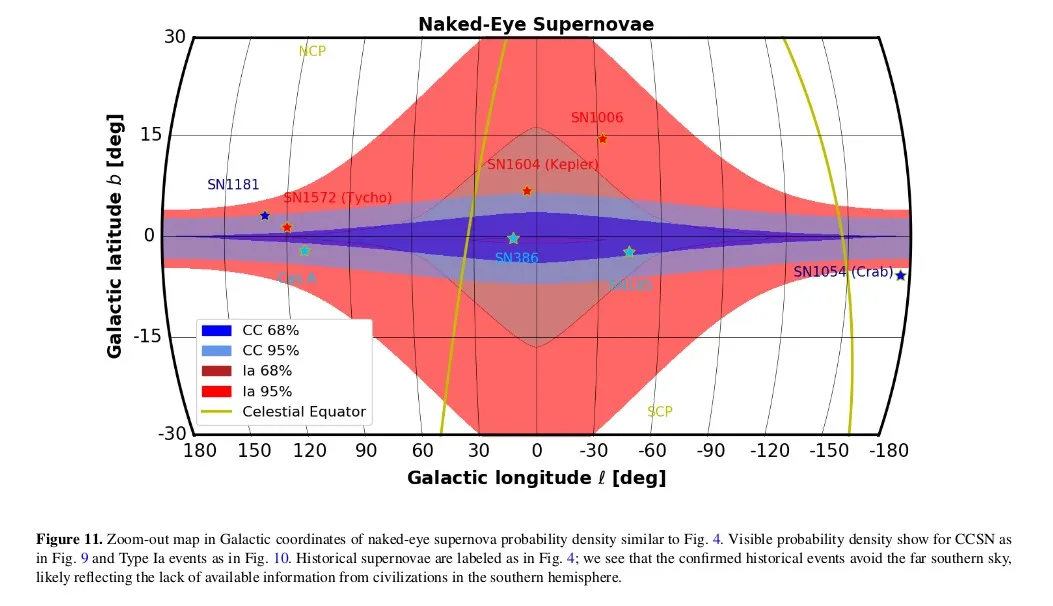
In Fig. 11 of the study, the location in galactic coordinates of supernovae visible to the naked eye is shown, noting a smaller number in the southern quadrant.
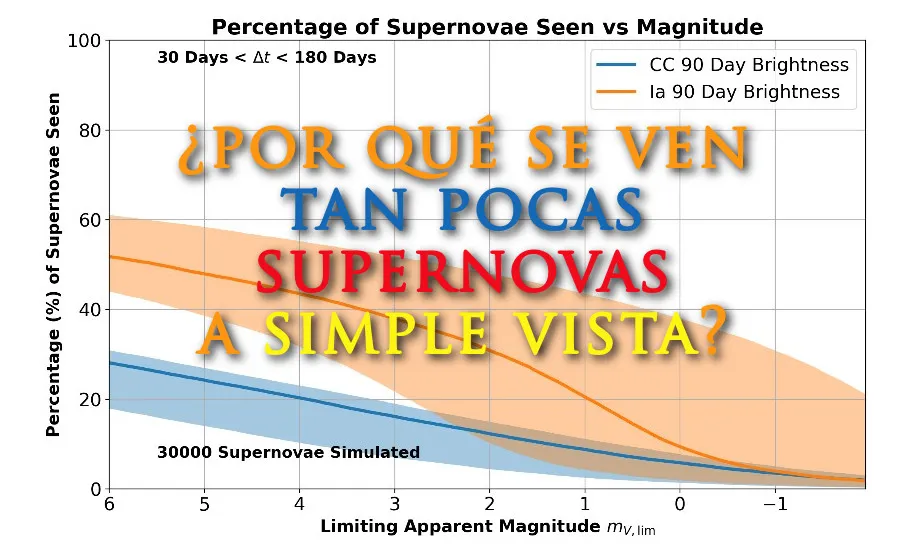
Using a Monte Carlo simulation, they arrive at this (Fig. 12):
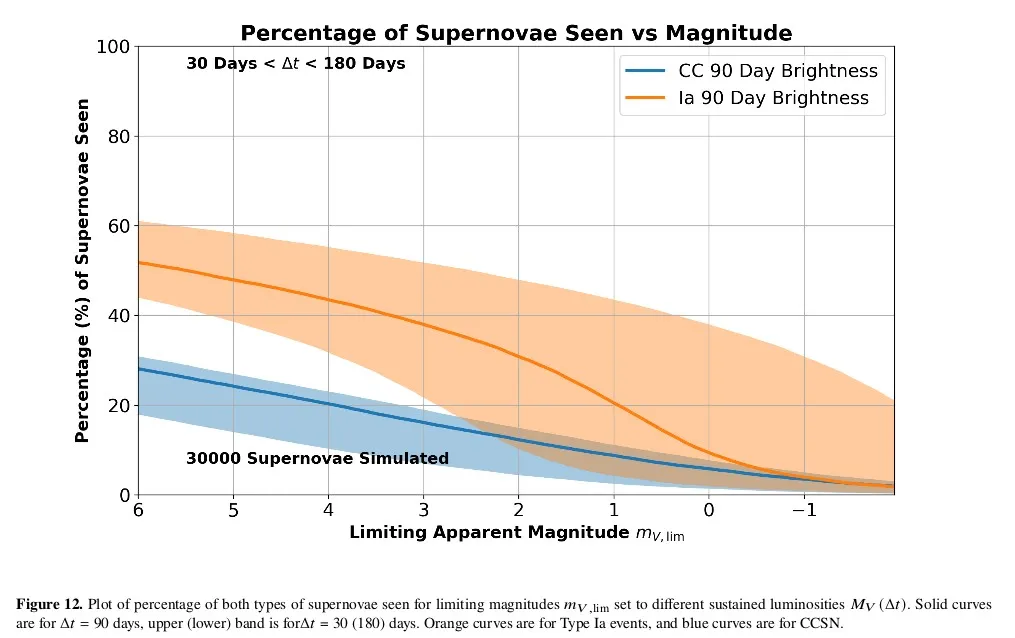
Based on the intrinsic frequencies (Fig. 1), the most likely is that the next naked-eye supernova will be type II (ccsn). With a nominal limit of mv=6, there is a 1 in 3 chance that such an event will be visible to the naked eye. For the next SNIa there is more hope: 50%.
Conclusions
Most supernovae occur in the thin central disk of the galaxy, where most of the dust lies. Hence, for a galactic supernova to be observable with the naked eye, it must occur outside that center. However, the models predict that supernovae that can be seen with the naked eye should occur right there, which means that there is still much to learn about supernovae.
Logically, the closer these events occur, the greater the probability they can be observed with the naked eye, so extra-galactic events are outside direct observation. The Large Magellanic Cloud, although it is another galaxy, is a satellite galaxy, lying about 170 thousand light-years away, compared to the almost 3 million light-years of Andromeda.
On the other hand, the star formation rate must also be considered and, as has been said, in which part of the galaxy the catastrophic transition occurs. Extinction also plays a role in the possible detection of these phases of stellar life. It is curious, however, that in this study Baade's Window, a central region of the Milky Way with less extinction, is not mentioned.
WHEN WILL THE NEXT NAKED-EYE SUPERNOVA BE
One approach to answer the question is to look for those known stars that are about to reach the end of their lives. We can make a list:
IK Pegasi
Spica
Alpha Lupi
Antares
Betelgeuse
Rigel
Gamma Velorum
T Coronae Borealis
The monitoring and detailed study of this list (the list is longer) could better answer the question. IK Pegasi is a binary system 150 light-years from Earth. One component is a main sequence star and the other, a white dwarf. They orbit each other every 21 days with an average separation less than the Mercury-Sun distance. Theory indicates that when the main component evolves into a red giant, its diameter will exceed the Roche lobe of its companion and the latter will begin an accretion process that, upon reaching the Chandrasekhar limit, will cause it to explode as a Type Ia supernova.
In the case of stars that are candidates for core collapse supernovae, like Betelgeuse, beyond their level of apparent brightness, it is advisable to monitor neutrino emission to avoid talking nonsense.
In any case, there are two key factors: on the one hand, the uncertainty about how supernovae occur. Although much knowledge has been accumulated in the last century, there are still many things to know.
On the other hand, the long life of stars, in relation to human life. Homo habilis appeared about 2.5 million years ago. Stars, even very massive ones, can have "lives" of a few hundred million years. That is, human history is comparable to 1% of the life of a very massive star. The "life window" of human beings in the life of the universe is very small. Nevertheless, some stars end their lives explosively within our small peephole, but they lie too far away for their apparent brightness to be less than 6. Thus, the probability of observing a supernova with the naked eye is very small.
Let's remember the case of the failed supernova prediction for 2022. You can still find the news on Google foretelling something that is not going to happen:

Observing a supernova with the naked eye is as unlikely as winning the lottery. They say hope is the last thing you lose. First you lose your sight...
I wonder if there isn't something morbid about all this. Because, after all, supernovae are like the luminous death throes of a cosmic corpse. Perhaps what fascinates us is the possibility of witnessing such a powerful end, of one who resists fate, even if it is futile. Like in that poem by Dylan Thomas used in Interstellar (Christopher Nolan, 2014):
Do not go gentle into that good night,
Old age should burn and rave at close of day;
Rage, rage against the dying of the light.
The light of supernovae can last for days or weeks, but it finally fades. And only the records and memories will remain. Until next time.☉
Sources and related links
Witnessing History: Rates and Detectability of Naked-Eye Milky-Way Supernovae
C. Tanner Murphey, Jacob W. Hogan, Brian D. Fields, Gautham Narayan arXiv:2012.06552 [astro-ph.SR]
https://arxiv.org/abs/2012.06552
There Should be a few Supernovae in the Milky Way Every Century, but we’ve Only Seen 5 in the Last 1000 Years. Why?
Observing the Next Galactic Supernova
Scott M. Adams, C. S. Kochanek, John F. Beacom, Mark R. Vagins, K. Z. Stanek https://arxiv.org/abs/1306.0559
When Will The Next Naked-eye Supernova Event Happen?
https://www.youtube.com/watch?v=382zVyI3oSU
List of supernova candidates https://en.wikipedia.org/wiki/List_of_supernova_candidates
About the images
Credit: C. Tanner Murphey et al. (2020)